• As mentioned earlier, I am taking a break from publishing new material for a few weeks. During these weeks I am republishing the series on e and the one on π. The post below was originally published on 24 May 2024.

    Recap

    In the previous post, I started a series of three posts focused on the number denoted by e. We then saw why it is the base of the natural logarithm and the base of the exponential function. We also saw the relation between e and compound interest. In this post we will try to determine the lower and upper bounds for e.

    In order to do this, we need to do seven things. First, we will then ‘discretize’ the function

    for integers n. Second, we will need to introduce ourselves to the limiting process. Here, we will only restrict ourselves to the cases where x becomes infinitely large. Third, we will introduce ourselves to the binomial expansion and obtain the lower bound for e. Fourth, we will show that the function

    is an increasing function. This means that the value of f(n) increases as the value of n increases. Fifth, we will combine the limiting process and the binomial expansion to obtain a very common infinite series for f(x). Sixth, we will introduce ourselves to the idea of an infinite geometric series. Seventh, we will use what we know from the infinite geometric series and the infinite series for f(x) to obtain the upper bound for e.

    Discretization

    In order to proceed with what I have called ‘discretization’, consider the function

    It is possible to prove that this function is defined for all positive values of x. We may not be able to calculate the value by hand. And we may not have a clue what

    might even mean, let alone how to calculate it. Nevertheless, if f(x) is defined for all positive values of x it must be defined for all positive integer values of x. In this f(x) is transformed to f(n), where 

    This is something that we can comprehend because exponentiation to a positive integer, in this case n, only signifies repeated multiplication. So now, we have to only deal with f(n).

    But now we have to show that f(n) is an increasing function. In more formal mathematical terminology, we have to show that f(n) is monotonically increasing. It is easy to see from the tables in the previous post that this is true. Below is one of the tables from that post.

    Since the values of x chosen were all integers, the same table would apply for n, f(n), and Δf(n). We can see that, as n increases, f(n) also increases. But this is not how we prove things in mathematics! So is there another way to prove that f(n) is increasing? Yes there is! 

    The Limiting Process

    But before we get to that, let us introduce some aspects of the limiting process. Consider the function

    We can easily see that, as n gets larger and larger, the value of g(n) gets closer and closer to 0. This is seen in the table below.

    What we can say is that, as n gets infinitely large, g(n) gets infinitesimally closer to 0. Or to be rigorous, we say that the limit of g(n) as n tends to infinity is 0. Please note what this language is claiming and what it isn’t. First, it is not claiming that infinity is a number. God forbid! I have dedicated a whole post to ridding ourselves of that mathematical heresy. Second, it is not claiming that the value of g(n) ever becomes zero. It is impossible for the reciprocal of any number to equal zero. If this were not true, we could argue as follows.

    But, as we know, division by zero is meaningless or ‘absurd’. Since this assumption leads to an absurdity, by the reasoning of reductio ad absurdum, we can conclude that the original assumption, namely that the reciprocal of some number can be equal to zero, is incorrect.

    The way we denote the limiting process is by writing

    The left side of the equation tells us what the variable of the limit is, in this case n, and how it is being made to vary, in this case getting infinitely large. It also tells us what function of the variable we are dealing with, in this case 1/n. The right side of the equation tells us the number that the value of this function approaches, in this case 0, as the variable (n) varies as specified.

    Due to the limiting process, we can draw the following conclusions.

    The table below can confirm our conclusions.

    So what we have managed to prove, albeit not with great rigor, is that the ratio of an integer to its predecessor or to its successor approaches 1 as the integer gets larger and larger. 

    The Binomial Expansion and the Lower Bound for e

    Now it is time for us to introduce another important result that we will be using. This is known as the binomial expansion. As seen in an earlier post, the number of ways of selecting r items out of n items is

    Now consider the expression

    This is called a binomial expression since there are 2 terms in the expression. Now consider the expression

    Quite obviously

    Here, on the right side of the equation, there are n sets of parentheses, reflecting the power n on the left side of the equation. Now we have to ask ourselves how we expand the right side. When we expand, we have to select one of the terms, either a or b, from each of the binomial terms. We could select a from all the binomial terms, leading to an. Or we could select b from all the binomial terms, leading to bn

    In general, if we select b from r of the binomial terms, this would mean we have selected a from the remaining n-r binomial terms, leading to an-rbr. In how many ways can we form the an-rbr term? This will be the same number of ways as selecting r out of n items, since, when we select r of the binomial terms to give us b, we will be auto-selecting the remaining n-r binomial terms to give us a. Hence, the binomial expansion gives us

    Hence, we can conclude that

    With special note are the first two terms. The first term is

    Similarly, the second term is

    Hence, the expansion can be expressed as

    Now, all the terms that are in red are the product and quotients of natural numbers. Hence, each term is necessarily positive. This allows us to conclude that

    Hence, we have obtained the lower bound for e. All we need now is to obtain the upper bound. This is somewhat more difficult. We first need to demonstrate that f(n) is an increasing function.

    f(n) is an Increasing Function

    Let us consider the two consecutive terms f(n) and f(n+1). We have

    Taking LCM inside the parentheses, we get

    Dividing the second equation by the first we get

    This can be further modified to give

    Choosing a new index m = n+1, the above gets transformed to

    This can further be written as

    Now consider consecutive terms in the expansion of the term in red above.

    Dividing the second equation by the first we get

    It is clear that the two terms in red will cancel. At the same time, the green terms will leave r+1 in the denominator, while the blue terms will leave m-r-1 in the numerator. Hence, the above simplifies to

    Redistributing the terms and taking absolute value so we do not have to deal with a negative quantity, this is equivalent to

    Since r takes values from 0 to m-1 and since m must be necessarily greater than or equal to 2 (remember m=n+1), each of the three terms above is strictly less than 1. Hence, in the expansion

    each term has a smaller magnitude than the preceding term. If we write out the expansion we get

    Now we have shown that the 3rd term (in red) has a greater magnitude than the 4th term (in green). Hence, the sum of the 3rd and 4th terms must be positive. Similarly for each subsequence pair of terms in the expansion. If m-1 is even, there will be an odd number of terms in the expansion, with the final term being positive. If m-1 is odd, there will be an even number of terms with the final pair of terms also yielding a positive sum. Hence, we can conclude that

    However, recall that

    This means that

    This means that f(m) is increasing, which also means that f(n) is increasing. 

    Whew! That took some doing, huh?

    Combining the Limit Process and the Binomial Expansion

    What we can now say is that f(n) will keep getting larger as n gets larger. Recall that we had shown

    This means that 

    if both limits exist. Now since f(n) keeps increasing, all we need to show is that there is some upper bound beyond which the expansion cannot go. That would also place an upper bound on the value of f(n).

    Introducing an Infinite Geometric Series

    Consider the infinite series

    Here each term is multiplied by ½ to get the next term. If we multiply the whole equation by 2 we get

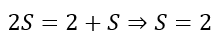
    However, note that the terms in red are the same series with which we started. This gives us
    Obtaining the Upper Bound for e
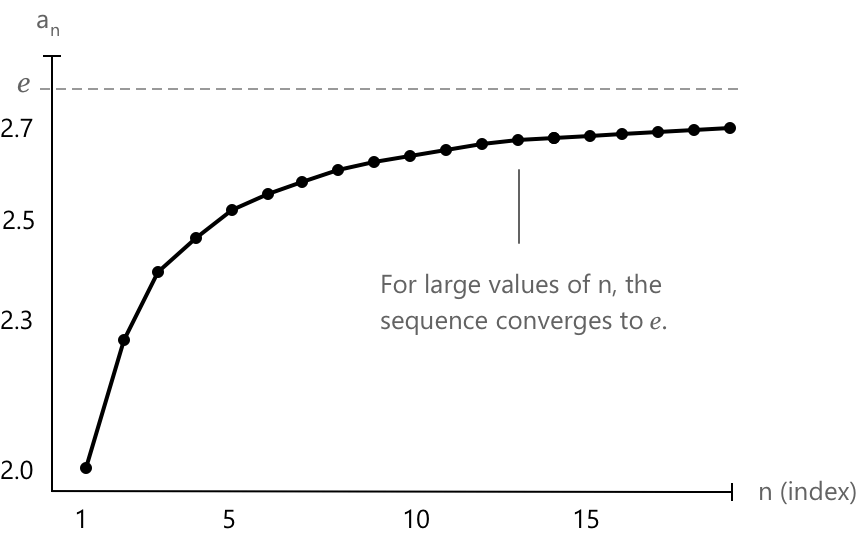
    Visualization of the convergence of f(n) (Source: Algebrica)

    Now once again consider the expansion for f(n), which is 

    Now the (r+1)th term is given by

    Note that this happens to be the rth red term above and it can be modified as follows

    Rearranging the terms we get

    Some more rearrangement gives

    Here, r varies between 0 and n. Hence, all the terms in red are necessarily positive and less than 1. However, in the limiting case, as n approaches infinity, the limiting value of each of the red terms is 1. This gives us

    Writing the infinite series this will give us

    For the fourth term onward, r is greater than or equal to 3. However, it is easy to see that for r > 2

    As examples

    Hence, we can conclude that 

    However, we have already shown that the terms in red add up to 2.

    Hence, using the earlier lower bound result, we conclude

    Conclusion

    We have shown that the value of e lies between 2 and 3. Along the way we used some mathematics that we had explored earlier, like reductio ad absurdum and the method of determining the number of ways of selecting r out of n items. But we also introduced new mathematics, like the limiting process, the binomial expansion, and the infinite geometric series. The crucial step was to show that f(n) is increasing. If this were not true then showing that it has a lower and upper bound would not indicate that there is a specific value to which f(n) approaches, since it could then just oscillate between slightly above 2 and slightly below 3. The process to demonstrate this was considerably involved and also included the idea of showing that successive pairs of a sequence added to give a positive sum. This was not necessarily the most intuitive step in the process, even though, without it, we would not have been able to prove the result.

    In the previous post, we introduced e and touched on what its significance is and why it is the base of the ‘natural’ logarithmic and exponential functions. In this post we have placed bounds on the value of e. Since this post end up being quite long and, I must admit, heavy, I am going to do a part of what I planned for this post in the next, where we will look at some common infinite series that have been derived for e and consider how rapidly each of these series converges to the actual value of e. In the post after that, I will deal with how we know that e is irrational.  I will, however, be taking a break next week. Hence, the next post on infinite series for e will be published on Friday, 7 June 2024.
  • A visualization of e (Source: Laughing Squid)

    While I am enjoying the series on counting principles, I need to take a break. Hence, I will be republishing the series on e and the one on π, both which I had first published in 2024. The post below was originally published on 17 May 2024.


    In the opening post of this blog, I had introduced Euler’s Identity, which states

    The identity combines five numbers – 0, 1, e, i, and π – and three mathematical operators – addition, multiplication, and exponentiations – and the equality. In other words, this identity captures many diverse parts of mathematics and links them, thereby demonstrating that what we call ‘mathematics’ is a unified field in which one area neatly dovetails into the next. For a few more links I suggest you read the earlier post. 

    In this post, however, I wish to focus on the number e. I will be devoting three posts to it, including this one. If this now seems excessive, I hope that, after you have read the three posts, you will have had a change of heart and mind. Indeed, my hope is that you would wish for a fourth. And a fifth! I could, of course, include it all in one post. However, I have realized that the last few posts have been considerably longer than I had planned for this blog. Granted that each post did deal with a unified theme, the fact still remains that they were quite long. Hence, in the interest of not squelching all the curiosity of the reader, I feel it is best, where possible, to publish shorter posts.

    In this post I wish to deal with the definition of e and its relation to a concept of mathematics that most students learn in the 9th or 10th grades. I also wish to address the significance of e that arises from the definition. 

    The second post on e will deal with some common bounds we can place on its value. The first post will have given us some indication of these bounds. However, in the second post I will take a more formal approach to this. This will involve looking at a few infinite series that mathematicians have derived as ways of calculating the value of e. The third post of e will deal with the issue of e being an irrational number. Along the way, in both future posts, we will learn a few more mathematical tricks to keep in our quiver should we ever need them.

    When I was introduced to e, my professor at the Guru Nanak Khalsa College in Bombay (now Mumbai) just told us that it was the base of the natural logarithm (logex) and the base of the exponential function (ex). I asked him a few questions like:

    1. Why was it this number and not some other number that was the base of both the logarithm and exponential functions?
    2. What was the significance of the number e?

    Unfortunately, all my professor could tell me was that the approximate value of e was 2.718. When I pressed him for more information, he summarily asked me to leave his class. Perhaps my mother will now understand why I hated attending classes there. I mean, if even the mathematics class was going to be transformed into one mind-numbing exercise of rote learning, the other subjects didn’t have a prayer!

    I have dealt with one mathematical issue that causes me trauma elsewhere. The trauma that this professor caused me remains to this day and surfaces when I hear students confidently tell me that the value of e is 2.718281828. (Yes, they can use their calculators now to get more digits than my professor had memorized!) When I hear something like that I have a strong urge to tug at my hair, which, fortunately, is somewhat difficult for me!

    Anyway, let me proceed with the definition of e and then hopefully address the two questions above.

    Consider the function

    Students who have learned about compound interest will recognize the similarity the above expression has to the formula for compound interest given by

    where P is the principal invested, R is the interest rate as a percentage per compounding cycle, N is the number of compounding cycles, and A is the amount upon maturation of the investment. If we divided both sides of the equation by P and express the interest rate as a number rather than a percentage, the formula gets transformed to

    where G is the ‘growth’, that is the ratio of the maturation amount to the principal invested, r is the interest rate per compounding cycle, and n is the number of compounding cycles. 

    Before proceeding, let’s consider an example so we understand how the formula works. Suppose we invest ₹1,000 at 10% interest per annum compounded annually for 3 years. Then, P = 1000, r = 0.1 (corresponding to R = 10%), and n = 3. Hence,

    This gives A = ₹1331 or G = 1.331.

    With the same numbers, but assuming that interest is compounded every 6 months, the value of R and r will be halved and the value of N and n will get doubled. This is because 10% per annum is the same as 5% semiannually. And in 3 years, there are actually 6 periods of 6 months each. Hence, R = 5%, r = 0.05, N = n = 6. This gives

    Hence, A = ₹1340.10 and G = 1.340096. [Note: I have rounded A to 2 decimal places as is the convention for currency.]

    Suppose now, that the interest rate is 100%. Then R = 100% and r = 1. Now, if we invest some amount for, say, 3 years, we will get:

    But suppose, we invest only for 1 year. Then we will have

    Suppose, now we keep reducing the duration of the compounding cycles. If we have 2 compounding cycles in a year, each lasting 6 months, we will have

    If we change this to compounding every 4 months, we will have 3 compounding cycles, giving us

    We can, of course, continue increasing the number of compounding cycles.

    For the sake of the discussion, I will rename G as f(x) and n as x, yielding the following table:

    The third column gives the change in the value of f(x) from the previous row. What we can observe is that the values of f(x) keep increasing from one row to the next. Also, the value of Δf(x) keeps decreasing from one row to the next. In fact, if we plotted the graph of the function, shown below, this is what we would expect.

    Graph of y = f(x)

    Since the graph becomes almost horizontal, it seems that the rate at which the function increases its value keeps decreasing. This is indeed the case as can be seen from the table below.

    What we can see here is that x is increasing by orders of magnitude, while the corresponding values of Δf(x) keep getting smaller and smaller, while remaining positive. 

    Now there are 31,536,000 seconds in a year. If we put this as the value of x we will get f(x) = 2.71828177847, which represents an increase of 0.00001354128 from the value when x = 100,000.

    At this stage, let us take a short detour. Suppose we have a sample of bacteria in a petri dish with enough nutrients for the bacteria to grow and undergo mitosis unhindered. Assuming no mutations occur, there will be no way of distinguishing any particular bacterium from another. All the bacteria in the sample are, in other words, identical. All are consuming nutrients and all will reach the next stage of mitosis simultaneously. Hence, 100% of the sample has the potential to undergo mitosis. But how frequently does mitosis occur? 

    Some bacteria need about 24 hours of feeding on the nutrients before they undergo mitosis. So here we have a doubling every day. But suppose we once again restricted ourselves to 1 day but somehow sped up the process of mitosis. What would happen? The tables above tell us exactly what would happen. If we have 100,000 cycles of mitosis in our day with only 1/100,000 of the sample undergoing mitosis each time, we will end up having 2.71826823719… times the number of bacteria with which we started.

    We can see that, as the number of cycles increases indefinitely, with the fraction of bacteria undergoing mitosis each time correspondingly decreasing, the growth will be given by the limiting value of the function f(x) as x gets infinitely large.

    Coming back to the issue of compound interest, every unit of currency we invest is identical to every other. Since we proposed a 100% interest rate, every currency unit is subject to growth at all times. However, if we reduce the compounding period indefinitely and correspondingly decrease the fraction of the currency units that actually multiply, at the end of the year we will have a growth equal to the same limiting value of f(x).

    Now currency is an artificial human construct. However, bacteria belong to the natural world. Many other things grow in the natural world. Similarly, there are things that decay, like radioactive nuclei. All these natural phenomena are, like our sample of bacteria or the invested money, continuously growing. Continuous growth, subject to sufficiently large environments and resources to expand into, and continuous decay, subject to sufficiently large numbers of species to undergo decay, are ubiquitous natural phenomena.

    The limiting value I have referred to is the number denoted by e. And we can see that we have answered both the questions I had posed. The significance of e is that it represents the limiting value of growth (i.e. a multiplicand) or decay (i.e. a divisor) when the growth or decay is continuous. And it is the base of the natural logarithm, which shows up when we know the final population and need to solve for time, and the base of the exponential function, which shows up when we need to solve for the population after a period of growth, because it represents the behavior of all natural systems. 

    Now, was that too hard for my professor to tell me? I do not think so. But, unfortunately, I have to face the dismal possibility that he had no clue about any of this, having resigned himself to learning by rote rather than learning by inquisitiveness.

  • The Fundamental Theorem of Arithmetic

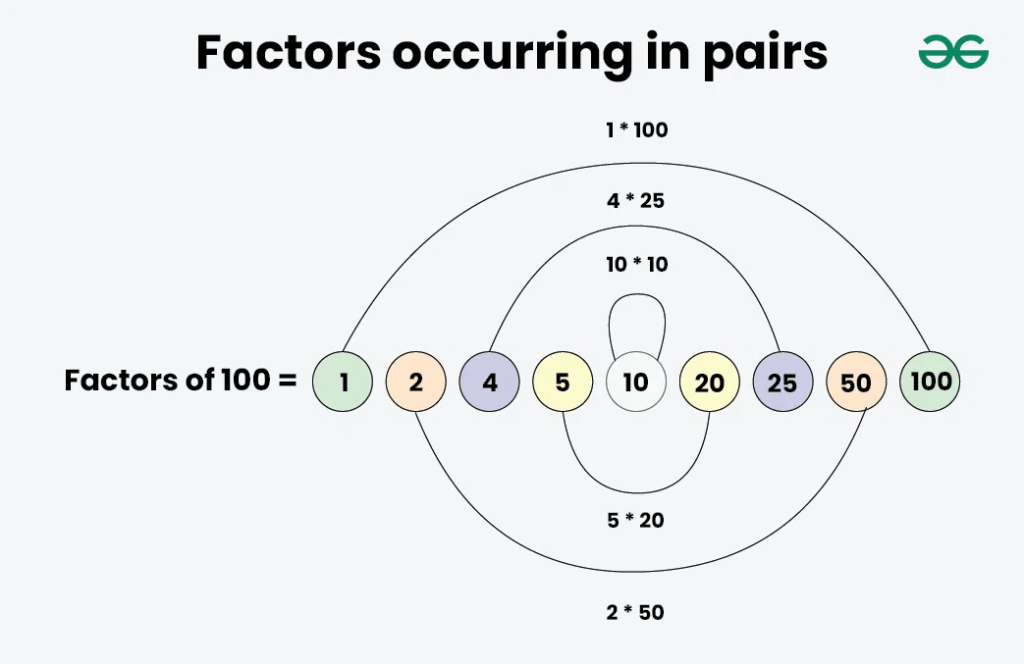
    (Source: Geeks for Geeks)

    We started a series on counting principles earlier this year. We first considered the most basic principles, namely the multiplication and addition principles. Then we looked at how permutations differ from combinations, considering some basic patterns of both including the elements of Pascal’s triangle. Next, we turned our attention to permutations of special kinds, including circular permutations and permutations of non-distinct objects. Then last week we considered combinatorial arguments and binomial identities. We are now poised to consider some ideas related to factors of numbers. I had thought I would be able to include the technique of partitions also in this post. However, I will tackle that in the next post.

    In an earlier post we had looked at the ideas related to factors of numbers. But that was many months ago. So let us start here as though we are addressing these issues for the first time. We begin with the observation that every natural number, except 1, is either a prime number or a composite number. As a reminder, a prime number is one whose factors are only 1 and itself. A number that has a factor other than 1 and itself is said to be a composite number. While it would seem that 1 satisfies the condition for being a prime number, 1 is not considered to be prime. Why is this the case?

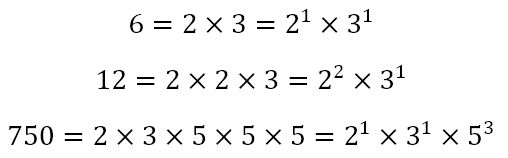
    The fundamental theorem of arithmetic states that every natural number greater than 1 is either a prime number or can be expressed as a unique product of prime numbers, disregarding the order of the primes. We must admit that this theorem, like many in mathematics, is a kind of after-thought. It was introduced specifically to exclude 1 from the set of primes. And this is because including 1 in the set of primes creates more problems than it solves. This is because 1 is the multiplicative identity element. That is, the product of any number and 1 is the number itself. This means that, if we allow 1 to be defined as a prime number, we could write

    Hence, any idea of a unique prime factorization would go into the gutter! However, nothing is gained by defining 1 to be a prime number. Hence, we exclude 1 from the set of primes. What this means is that every natural number greater than 1 can be written with a unique prime factorization, disregarding the order of the primes. For example,

    Since multiplication is commutative, the order in which we multiply the prime numbers does not matter.

    Number of Factors of N

    Let us consider, for example, the number 450. We can determine the factors by using a method like that indicated in the diagram at the start of this post. However, for large numbers this may be an onerous task. However, we can resort to prime factorization and write 450 as

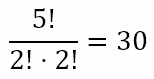
    We can see that there are 5 prime factors with two of them being repeated twice. Hence, from what we have learned earlier, there are

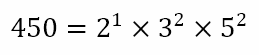
    ways of permuting these prime factors. However, all of them give the product of 450. Hence, if we disregard the order in which we multiply the prime factors, the prime factorization of 450 is unique and can be written as

    Let us consider the factors of 450. They are 1, 2, 3, 5, 6, 9, 10, 15, 18, 25, 30, 45, 50, 75, 90, 150, 225, and 450. Hence, 450 has 18 distinct factors. Some of them are odd, like 1, 3, 5, 9, 15, 25, 45, 75, and 225. The others are even, like 2, 6, 10, 18, 30, 50, 90, 150, and 450. We can see that there are 9 factors that are odd and 9 that are even. That is curious because 9 + 9 = 18. Perhaps there is something here.

    Let us consider the other prime factors. There are factors that are not divisible by 3, such as 1, 2, 5, 10, 25, and 50. There are factors that are divisible by 3 but not divisible by 9, such as 3, 6, 15, 30, 75, and 150. And there are factors that are divisible by 9, such as 9, 18, 45, 90, 225, and 450. We can see that there are 6 of each such factors and 6 + 6 + 6 = 18. In a similar way, the factors not divisible by 5 are 1, 2, 3, 6, 9, and 18. The factors divisible by 5 but not by 25 are 5, 10, 15, 30, 45, and 90. And the factors divisible by 25 are 25, 50, 75, 150, 225, and 450. Once again, there are 6 of each and 6 + 6 + 6 = 18. Surely there is some significance to this. Perhaps we can get a pattern by considering a number with fewer distinct factors.

    Let us consider the number 18. It has 6 distinct factors, namely 1, 2, 3, 6, 9, and 18. Of these, 3 are odd, namely 1, 3, and 9, and 3 are even, namely 2, 6 and 18. Also 2 are not divisible by 3, namely 1 and 2, 2 are divisible by 3, but not by 9, namely 3 and 6, and 2 are divisible by 9, namely 9 and 18. We will now invoke the fact that 1 is the multiplicative identity element and that, for any natural number n, n0 = 1. Since the prime factorization of 18 is 2132, any factor of 6 can have as its factors 20, giving an odd number, or 21, giving an even number. In a similar way, any factor of 18 can have as its factor 30, giving a number not divisible by 3, or 31, giving a number divisible by 3, but not by 9, or 32, giving a number divisible by 9. In other words, there. So, since we had 21 in the prime factorization of 18, there are 1 + 1 = 2 ways of including 2 in the factor, either exclude it, giving an odd number, or include it, giving an even number. And since we had 32 in the prime factorization of 19, there are 2 + 1 = 3 ways of including 3 in the factor, exclude it completely, giving a number not divisible by 3, include only one 3, giving a number divisible by 3 but not by 9, or include both 3s, giving a number divisible by 9.

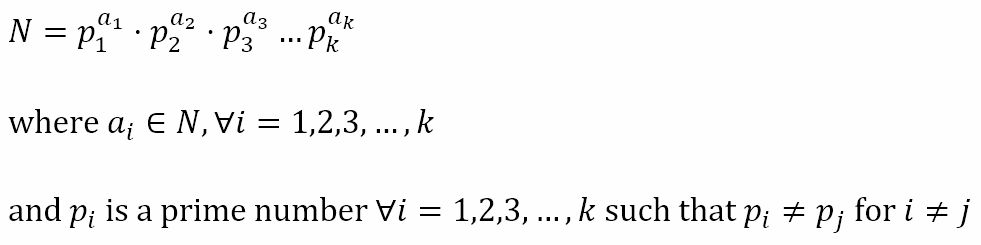
    Let us see if we can generalize this result. Suppose we have the number N. Suppose its prime factorizations is

    Then, the number of distinct factors of N will be

    Let us put this to the test. For 18 = 2132, p1 = 2, p2 = 3, a1 = 1, and a2 = 2. According to the result, the number of factors should be (1 + 1)(2 + 1) = 6, which is correct. For 450 = 213252, p1 = 2, p2 = 3, p3 = 5, a1 = 1, a2 = 2, and a3 = 2. According to the result, the number of factors should be (1 + 1)(2 + 1)(2 + 1) = 18, which is correct.

    Sum of Factors of N

    Now, let us try to find the sum of the factors of a natural number. Consider the number 18. The sum of its factors will be 1 + 2 + 3 + 6 + 9 + 18 = 39. For the number 450, the sum of the factors is 1 + 2 + 3 + 5 + 6 + 9 + 10 + 15 + 18 + 25 + 30 + 45 + 50 + 75 + 90 + 150 + 225 + 450 = 1209. If we attempt to factorize 39 we get 39 = 3 × 13. Similarly 3 × 13 × 31. The repetition of the 3 and 13 seems interesting.

    Let us consider another number, say 6, which has a prime factorization of 2131. The factors are 1, 2, 3 and 6, which add up to 12, which in turn can be written as 3 × 4. Similarly, the factors of 15, which has a prime factorization of 3151, are 1, 3, 5, and 15, which add up to 24, which is 4 × 6. Also, the factors of 30, which has a prime factorization of 213151, are 1, 2, 3, 5, 6, 10, 15, and 30, which add up to 72, which is 3 × 4 × 6. We can see that, when 21 appears in the prime factorization, the sum of the factors has 3 as a factor. Similarly, when 31 appears in the prime factorization, the sum of the factors has 4 as a factor. And when 51 appears in the prime factorization, the sum of the factors has 6 as a factor.

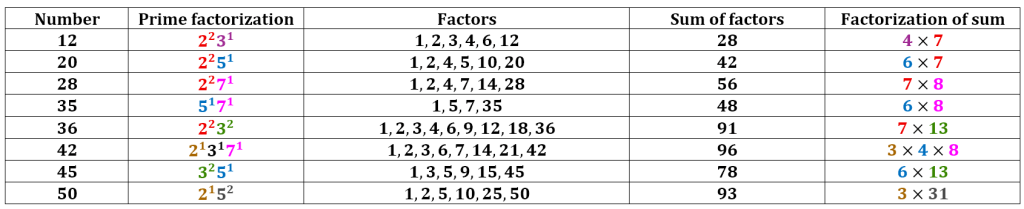
    Now let us consider some other examples. These are summarized in the table below.

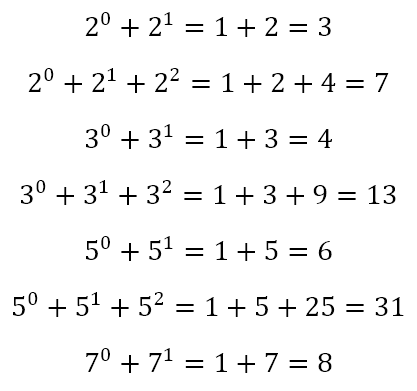
    The results are also color coded. 21 links with 3, 22 links with 7, 31 links with 4, 32 links with 13, 51 links with 6, 52 links with 31, and 71 links with 8. Of course, if you are familiar with series of powers of natural numbers, you will recognize that

    Hence, it seem as though, for a number like, say 42, the sum of the factors can be written as

    We can see how this makes sense. The final expression involving a product of three terms can be expanded as follows:

    We can, therefore, reach a generalization as follows for any natural number, N. Suppose the prime factorization of N is

    Then the sum of the factors of N will be

    Consider the number 12,600 = 23325271. According to the result we have just obtained, the sum of all the factors should be (1 + 2 + 3 + 4 + 5)(1 + 3 + 9)(1 + 5 + 25)(1 + 7) =48,360. This is confirmed here. Of course, we could use the previous result to determine that 12,600 has (3 + 1)(2 + 1)(2 + 1)(1 + 1) = 72 factors.

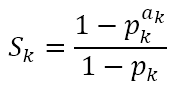
    Using the two results we have obtained we can determine how many factors a number has and the sum of those factors without determining what those factors are. So, for example, if we are given the number 174,636,000 = 25345372111, we can determine that it has (5 + 1)(4 + 1)(3 + 1)(2 + 1)(1 + 1) = 720 factors, the sum of which is (1 + 2 + 4 + 8 + 16 + 32)(1 + 3 + 9 + 27 + 81)(1 + 5 + 25 + 125)(1 + 7 + 49)(1 + 11) = 813,404,592. We can observe that the terms in each set of parentheses form a geometric sequence with first term 1, which can easily be summed using the formula

    In other words, even with extremely large numbers, we can obtain the number of factors and the sum of factors with a few lines of code in a computer.

    Looking Ahead

    What we have seen in this post is a way of determining the number of factors of a number and the sum of its factors without having to find all the factors. We do need to determine the prime factorization of the number However, this is a straightforward process. Now, we used the fundamental theorem of arithmetic to help us determine both the number of factors and the sum of the factors. While this may not be a theorem that is explicitly named when we are in school, it is something that we use regularly after learning division and factorization. Hence, we used some relatively simple mathematics that we learned in elementary school to unravel the question of the number and sum of factors. While some of the formalism and symbols used might be beyond what a student in elementary can understand, the arithmetic behind it is something that elementary students can understand. This is especially so if we demonstrate how, while expanding the expression for the sum of factors, we need to choose one term from each set of parentheses without repetition.

    In the next post, we will tackle the technique of partitioning. In order to set up the post, I will leave you with a question. Given that x, y, and z are natural numbers, how many solutions exist to the equation x + y + z = 100?

  • Recapitulation

    (Source: i-Scoop)

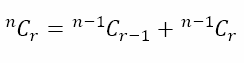
    In this post we continue with the series on Counting Principles. Whereas we devoted the previous post to permutations of special kinds, we will turn our attention today to the matter of combinations. In Arranging and Choosing we saw that the binomial coefficients are related to the elements of Pascal’s triangle. We saw that the process of expanding an expression like (a + b)n involves multiplying a + b by itself n times. This involves choosing either a or b from each factor. We were, therefore, able to show that the (r + 1)th element of the nth row of Pascal’s triangle is the sum of the rth element of the (n – 1)th row and the (r + 1)th element of the (n – 1)th row. In symbolic notation,

    While we proved this result with algebra, I claimed that the algebraic method, involving pure brute force of algebraic manipulation, did not yield any particular insight. However, we proved the above result using

    and arguing from how a particular element on the left side is obtained by adding two terms on the right side. This sort of argumentation does not use algebra. However, the argument in Arranging and Choosing is not technically what is called a ‘combinatorial argument’. So, what is a combinatorial argument? Let us learn with a few examples.

    Combinatorial Arguments

    Example 1

    We begin with the same result we proved earlier. Suppose we have n distinct items and we wish to choose r out of them. This can obviously be done in nCr ways. Now, let us focus on one particular item (say A) out of the n items. The group of r items that are selected either contains A or does not contain A. If the selection contains A, then we have to choose r – 1 more items from the remaining n – 1 items, which can be done in n – 1Cr – 1 ways. If the selection does not contain A, then we still have to choose r items from the remaining n – 1 items, which can be done in n – 1Cr ways. Since the selections that contain A and do not contain A are mutually exclusive (meaning they have no common members) and exhaustive (meaning that there are no other possibilities), it follows that

    As an example, suppose we have to choose 6 items out of 20. This can be done in 20C6 = 38,760 ways. Now, if one of the items is A, then the selection either contains A or does not contain A. If it contains A, then we have to select 5 more items from the remaining 19 items, which can be done in 19C5 = 11,628 ways. If it does not contain A, then we have to select 6 items from the remaining 19 items, which can be done in 19C6 = 27,132 ways. It is easy to check that 11,628 + 27,132 = 38,760. This is an example of the addition principle that we dealt with in Down for the Count.

    Example 2

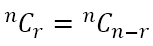
    Let us consider another result, namely

    We proceed as follows. Suppose we have n items and we have to select r of them for some purpose. This obviously can be done in nCr ways. However, by selecting the r items for the purpose, we automatically create a selection of the remaining nr items not for that purpose – that is for some other purpose. Selecting nr items for some other purpose can obviously be done in nCn – r ways. Since the selection of r items automatically creates a selection of the remaining nr items, the number of ways must be equal. Hence, nCr = nCn – r .

    Example 3

    Now let us try to prove

    We proceed as follows. Suppose we have n items from which we have to select r items. This can be done in nCr ways. Now suppose we select k items from the r. This can be done in rCk ways. The two selections can obviously be done in nCr rCk ways. But we can make these selections in a different way. Let us first select the k items from the original n items. This can be done in nCk ways. Now we have to select rk items from the remaining nk items, which can be done in n – kCr – k ways. The two selections can obviously be done in nCk n – kCr – k ways. Since in both cases we end up with rk items for one purpose and k items for a second purpose, the number of ways must be the same. Hence, nCr rCk = nCk n – kCr – k.

    An example of this last result is as follows. Suppose we have a class of 30 students. We need to select a committee of 7 members within which we select a sub-committee of 3 members. Then we can first select the entire committee, which can be done in 30C7 = 2,035,800 ways. Then we select the sub-committee, which can be done in 7C3 = 35 ways. This gives a total of 2,035,800 × 35 = 71,253,000 ways. Alternately, we select the sub-committee first, which can be done in 30C3 = 4,060 ways. Now we have to choose the remaining 4 members of the committee from the remaining 27 students, which can be done in 27C4 = 17,550 ways. This gives a total of 4,060 × 17,550 = 71,253,000 ways. This is an example of the multiplication principle that we dealt with in Down for the Count.

    Binomial Identities

    Having considered some combinatorial arguments, we turn our attention to the binomial coefficients themselves. Since there is a pattern leading from one row to the next, there must be some relationships that hold among these coefficients. For simplicity in proposing and proving these relationships, let us take a = 1 and b = x in the expansion of (a + b)n, which becomes (1 + x)n.

    Example 1

    Using the normal binomial expansion we obtain

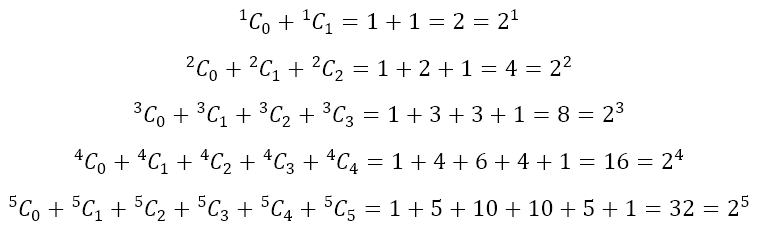
    If we substitute x = 1 in the above we get

    We can verify this by considering a few rows of Pascal’s triangle. For example

    We can see that the identity holds true for the first 5 values of n.

    Example 2

    Now, if we substitute x = -1 in the expansion of (1 + x)n, we will get

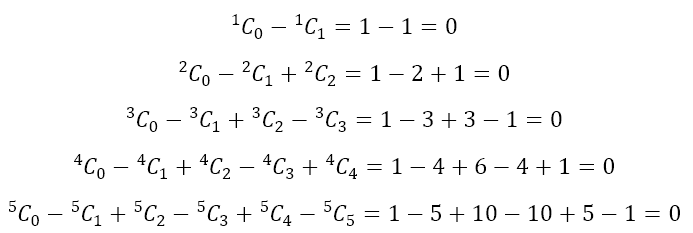
    We can verify this for the first few rows of Pascal’s triangle. For example

    Again, we can see that the identity holds true for the first 5 values of n.

    Example 3

    We can even use differentiation to obtain various results. For example, consider the expansion

    If we differentiate both sides with respect to x we will get

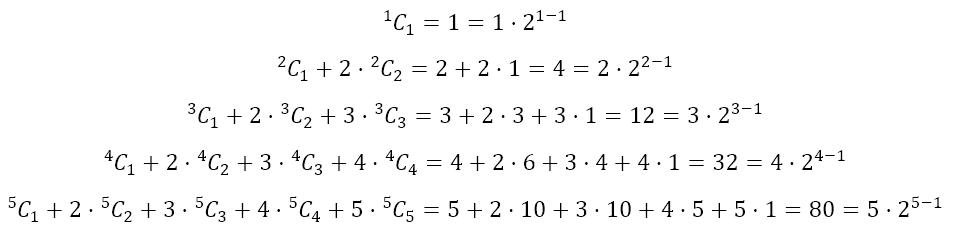
    Now, if we substitute x = 1 in the above equation, we will get

    Again, we can verify this for the first few rows of Pascal’s triangle. For example

    Once again, we have seen that the derived identity holds for the first 5 values of n.

    Example 4

    We can carry the idea of differentiation further as follows. We know that

    If we multiply both sides by x we will get

    Now, if we differentiate with respect to x we will get

    Once again, we can verify this for the first few rows of Pascal’s triangle. For example

    So, we have verified the result for the first 3 rows of Pascal’s triangle.

    Parting Shot

    What we have seen in this post is that we can use logical arguments to obtain relationships between binomial coefficients. We can also use simple algebra and calculus to obtain other relationships. As seen in the last example, we can multiple (1 + x)n by other terms to obtain further identities. The results are quite obviously endless. For example, I leave the reader to attempt to prove that

    Perhaps a hint would help. Consider the expansion of

    If you wish to check the proof, click here.

    Our study of counting principles is not over, though. There is much more left to go. In the next post, we will consider how to obtain the number of divisors and sum of the divisors of any natural number without actually listing the divisors or counting them. And we will consider the technique of partitions. Till then, the ball is in your court.

  • Refresher

    Two weeks back, we started a new series on Counting Principles. In Down for the Count we looked the the basic multiplication and addition principles of counting. In Arranging and Choosing we introduced the ideas of permutations and combinations. In this post, we will consider circular permutations and permutations with restrictions.

    Circular Permutations

    When we introduced permutations, even though we did not mention it explicitly, the implicit understanding was that we were arranging the objects in a row. In fact, this is not necessarily the case. However, if we are able to call one position the ‘first’ position and another the ‘second’, etc., then what we have, in effect, is a row of positions since we can place the positions in a row according to their ‘number’.

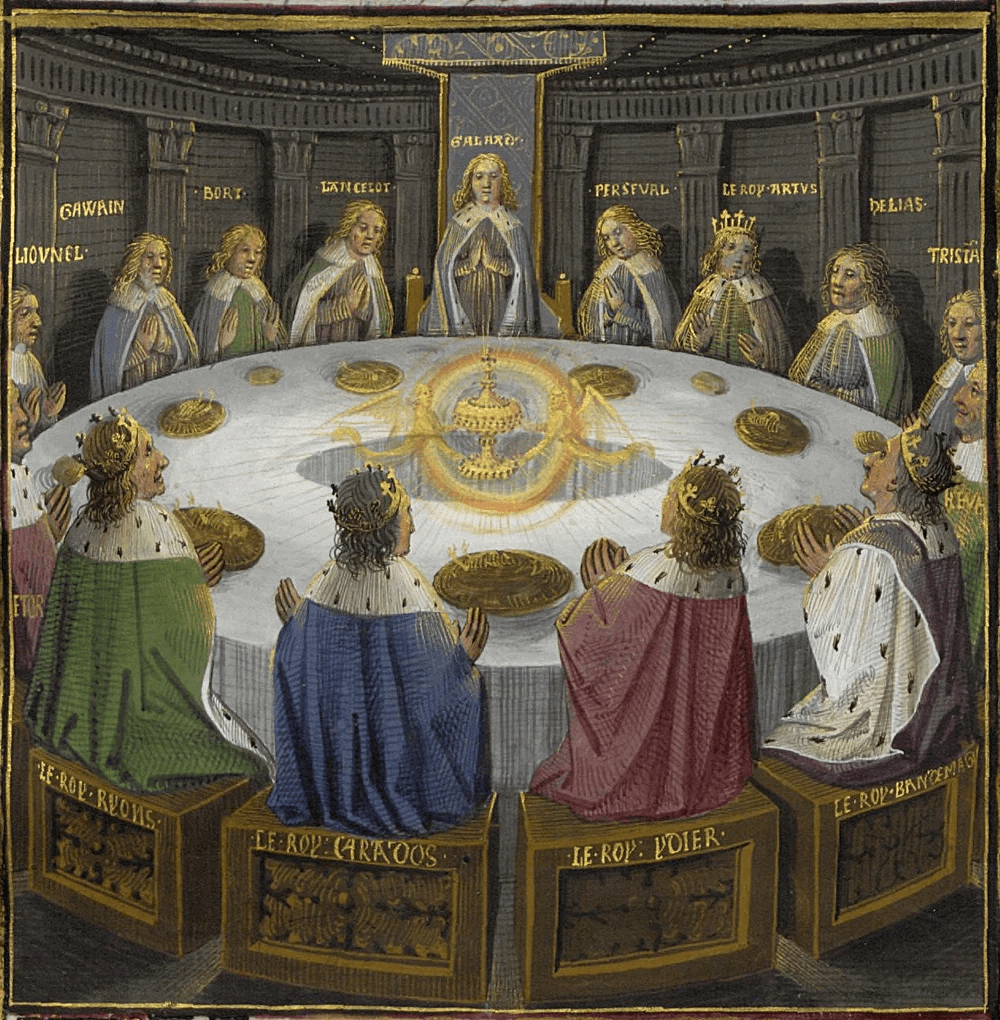
    The knights of the round table. (Source: World History)

    Now, if we arrange the positions in a circle, what we lose is the ability to name a position as genuinely ‘first’. As the legendary round table of Arthur asserted, there is no ‘first’ in such a seating arrangement. Since there is no head, there is no primacy given to any particular position. We are only left with the relative positions and can say, “Person A is seated to the right of person B” or “Person B is seated to the left of person A.”

    Now suppose there are 5 distinct objects that need to be permuted and placed in a circle. Two of the permutations are ABCDE and BCDEA. These are shown below

    Since no position is a ‘starting’ positions or ‘first’ position, the two linear permutations above represent the same circular permutation, with A→B→C→D→E→A, being the progression if we went clockwise around the circle. We can easily see that the permutations CDEAB, DEABC, and EABCD represent the same circular permutation. Hence, there are 5 linear permutations that represent the same circular permutation. This simply represents having 5 options for the top position.

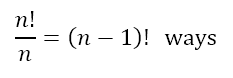
    If we generalize this to n objects, we can see that we will have n linear permutations that represent the same circular permutation. Now, n objects can be permuted in n! ways, as we saw in the previous post. This means that n objects can be permuted in a circle in

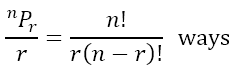
    We can extend this further to permuting r out of n objects. We know that r out of n objects can be permuted in nPr ways. However, for each set of r objects, there will be r linear permutations that represent the same circular permutation. This means that r out of n objects can be permuted in

    Permutations of Non-Distinct Objects

    Now suppose we do not have distinct objects. Rather, there are some objects that are identical. Let us consider a small set to get started. Now, instead of 5 distinct objects, let us consider 5 objects, 2 of which are identical. Hence, we could consider the set to be A, A, B, C, D. Note that the two ‘A’s are identical. Hence, it is impossible to distinguish between them. However, for the sake of this illustration, let us use subscripts to indicate patterns. So the two ‘A’s are A1 and A2.

    Now, it is clear that the patterns A1A2BCD and A2A1BCD will be indistinguishable since both will appear as AABCD. In other words, there are 2 patterns that are indistinguishable from each other. In a similar way, BA1CA2D and BA2CA1D will appear as BACAD. What this means is that, no matter where we place the two ‘A’s, there will be two permutations that will be indistinguishable from each other.

    What happens if there are 3 identical objects (e.g. AAABC)? Well, we can see that the patterns A1A2A3BC, A1A3A2BC, A2A1A3BC, A2A3A1BC, A3A1A2BC, and A3A2A1BC will all appear as AAABC. Hence, there are 6 permutations that will be indistinguishable.

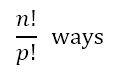
    We can see that, if there are p objects that are identical, then there will be p! permutations that will be indistinguishable, all of which represent permutations in which the identical objects occupy the same positions in the pattern. Hence, if there are n objects, p of which are identical, they can be permuted in

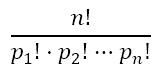
    We can extend this to multiple kinds of identical objects. Suppose we have n objects with p1 of one kind, p2 of a second kind, etc. up to pk of a kth kind. Then the number of permutations will be

    Let’s apply this. Let’s say I have 50 tiles, 4 of which are blue, 5 of which are red, and 10 of which are green, all others being distinct. Then then number of permutations will be

    That’s 2.91… septendecillion permutations! I bet you learned a new word here!

    Permutations with Restrictions

    We can also consider a different kind of permutation in which we have some restrictions. For example, suppose we have 5 distinct objects (e.g. A, B, C, D, and E), which have to be arranged such that two of them, say A and B, have to be adjacent to each other. To find the number of permutations, we consider the group formed by A and B to be a distinct group, say X. Then, we have 4 distinct objects, C, D, E and X, which need to be permuted. This can obviously be done in 4! = 24 ways. However, the objects A and B can be permuted among themselves in 2! = 2 ways. For example, the permutation CXDE can be CABDE or CBADE. Hence, the total number of permutations is 4! × 2! = 24 × 2 = 48.

    We can generalize this. Suppose we have n distinct objects, p of which need to be placed in a group and arranged among themselves. Hence, there are np distinct objects which have no restrictions. Then the number of distinct objects will be np + 1, including the group with p objects, which can be permuted in (np +1)! ways. However, the p objects can be permuted among themselves in p! ways. Hence, the total number of permutations will be (np + 1)! × p!.

    Let’s consider an example. Suppose there is a group of 20 people, 5 of whom must be seated together. Then then number of permutations will be

    Of course, we can extend this further. Suppose there are n distinct objects that need to be arranged such that a group of p1 objects need to be together, another group of p2 objects need to be together, and so on till a group of pk objects need to be together. Note that each group will count as 1 object. Hence, the effective number of objects, including distinct objects and groups, which need to be permuted will be

    Hence, the number of permutations, including the permutations within the groups, will be

    Let’s try this out. Suppose there are 50 seats in a bus and 50 passengers. Among the passengers are a family of 5, a couple, and a group of 11 friends. If the groups have to sit together, the number of permutations will be

    That’s 98.99… quindecillion permutations!

    Looking Ahead

    In this post we have looked art some different kinds of permutations, where the objects are arranged in a circle or where some of the objects are identical or where some distinct objects need to be kept together. Of course, there are cases where we may need to ensure some objects are not placed together, as in the case of rivals or bitter enemies. This is a much more complex situation than simply keeping a group together. So we will look into that in a post much later. However, in the next post, we will turn our attention to combinations and look at what are known as combinatorial arguments, which will help us to derive identities using the binomial coefficients solely through logical argumentation rather than through algebraic manipulation. Auf wiedersehen!

  • Defining Terms

    (Source: Willing Ways)

    In the previous post, Down for the Count, we started a series on counting principles. We looked at the multiplication and addition principles of counting and I promised that, in this post, we would look at permutations and combinations, as well as the relationship between combinations and the binomial coefficients. So, what do these strange words mean?

    A permutation is an arrangement. Hence, if I have three objects, A, B, and C, I could arrange them as ABC, ACB, BAC, BCA, CAB, and CBA. Each of these, while containing each of the objects, represents a different ordering of the object and, hence, a different permutation. Now, suppose I have to choose two out of the three objects. I could choose A followed by B or B followed by A. But in both cases I have chosen A and B. What is end up with, in other words, does not depend, in this case, on the order in which I chose the objects. Both of them represent the same combination of A and B. Hence, if the order is important, we call it a permutation. And if order is unimportant, we call it a combination.

    The term ‘binomial coefficient’ is a little more difficult to explain. Consider the expression a + b. Since there are two terms, a and b, this expression is called a binomial. Now, consider the expression (a + b)n. We know that this means the expression a + b is multiplied by itself n times. For example, (a + b)2 = a2 + 2ab + b2. The coefficients of the terms are 1, 2, and 1. Since these are obtained by expanding the power of the binomial, they are called ‘binomial coefficients’. Similarly, the binomial coefficients of (a + b)3 are 1, 3, 3, and 1, while those of (a + b)4 are 1, 4, 6, 4, and 1.

    Enumerating Permutations

    Suppose I have two distinct objects, A and B. I need to place them in some order. I can choose either A or B to occupy the first position. Hence, for the first position, I have 2 options to choose from. Once I do this, I am left with the second object and am forced to place it in the second position. This means that I have 2 × 1 = 2 ways of arranging A and B, namely AB or BA.

    Now, if I have three objects A, B, and C, I have 3 options for the first position. Once I have placed that object, I am left with 2 objects, which can be arranged, as we have seen in the previous paragraph, in 2 ways. Since I have to arrange all three objects, I use the multiplication principle and conclude that there are 3 × (2 × 1) = 6 ways of arranging A, B, and C. These have already been listed earlier.

    Now, if I have four objects A, B, C, and D, I have 4 options for the first position. Once I have placed that object, I am left with 3 objects, which can be arranged, as we have just seen, in 6 ways. Against, using the multiplication principle, we can conclude that there are 4 × (3 × 2 × 1) = 24 ways of arranging A, B, C, and D. These are ABCD, ABDC, ACBD, ACDB, ADBC, ADCB, BACD, BADC, BCAD, BCDA, BDAC, BDCA, CABD, CADB, CBAD, CBDA, CDAB, CDBA, DABC, DACB, DBAC, DBCA, DCAB, and DCBA.

    We can see that, if we proceed this way, the number of ways of arranging 5 objects would be 5 × 4 × 3 × 2 × 1 = 120 ways. We can generalize this and conclude that, given n distinct objects, the number of ways of permuting all of them would be

    Now, suppose we do not wish to arrange all the objects, but only r of the n available objects. We can obtain the following table.

    The first row in red contains the position numbers. The second row indicates the number of options available for that position. Note that the third row is simply the sum of the items in the preceding two rows, which all happen to be n + 1. It follows then that the number of ways of permuting r out of n items is

    This is a cumbersome formula. However, we can make it simpler as follows

    We can use this formula quite easily now. For example, if we wish to arrange 9 out of 15 distinct objects, then we number of permutations is

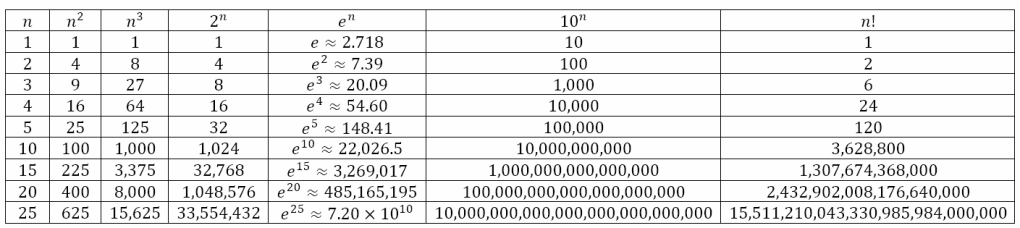
    The answer of 1,816,214,000 should also give a reason why, in many cases, we simply prefer to write it in short form as 15P9. The large numbers are due to the fact that the factorial (n!) grows at a remarkably fast pace. The table below gives a comparison of the growth of various common functions.

    As can be seen, after a relatively slow start, the factorial function just balloons up. It will eventually grow faster than any exponential function because, for any function y = ax, for values of n > a, the multipliers for n! will be greater than the multipliers for ax, which is a. As the table above shows, 25! > 1025. If we had 25 distinct objects and wish to arrange all of them, we would have 15 septillion, 511 sextillion, 210 quintillion, 43 quadrillion, 330, trillion, 985 billion, 984 million arrangements. Just to give you an idea of how large this number is, if you started at the big bang, forming one arrangement every 1 second for the 14 billion years of the life of the universe so far, you would need more than 35 million such universes before you were able to finish every arrangement!

    Enumerating Combinations

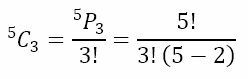
    Anyway, there are times when the order of objects does not matter. For example, if we are selecting a 3-member committee from person A, B, C, D, and E, it does not matter if we chose them in the order DBE or BED, etc. Only the final members selected would matter. Now, recall that permuting 3 out of 5 objects can be done in 5P3 ways. However, this represents all the permutations of the three objects selected. Hence, for the set {B, E, D} we have 3! ways of permuting them (i.e. BED, BDE, DBE, DEB, EBD, and EDB), all of which constitute the same selection of the set {B, E, D}. In other words, if we are only concerned about the objects selected and not the order in which they are selected, then 5P3 represents an ‘over counting’ by a factor of 3!. This means that the number of ways of selecting 3 objects from 5 objects would be

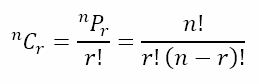
    We can extend this to a more general case. Given n distinct objects, we can arrange r of them in nPr ways. However, the r objects can be permuted among themselves in r! ways, all of which represent the same selection. Hence, nPr represents an ‘over counting’ by a factor of r!. This gives the number of ways of selecting r out of n distinct objects to be

    Now, we can see that, given n objects to choose from, we can choose anywhere from 0 of the objects to all of the objects. However, if we put r = 0 or r = n in the above formula, we get

    However, common sense tells us that there is only 1 way to choose none or all the n objects. Because of this 0! is defined to be equal to 1.

    Now, if we tabulated the values of nCr, we would get a table as follows.

    The Binomial Coefficients and Pascal’s Triangle

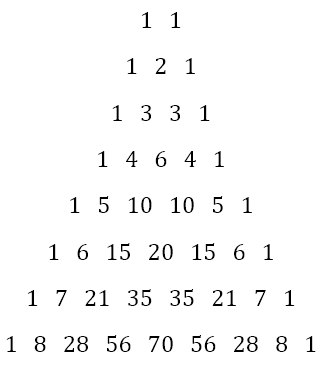
    We can also prepare the first 8 rows of Pascal’s triangle and obtain

    We can see that the values of nCr match the elements of the rth row of Pascal’s triangle. Why is this?

    Consider the expression (a + b)n. As mentioned earlier, when we expand this, we are multiplying a + b by itself n times. So we have

    where there are n sets of parentheses. Now, to complete the multiplication, we need to multiply each element from each set of parentheses by each element in every other set of parentheses. When we get to a particular binomial, we have to decide whether to choose a or to choose b. We cannot choose both, nor can we choose neither. In the end, we will multiply n elements, one from each set of parentheses. Hence, the power of every such product will be n, distributed between the power of a and the power of b. Hence, if the power of a is r, the power of b will be nr, yielding terms that have arbnr. However, this means that we have to choose r sets of parentheses to contribute the a, thereby making the other nr sets of parentheses to contribute the b. Hence, we have to ask, “In how many ways can we choose r sets of parentheses out of n?” Since this is obviously nCr, we can see why these combination values show up as the binomial coefficients. But why do they show up in Pascal’s triangle?

    Psacal’s triangle begins with the top row containing two ‘1’s. Each subsequent row is built by starting and ending with a ‘1’ and obtaining the middle values by adding the two elements above it in the previous row. Hence, the second row starts and ends with ‘1’, with the middle ‘2’ being the sum of ‘1’ and ‘1’ from the first row, giving 1 2 1. The third row starts and ends with ‘1’, with the middle values of ‘3’ being the sum of 1 and 2 and the sum of 2 and 1 respectively, giving 1 3 3 1.

    We can see how this happens. We can write

    Now, to get the term with arbnr, we need to either select a from the first parentheses and the ar – 1bnr term from the second parentheses or select b from the first parentheses and the arbnr – 1 term from the second parentheses. However, both ar – 1bnr and arbnr – 1 are terms from the (n – 1)th row of Pascal’s triangle, that is the preceding row.

    Moreover, the term with ar – 1bnr is the rth element of the (n – 1)th row, while the term with arbnr – 1 is the (r + 1)th element of the (n – 1)th row. And the term with arbnr is the (r + 1)th element of the nth row.

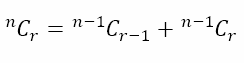
    But this means that the (r + 1)th element of the nth row is the sum of the rth element of the (n – 1)th row and the (r + 1)th element of the (n – 1)th row, which is exactly how each subsequent row of Pascal’s triangle is built. We can put this in terms of combinations and write

    Since the above equation relating binomial coefficients indicates the way the elements of Pascal’s triangle are obtained, it is clear why the two are identical.

    Making it Count

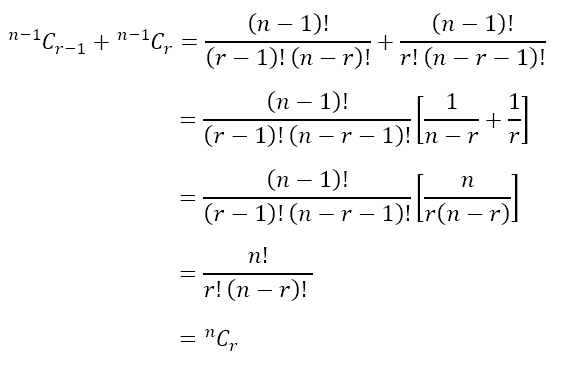
    So far we have learned how to determine the number of permutations of r out of n distinct objects as well as the number of combinations of r out of n distinct objects. We have also seen how the binomial coefficients relate to the elements of Pascal’s triangle. We could have proved the final relation using algebra as below.

    However, the algebra does not give us any special insight, which is what we need. We did get some insight when we showed why Pascal’s triangle has elements that are the same as the binomial coefficients and when we showed why the binomial coefficients show how Pascal’s triangle is built up. But we have only just started our journey of learning how to count.

    In this post, we have considered permutations and combinations of distinct objects in a row. What if some of the objects are not distinct? What if the objects are not in a row, but in a circle? What if we have some restrictions, like two objects cannot be placed side by side or that two objects must always be placed side by side? How do we manage to use the basic counting principles to determine how to proceed counting in these cases? We will turn to that in the next post. Till then, permute your life to make every moment count.

  • What Are Counting Principles?

    (Source: Inner Drive)

    Counting is something that we learn from a very young age, either in the informal environment at home or in the formal environment of school. It forms the basis of all the mathematics we learn through our lives. All the basic mathematical operations (addition, subtraction, multiplication, division, and exponentiation) can be explained in terms of counting. Hence, it is often the case that, when students reach high school, after probably 10 years of formal mathematics, they are surprised when they see a chapter in their book with the title “Counting Principles”. They may think, “What principles might this involve? How much more is there to counting? Didn’t we put the issue of counting behind us when we learned how to perform the operations?”

    What the student does not realize is that what she has learned so far are ‘recipes’ for performing the mathematical operations. That is, she has been given some idea of what the operations involve. However, the main focus would have been on how to perform the operations not on why certain operations are needed to be performed. For example, if you were given 3 ⊗ 7, where ⊗ indicates some mathematical operation, what would the result be? 3 + 7 gives us 10, 3 – 7 would yield -4, 3 × 7 is 21, 3 ÷ 7 would be 0.428571…, and 37 is 2187. While the student would easily be able to determine each of these five answers, which operation should she use in a given context? This is where the idea of the counting principles comes in. These principles tell us which operations are to be used in a given context.

    The Multiplication and Addition Principles

    As an example, suppose a restaurant offers a 3-course lunch with 3 options of starters, 5 of main courses, and 2 of desserts. How many different selections of lunch can a customer make? Or if you have a choice of a room from 3 hotels, one of which has 20 rooms, the second 30 rooms, and the third 50 rooms, how many choices of rooms do you have? How do the 3, 5, and 2 in the first situation relate to each other. How do the 20, 30, and 50 in the second situation relate to each other? There needs to be some principles on the basis of which the student would decide how to find the answer to each of the situations. What are these principles?

    Today, we are starting a new series on counting principles. We will start with some basic ideas and work ourselves to more complex ideas. At the end we will answer the following question: “For a theatre production of a play there are n characters, each of which requires an understudy. If any of the actors and understudies can play all the parts and if the main actor must have more years of experience than the understudy, in how many ways can main actors and understudy actors be assigned?”

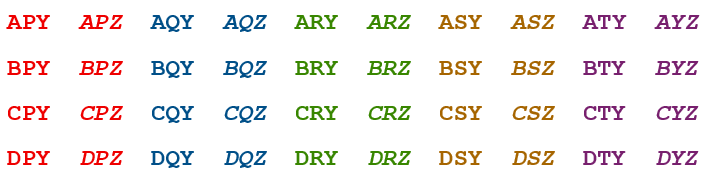
    As promised, let us begin with the two earlier examples, which are relatively easy. Suppose we label the starters as A, B, and C, the main courses as P, Q, R, S, and T, and the desserts as Y, and Z. The possible choices are listed below:

    In the above, each row represents a different choice of starter. The colors differentiate the main courses. Finally, the dessert choice is differentiated between normal and italicized fonts. We can see that there are 40 possible selections because 4 × 5 × 2 = 40. But the reason we multiply is that the customer has to choose a starter and a main course and a dessert.

    In the case of the hotels, we cannot multiply because the person can only occupy one room. Hence, he must choose to go to either hotel A, where he has a choice of 20 rooms, or hotel B, where he has a choice of 30 rooms, or hotel C, where he has a choice of 50 rooms, yielding a total of 20 + 30 + 50 = 100 choices.

    The situation with the lunch choices is one in which we use what is known as the multiplication principle, while the case with the hotel rooms uses the addition principle.

    The multiplication principle states that, if there are m ways of doing one thing and n ways of doing a second thing, then the number of ways of doing both things is m × n. The addition principles states that, if there are m ways of doing one thing and n ways of doing a second thing, then the number of ways of doing either thing is m + n.

    Since the lunch menu required a choice of starter and main course and dessert, the multiplication principle was applicable. And since the hotel room required a choice of only one of the three hotels, the addition principle was applicable.

    Your Turn

    Why don’t you try the questions below?

    1. A football squad consists of 3 goalkeepers and 5 strikers. In how many ways can the coach choose 1 goalkeeper and 1 striker?
    2. A library allows members to borrow two books at a time. The library has 15 books by Jeffrey Archer and 23 books by Paulo Coelho. In how many ways can a member borrow 1 book by each author?
    3. There are 5 apples and 7 oranges in a fruit basket. In how many ways can a person choose either an apple or an orange?
    4. A student has 3 colleges to choose from. The first college has 3 programs, the second has 5 and the third has 6. Assuming that the programs are full-time programs, in how many ways can she choose a program?
    5. A library allows members to borrow only one book at a time. The library has 15 books by Jeffrey Archer and 23 books by Paulo Coelho. In how many ways can a member borrow a book by either author?
    6. Three cities A,B, and C are connected by 4 roads between A and B, 5 between B and C, and 6 between C and A. In how many ways can a round trip be made?

    How did you fare with the above questions? The answers are 15, 345, 12, 14, 38, and 720. Many students get the first 5 but stumble on the last one. The answer I have given is correct. It is 720. If you wish to check the solution, click here.

    Checking Out

    As we continue with the series, we will see that there are many ways to put these two basic counting principles together. We will learn about permutations and combinations in the next post as well as the relation of the latter to Pascal’s triangle. We will also learn about how permutations and combinations relate to each other. We will also see why the combinations show up as the coefficients of the binomial expansion. Till then, let everything count.

  • This will be the final post for 2025. And it is a short one. I will be taking a break of a few weeks after that and will resume on 16 January 2026. For this final post, I would like to consider another problem I recently came across, depicted in the figure below.

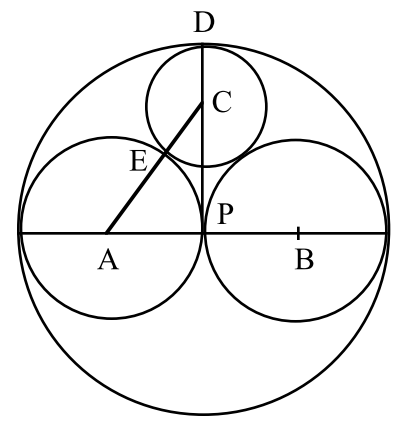
    Each of the four circles is tangential to the other three. Also, it is given that the radius of the largest circle is 2 units and the radii of the two identical circles is 1 unit. We are asked to determine the radius of the smallest circle.

    As is often the case with geometry problems, a few simple constructions and a properly labelled diagram prove to be immensely helpful. These are shown below.

    Here, A and B are the centers of the two identical circles and C is the center of the smallest circle. D is the point of tangency of the biggest and smallest circles. P is the point of tangency of the two identical circles. E is the point of tangency of the smallest circle and one of the identical circles. The points D, C, and P are collinear. Similarly, the points A, E, and C are collinear. Let the radius of the smallest circle be r.

    Now, we know that AP = 1. AC = AE + EC = 1 + r. And CP = DP – DC = 2 – r. We can simply use Pythagoras’ theorem to obtain (1 + r)2 = 12 + (2 – r)2. This is trivial to solve as it yields a linear equation that gives r = 2/3.

  • Problem 1: Pure geometry

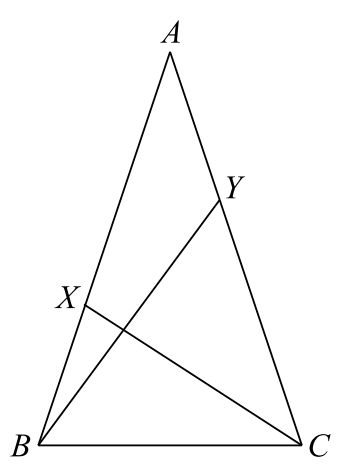
    I recently came across two other interesting geometry problems, which I would like to tackle here. The first is depicted in the figure below.

    In the figure above, ΔABC is isosceles, with AB = AC and ∠A = 36°. Point X on side AB and point Y on side AC are chosen so that AX = BC = CY . Prove that BY and CX are perpendicular.

    Given that the measure of ∠A is specified exactly and that the triangle is said to be isosceles, we should expect that both those factors of the problem will feature in the solution. We begin by observing that, if ∠A = 36° and ΔABC is isosceles, it must follow that ∠B = ∠C = 72°. But as soon as we say that, we also realize that 36 is half of 72. Could it be the case that CX actually bisects ∠C? Let us attempt to approach this by assuming that CX does not bisect ∠C. In that case, there must be another point Z on AB such that CZ bisects ∠C. This is shown in the figure below.

    Now, if CZ bisects ∠C, then it follows that ∠ZCB = ∠ZCA = 36° = ∠A. Hence, in ΔZCA, ∠A = ∠ZCA, meaning that ΔZCA is isosceles, allowing us to conclude that CZ = AZ.

    Now, ∠BZC is an exterior angle of ΔZCA. This means that its measure is equal to the sum of the opposite angles. Hence, ∠BZC = ∠A + ∠ZCA = 36° + 36° = 72° = ∠B. Hence, in ΔBZC, ∠BZC =∠B, meaning that ΔBZC is isosceles, allowing us to conclude that CZ = BC.

    This means that AZ = BC. However, we are given that BC = AX. This can only be true if X and Z are the same point. Hence, we can conclude that CX bisects ∠C.

    However, we are also given that BC = CY. Hence, ΔBCY is isosceles. But CX bisects the apex angle of this isosceles triangle, which means that it must be perpendicular to the base BY. And this concludes the proof.

    Problem 2: Geometry and number theory

    The second problem is depicted in the figure below.

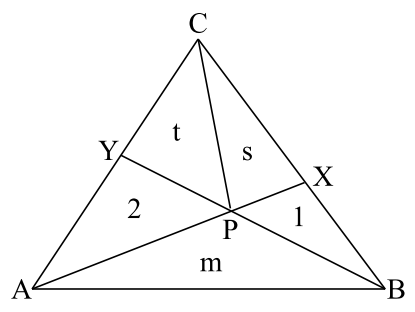
    In the figure above, the area of ΔABC is a whole number. Lines AX and BY are drawn, where X lies on side BC and Y lies on side AC, and these lines meet at point P, inside the triangle. The area of ΔBPX is 1, the area of ΔAPY is 2, and the area of ΔAPB is a whole number. Find the area of ΔABC, and prove that your answer is correct.

    We begin by drawing the line PC and by labelling the regions as shown in the figure below.

    Hence, the areas of ΔABP, ΔPXC and ΔPY C are m, s and t, respectively, as indicated in the diagram. By hypothesis, m is an integer, and hence s + t is an integer, which we will call n. The ratio CX/BX is equal to the ratio of the area of ΔACX to the area of ΔABX, since the two triangles have the same height. This ratio is also equal to the ratio of the area of ΔPCX to the area of ΔPBX for the same reason. Hence,

    Similarly, the ratio CY/AY is equal to the ratio of the area of ΔBCY to the area of ΔBAY, which is equal to the ratio of the area of ΔPCY to the area of ΔPAY. Hence,

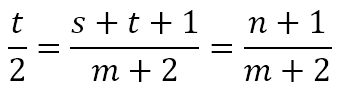
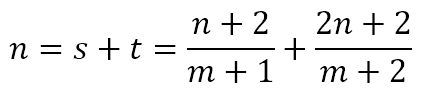
    Now, since n = s + t, we can obtain

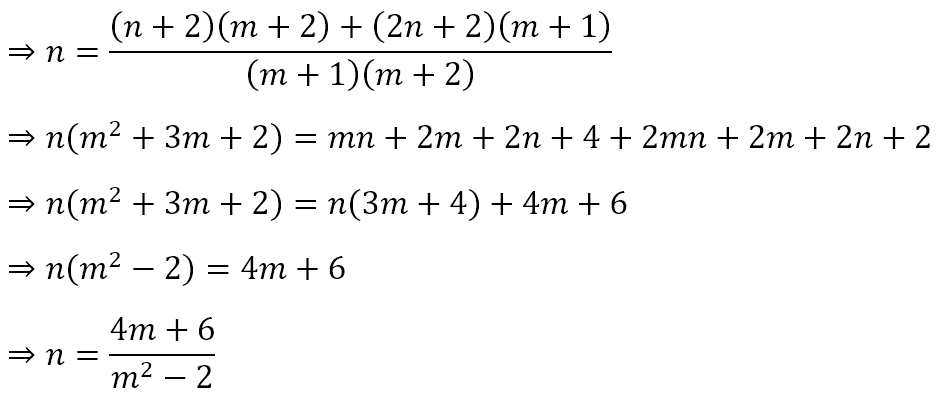
    Some basic algebraic manipulations will give us

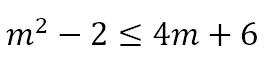
    Now, since s + t = n is a whole number, we must have, n ≥ 1, which means that

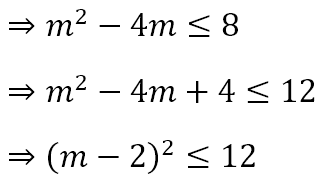
    Rearranging this we get

    Since m is a whole number, we must have m is an element of the set {1, 2, 3, 4, 5}. The corresponding values of n are -10, 7, 18/7, 11/7, and 26/23. This means that the only solution is m = 2 and n = 7, allowing us to conclude that the area of ΔABC is 1 + 2 + 2 + 7 = 12.

  • Framing the Problem

    I recently came across an intriguing problem that I thought worth pursuing. It is represented by the figure below.

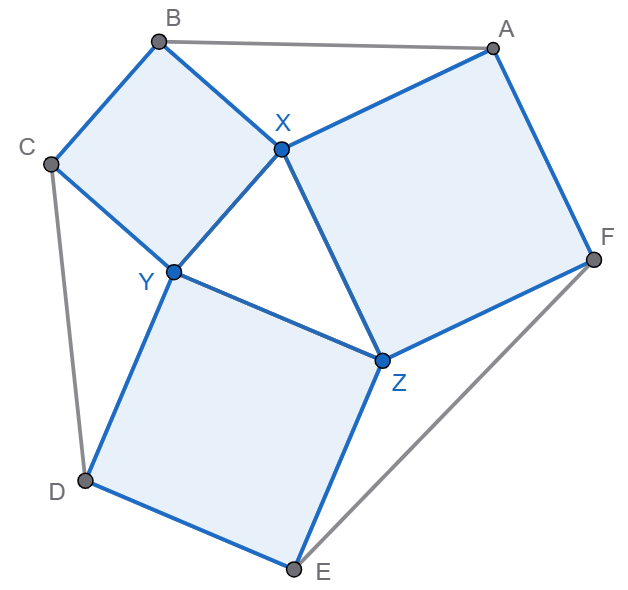
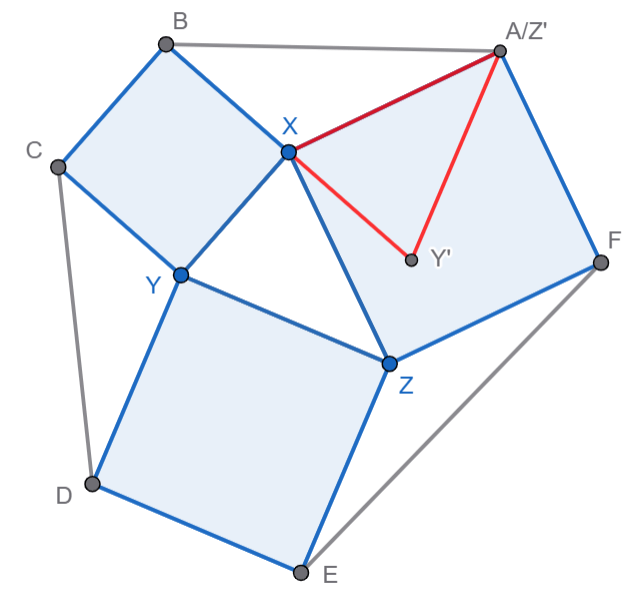
    We are given a triangle XYZ. On each of its sides, we construct a square so that the squares are outside the triangle. This gives us the squares XYCB, YZED, and ZXAF. Now, we join the segments AB, CD, and EF, thereby forming a hexagon ABCDEF. We have to show that the areas of ΔXYZ, ΔABX, ΔCDY, and ΔEFZ are equal.

    Note that this holds true for any initial ΔXYZ. Hence, we cannot assume anything special about the starting triangle. If you wish to explore this, you can access a Geogebra applet I created here. You can click and drag on X, Y, or Z to change the initial triangle. All the other points are automatically generated. You can convince yourself that the four triangles do indeed have the same area.

    The solution, once it strikes you, is really quite elegant and does not require making any tedious measurements. Measurements of any given situation of course would not constitute a proof of any kind. I cannot stress this point enough. So please allow me a short diversion while I vent about one particularly troubling issue. I will proceed with the solution after that.

    A Reason for Venting

    Mathematical proof is something that works quite differently from so-called ‘proofs’ in other areas of human knowledge. In mathematics, proof proceeds by deductive reasoning, while in every other field, what qualifies as ‘proof’ proceeds either by inductive or abductive reasoning. In The Promise and Pitfalls of Mathematical Abduction I had written in length about these modes of reasoning. The image below captures the essential differences between the three primary modes of reasoning quite well.

    Comparison between deductive, inductive, and abductive reasoning. (Source: Design Thinking)

    A Geometric Excursus

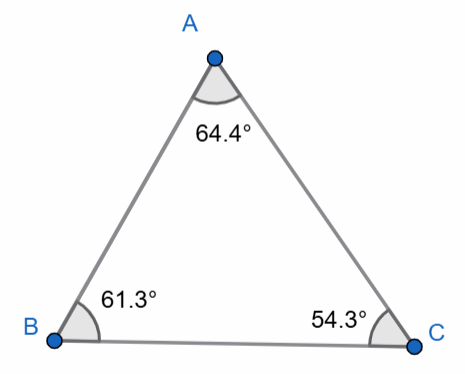
    Since the image above may be too general, let me reiterate the differences by taking a specific example. Suppose we are attempting to prove that the sum of the angles of a triangle is 180°. We could start with a particular triangle, like the one below.

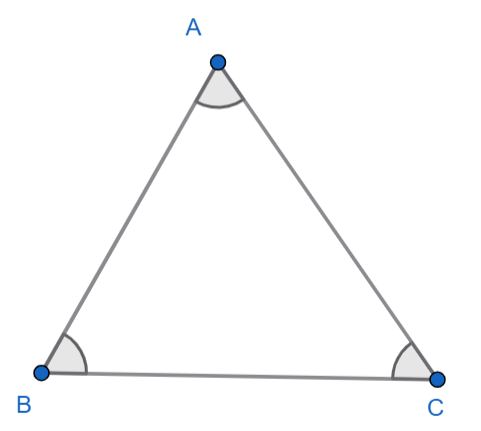
    A quick scratch pad addition will confirm that the sum of the angles is 180°. We could proceed to another triangle shown below.

    Once again we can confirm that the sum of the angles is 180°. However, we have actually not proved anything! All we have done is confirm the hypothesis for two triangles. Note that the angles are different in the two triangles. Indeed, there are infinitely man values that could be chosen for angle A and for each of those infinitely many for angle B. Assuming the sum of the angles is 180°, choosing A and B would fix angle C since the sum is a constant. However, we have an infinite number of triangles. And no matter how many triangles we confirm the hypothesis for, there will always be infinitely many more triangles that remain untested.

    For example, there is the conjecture that the two numbers a = n19+ 6 and b = (n + 1)16 + 9 are relatively prime. However, you have to test till n = 1, 578, 270, 389, 554, 680, 057, 141, 787, 800, 241, 971, 645, 032, 008, 710, 129, 107, 338, 825, 798 (61 digits), before you reach a counterexample with the two numbers having a greatest common divisor equal to 5, 299, 875, 888, 670, 549, 565, 548, 724, 808, 121, 659, 894, 902, 032, 916, 925, 752, 559, 262, 837!1 We don’t even have names for numbers this large! In contrast, if the universe is 14 billion years old, that is only about 441, 504, 000, 000, 000, 000 seconds! That’s 441 trillion, 504 billion seconds. It’s nameable. My point is that there is no way to prove a conjecture like this by the method of testing since a single counterexample will disprove it and there is no guarantee if or when we will encounter the counterexample.

    However, we can prove the result for the sum of the angles of a triangle in a very elegant manner. Consider a general triangle as shown in the figure below.

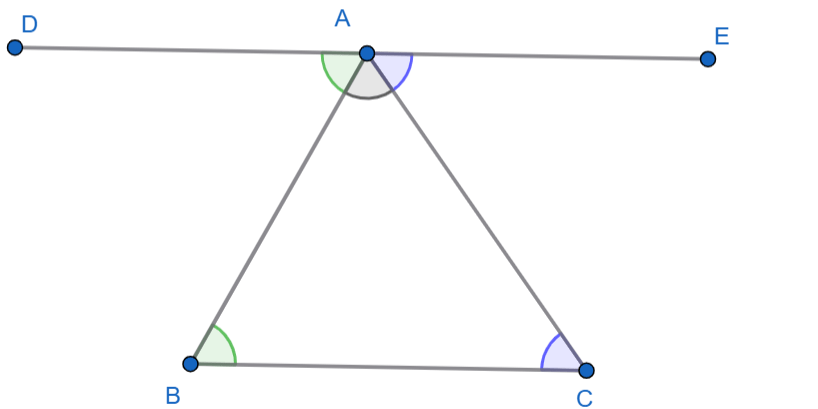
    Now, we draw a line parallel to BC passing through A. This is shown below.

    Now since DE is parallel to BC, ∠DAB and ∠ABC are alternate interior angles and are, therefore, equal. By a similar argument, ∠EAC and ∠BCA are equal. Hence, ∠ABC + ∠CAB + ∠BCA = ∠DAC + ∠CAB + ∠EAC. However, ∠DAC, ∠CAB, and ∠EAC add to form a straight line, which by definition is 180°. Hence, we can conclude that the sum ∠ABC + ∠CAB + ∠BCA is 180°, thereby proving the result.

    What we have seen here is an example of deductive reasoning where we proceed from a general triangle to a result that is true about any specific triangle. This is the kind of reasoning mathematics engages in and I really wish my fellow mathematics teachers spent time teaching students the difference between ‘proof’ and ‘confirmation’ or ‘verification’.

    An Elegant Solution

    With that out of the way, we can return to our opening problem for which we will use one of the elements of the preceding proof. Let’s remind ourselves of our problem with the figure once again.

    Let us focus on ΔABX and ΔXYZ. If we can prove that they are equal in area, we can prove that all four triangles are equal in area because there is nothing special about ΔABX. We also observe that ∠BXY = ∠AXZ = 90° since they are interior angles of squares. What this means is that ∠AXB + ∠ZXY = 180° since the angles about a point equals 360°.

    We now proceed with the realization that moving an object does not change its size. Let us rotate ΔXYZ about vertex X in a counterclockwise direction until line XZ coincides with line XA. This will give us the figure below.

    Note that the point A is also the point Z’. However, to avoid confusion, let us refer to it as A. Now, since ∠AXB + ∠ZXY = 180°, it follows that ∠AXB + ∠AXY’ = 180° since rotating ΔXYZ does not change its internal angles. But this means that B, X, and Y’ form a straight line since the angle formed by a straight line is 180°. Further, X is the midpoint of BY’ since BX = XY’. Hence, X divides ΔABY’ into two equal halves. This means that the areas of ΔABX and ΔAXY’ are equal. But since rotating does not change the size of a triangle, this means that ΔABX and ΔXYZ are equal in area.

    What we have seen is that this problem can be solved quite elegantly with just the basics of school geometry. In fact, we have not used any geometric results that are taught beyond grade 10. In other words, any high school student should be able to understand the solution. However, what the solution required is a willingness to move things around. There are times when we need to break things down before we can put them together in ways that reveal more than conceal.

    1. I obtained this information from Math Stack Exchange. ↩︎