
Personal Experiences
This post is of a more personal nature and really does not deal with mathematics per se. Rather, it uses my experiences as a student and teacher of mathematics as a springboard to talk about women in the field of mathematics. For as long as I can remember, I have been reasonably adept at mathematics. And as mentioned in the previous post, it would not be misleading to say I ‘loved’ mathematics all along.
Now, I am quite a competitive person by nature. And I become better when I face stiff competition. Hence, I am glad my parents enrolled me in a co-educational school because some of my fiercest competitors, at least for the honor of scoring the highest in mathematics, were some girls in my class. You/they know who you/they are. Today, I see a trend away from competition in most schools. However, competition itself is not damaging as there is a healthy kind in which you attempt to improve yourself, not pull the other person down. And I had this sort of competition with the girls in my class. I doff my hat to them since I believe my understanding and appreciation of mathematics wouldn’t be half as good as it is now were it not for their friendship and competition.
Despite this, I still notice a reluctance among parents especially to see that their daughters could very well have a keen mathematical mind. I have had parents deliberately choose for their daughters college programs in the humanities or the biological sciences specifically because these programs involve less mathematics. Don’t misunderstand me. There is nothing wrong with a girl wanting to study the humanities or the biological sciences. All I am bemoaning is the closing of certain doors to girls based on some a priori notion of what girls are able to do.
In my over three decade long career I have had hundreds of students. Without painting too rosy a picture, I have found the girl students to be on average more diligent than the boy students. This is probably because they face more obstacles and, therefore, have more to prove. I don’t think that there is any statistically significant difference in the inherent mathematical abilities of girls and boys. However, the very fact that they have to face greater challenges just to be accepted in fields that are heavy with mathematics develops in them the tenacity that is essential in the acquisition of mathematical understanding and the development of mathematical intuition.
This, of course, should come as no surprise to most mathematics teachers. We know that, while the number of male mathematicians is significantly more than the number of female mathematicians, there have been very significant contributions to the subject made by female mathematicians. Unfortunately, while we know about them, our curriculum barely has the space to include the historical study of the development of the subject, so packed it is with inane procedures and inconsequential concepts! Hence, we are barely able to mention a handful of mathematicians over the course of an entire 12 year program of study in mathematics. This invariably means that students would be fortunate if they were told the name of even one woman mathematician, let alone more.
I may be mistaken, but I think mathematics might be the only area of study in schools where we barely learn about the history of the discipline. This is because we have been sold a lie – namely, that, since mathematical concepts seem to transcend space and time, there is no reason to study their development in space and time. In order to redress this situation, I have consistently given historical information in my classes. One memorable time was when I was in Albania. I had asked all my students to give a 5 minute presentation on one mathematician. I am glad to say that over a quarter of the students, including boys, chose to study women mathematicians. Yes, there have been that many women in mathematics! But unfortunately, this is not common knowledge, even among mathematics teachers!
This is a travesty because it not only means that students are unaware of the contributions of women to mathematical knowledge but also deprives girls today of real life role models who demonstrate that women can be as much at home in the mathematical world as are men. It is time, then, to address this lacuna. I cannot, of course, cover even one of these women to sufficient depth in a blog post, let alone even mention them all. So on the occasion of International Women’s Day, I will briefly consider three women mathematicians in this post. For further reading, I direct the reader here, here, here, here, and here. The lists are not exhaustive. There is also significant overlap in some cases, with a few names appearing in most lists.
So how have I chosen the three mathematicians for this post? One bridges two of the worlds in which I live and breathe and have my being – mathematics and Christian faith. Another bridges another set of two worlds – mathematics and literature. The third was a contemporary, whose all too short life hits home at a very personal level. I will refer to them by their first names, except when drawing comparisons with other mathematicians, when I will revert to their last names. I do not mean this as a sign of disrespect. I believe after many years of learning about these women I have somehow gotten to know them as friends. Of course, they far outstrip my mathematical ability. But I think that one can befriend a superior!
The Philosopher

One of the earliest woman mathematicians and one who makes almost every list is Hypatia of Alexandria. It is not just that she is the earliest known woman mathematician. Rather, her accomplishments speak for themselves. In order to understand the importance of her accomplishments, however, we need to look at the context within which she worked.
By all accounts Hypatia was born somewhere between 350 CE and 370 CE and died in 415 CE. The latter half of the fourth century to the start of the fifth were tumultuous decades in the history of Northern Africa and Europe. Just about a century before her death in 415 CE, the Roman Emperor Constantine had issued the Edict of Milan, in collaboration with Emperor Licinius, in which the official policy of the Empire towards the Christian Church was changed. The edict officially recognized Christianity as a religion and gave everyone in the Empire the freedom to worship according to their conscience.
Quite obviously such a drastic change was not received by everyone with open arms and it wasn’t until 380 CE and the Edict of Thessalonica by Emperor Theodosius I that Christianity forcibly became the official state religion of the Roman Empire.
Suddenly being thrust into a role with power, I am anguished to admit that the Church did not respond with the grace it purportedly preached. Rather, the Christians, now backed by the military might of the Empire, began to crackdown on those who were not Orthodox Christians. This included those with Heterodox beliefs and of course those who held pagan views.
Hypatia was born between the issuance of the two edicts. In other words, she was born into a world in which Christianity was a recognized religion. However, when she was in her early teens to late twenties, suddenly she would have found herself in a strange situation.
You see, her father, Theon, was the head of an exclusive school called Mouseion, which endorsed conservative Neoplatonism. In other words, the school was a bastion of pagan doctrine. But suddenly the philosophy which had ruled the roost in the Empire for centuries had been relegated to a supporting role at best and a shunned and despised one at worst. Suddenly, the philosophy with which she was familiar and in which she had been educated was looked on with suspicion, especially by some of the more radical elements within the Church.
Hypatia, nevertheless, was tolerant of Christians and even welcomed them as students, becoming a mentor of a future bishop, Synesius. In fact, most of our personal information about her comes from extant letters from Synesius to her. Since she bridged both the worlds of academia and religion, the Roman prefect, Orestes, relied heavily on her for advice.
While Hypatia is not known to have made any innovations in mathematics, she was reputedly a more accomplished mathematician than her father. She was known to hold impromptu lectures when people asked her questions in public.
However, Hypatia is known to have written commentaries on many works spanning astronomical calculations, arithmetic algorithms, algebra, and conic sections. Unfortunately, most of her writings were destroyed in the furore that ensued following her death. I would have really liked to know what she wrote about the conic sections.
Her death, of course, is tragic. Hypatia had maintained friendly relations with the Christian leaders of Alexandria, even being considered as an ally by bishop Theophilus. This was despite Theophilus’ opposition towards Neoplatonism, which itself indicates the irenic spirit with which Hypatia conducted herself. When Theophilus died in 412 CE, he had not named a successor. The power vacuum resulting from his death only caused more conflict within the Church at Alexandria between Theophilus’ nephew, Cyril, and his rival, Timothy. The struggle between Cyril and Timothy was violent and made Hypatia distance herself from the Church leaders.
Despite this, she remained in close relationship with the prefect Orestes, a new convert to Christianity. In one of his letters, Synesius urges her to use her good graces with Orestes to enable Cyril and Timothy to reach a peaceful resolution to their conflict. However, some radical elements within the Church used her advisory relationship with Orestes as a pretext to accuse her of inciting anti-Christian sentiments with the prefect.
On one fateful evening in Lent of 415 CE, while Hypatia was returning home, a mob of Christians led by a lector named Peter, stopped her carriage, pulled her out, stripped her naked, dragged her through the streets, and then flayed her to death with roof tiles.
/https://tf-cmsv2-smithsonianmag-media.s3.amazonaws.com/filer/Hypatia-murdered-631.jpg)
For me Hypatia stands as a symbol of inspiration and a totem of warning. Though living in a violent world, she maintained her commitment to nonviolence. Though living in a world dominated by men, she proved herself worthy of being considered to have overshadowed most of her contemporaries. While she may not have made any innovations, the writing of commentaries to explain difficult ideas is a crucial contribution to the abstract area of mathematics and its often esoteric writings. Her murder at the hands of people who held to the same faith as I do is a warning to me that religious zeal can quite often be destructive. But I write about her to honor a teacher of mathematics like me and hope that she will inspire many of my students, especially girl students, to wade into these deep and refreshing waters of mathematical discovery.
The Poet

From North Africa in the fifth century CE, we wend our way to Russia in the nineteenth century. Not that there weren’t any other woman mathematicians in the intervening fourteen centuries! Of course there were! But Sofia Kovalevskaya has a special place in my heart because of the lyrical way in which she communicated mathematics. But that is to get ahead of myself.
Sofia was born in 1850 CE. Her father belonged to a house of minor nobility while her mother’s family had immigrated to Russia from Germany. When she was 11 years old, a miscalculation of wallpaper needed to cover the rooms of her home led to there being one roll of wallpaper less than what was required. Her parents decided to paper the walls of her room with some old sheets of paper lying in the attic. These turned out to be her father’s notes from Mikhail Vasilevich Ostrogradski‘s lectures on differential and integral analysis. Perhaps this was a foreshadowing of the future? With an introduction to calculus at such an advanced level, it is hardly surprising that she would develop a keen mind for mathematical analysis.
To encourage her interest in mathematics, her father employed a tutor, under whose guidance Sofia’s love for the subject grew. In her words, “I began to feel an attraction for my mathematics so intense that I started to neglect my other studies.” At this, her father chose to put an end to the tutoring.
But the fire had been kindled. She smuggled a copy of Bourdon‘s Elements of Algebra, which she read in bed after the rest of the family had gone to sleep. Yet, she knew that her knowledge of mathematics would be limited to what was in that book if something did not happen to change her father’s outlook.
Soon after, a neighbor presented her with a physics book on optics, which required the use of trigonometry. However, since her study of mathematics had been limited to algebra, she was ignorant of trigonometry. Yet, she took it on herself to derive the Trigonometric identities by herself and did so in almost the same way as had been done historically. The neighbor began to persuade her father to allow her to study mathematics, which he succeeded at after two years! Sofia’s study of mathematics included analytic geometry and calculus and she excelled at these.
Shortly after this, the family made the acquaintance of the great Russian novelist Fyodor Dostoevsky. During one of their visits to his house Sofia’s sister, Anya, showed some of Sofia’s poetry to the author, who was impressed with her way with words.
When she was eighteen, she entered into a marriage of convenience with Vladimir Kovalevsky. The marriage gave Sofia the freedom to move away from her birth family and follow Vladimir. But soon her aspirations were dashed when they moved to Heidelberg and discovered that women could not graduate from the university there. Somehow she persuaded the university to allow her to at least attend the classes. They reluctantly agreed subject to the condition that she obtain prior approval from all the professors whose classes she wanted to attend. Nothing could stop her now and she met with the professors and obtained their approval.
Two years later, on the advice of Leo Königsberger, Sofia moved to Berlin hoping to study under Karl Weierstrass. Since the university at Berlin did not allow her to attend classes since she was a woman, Weierstrass agreed to tutor her in private. Under the guidance of Weierstrass, in 1874 she produced three ground breaking papers on Partial differential equations, Abelian integrals and Saturn’s Rings. The first of these was published in Crelle’s journal in 1875.
Her work on partial differential equations (PDE) is particularly significant. PDEs are notoriously difficult to solve. This is so even when we know the initial conditions. Sofia extended a special case framed by Augustin-Louis Cauchy to a general case now known as the Cauchy–Kovalevskaya theorem, which specifies the kinds of initial conditions under which the PDEs can be solved. (For the stout of heart, the proof of the theorem can be found here.)
Despite all the obstacles she faced, Sofia became the first woman to get a doctorate in mathematics, the first woman professor in the world, the first woman editor of a mathematics journal. Shortly after being appointed as professor at the University of Stockholm, she published a seminal paper on the mathematics of crystals and was subsequently also appointed as the chair of Mechanics at the university.
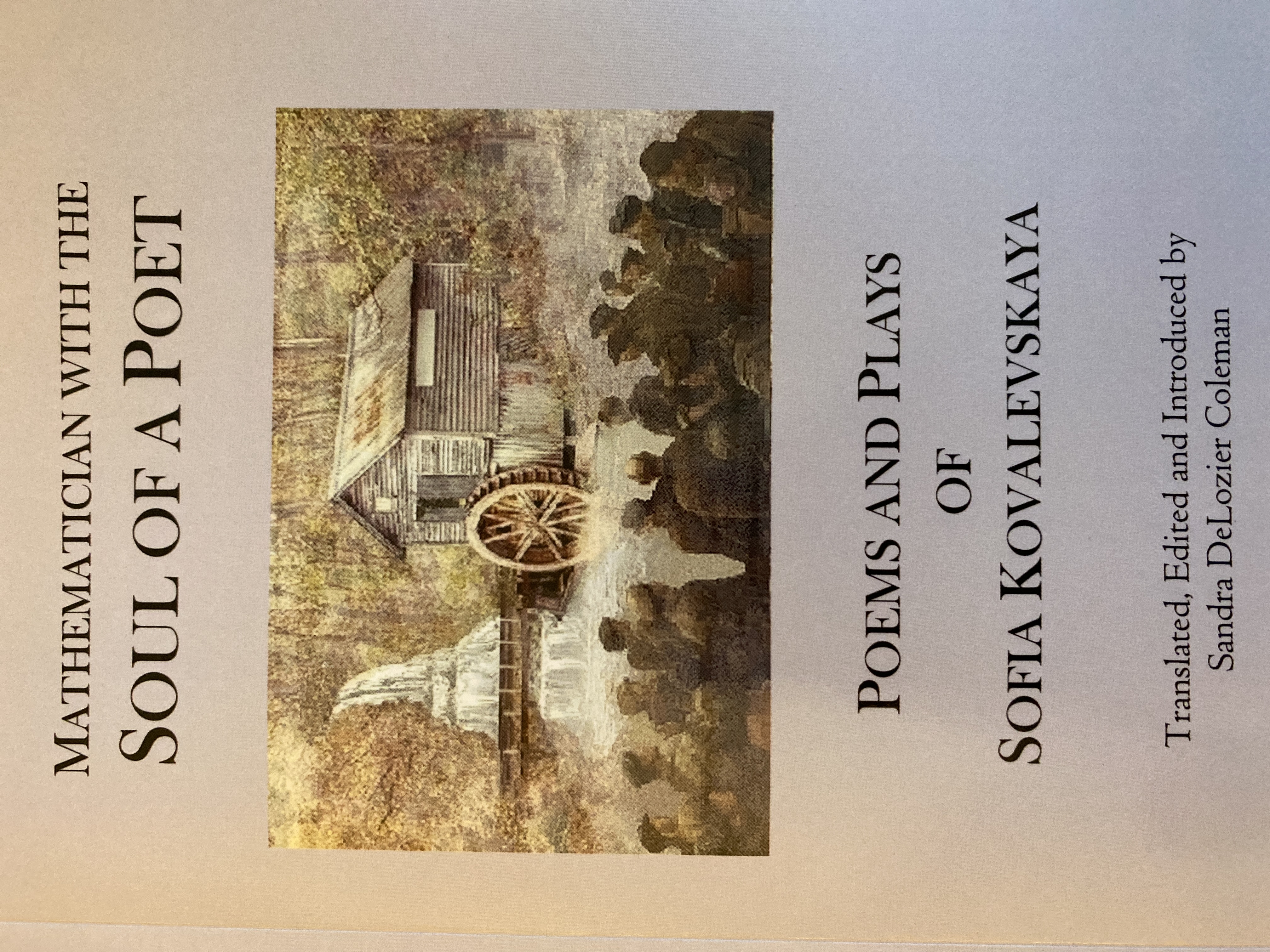
Though being so accomplished in mathematics and physics, two fields that are often considered to be rigid and rule based, Sofia claimed, “It is impossible to be a mathematician without having the soul of a poet.” In an attempt to dispel an unfortunately common perception of mathematics, she wrote, “Many who have had an opportunity of knowing any more about mathematics confuse it with arithmetic, and consider it an arid science. In reality, however, it is a science which requires a great amount of imagination.” In asserting that there is a poetic element and essential role of the imagination in mathematics she wrote, “It seems to me that the poet has only to perceive that which others do not perceive, to look deeper than others look. And the mathematician must do the same thing.”
In keeping with her openness to the imagination, Sofia was also a poet, author and playwright. With her friend, Anna Leffler, she co-authored The Struggle for Happiness, a play that drew heavily from her relationship with Vladimir. She also wrote a memoir of her younger days titled Recollections of Childhood about which one critic wrote that she “should without doubt occupy one of the most prominent places among Russian authoresses.” Her novel The Nihilist Girl, containing a lot of her political views, was repeatedly banned by the Russian authorities.
With so many ‘firsts’ under her belt in the face of so many policies that discriminated against women, Sofia showed herself to be perseverant and tenacious. Her contributions in areas of literature and mathematics gives the lie to the commonly held view that those who are good at mathematics have poor language skills and vice versa. She is a powerful example to girl students today, not just in the area of mathematics, but as an inspiration to fight against all kinds of policies that discriminate against women.
The Artist
From Moscow and Stockholm we move our gaze to Tehran, Iran, where our next woman mathematician was born. Maryam Mirzakhani was born in 1977, two years before the Iranian Revolution.
She completed her schooling and undergraduate studies in Tehran itself and demonstrated an exceptional mathematical mind when she won the Iranian Mathematical Olympiad in her junior (11th) and senior (12th) years at high school. While in school she also won the International Mathematical Olympiad in 1994, becoming the first Iranian woman to do so, and in 1995, becoming the first Iranian to achieve a perfect score. After she won the Iranian Mathematical Olympiad in 1994, one of her teachers challenged her to find what are known as complete tripartite graphs, promising her a dollar for each one she found. As a response to this challenge, she derived a method for forming complete tripartite graphs of any size, meaning that her teacher technically owes her an infinite amount of money!

In March 1998 she had a brush with death when a bus she was riding in fell off a cliff. Her success at the Iranian Mathematical Olympiad allowed her direct admission to the Sharif Institute of Technology1 where she earned a BSc in 1999.
After her undergraduate studies Maryam enrolled at Harvard University where she worked under the supervision of Curtis T. McMullen, who observed that she was “distinguished by determination and relentless questioning.” This shouldn’t come as a surprise since she once declared, “The beauty of mathematics only shows itself to more patient followers.” Treating mathematics as a field that reveals its beauty only to those willing to invest in the search she said, “You have to spend some energy and effort to see the beauty of math.” These twin statements resonate with me, as seen from the previous post. Maryam received her Ph.D. from Harvard University in 2004. From 2004 to 2009, she was a research fellow at the Clay Mathematics Institute and a professor at Princeton University.
Maryam had incredible mathematical insight, managing to produce a simple proof2 of Schur’s Theorem, cleverly employing the principle of mathematical induction to produce an elegant proof. However, as can be seen here, there is a silencing of women’s voices. The reader will easily recognize that Mirzakhani’s proof is much more elegant than the one by William Gustafson presented in the post. Despite this the author of the blog says Gustafson’s proof is the most elegant. While beauty is indeed in the eye of the beholder, no one would confuse the Antilla-like patchwork of Gustafson’s proof with the Lotus Temple-like simplicity of Mirzakhani’s.
Maryam’s areas of interest included Teichmüller theory, hyperbolic geometry, ergodic theory, and symplectic geometry. If the previous sentence seemed like it was in another language, you are not alone. Apart from hyperbolic geometry, I had not heard of any of the other areas before I started learning about Maryam. And I don’t claim to understand any of those esoteric areas.
In 2013 Maryam was diagnosed with breast cancer. By 2016, the cancer had metastasized to her bones and liver. She died in July 2017 aged only 40. She is survived by her husband, Jan Vondrák, and their daughter, Anahita. Following her death, the Iranian leaders broke protocol and posted pictures of her not wearing a head covering. This made Maryam the first Iranian woman to be officially portrayed without head covering and that too with the short hair she chose as her style following the cancer diagnosis!
Maryam’s contributions to the field of mathematics are enormous considering that she was a professor for less than 15 years. The international mathematics community recognized her contributions by awarding her the prestigious Fields Medal in 2014, making her the first and only woman, the first Iranian, and the first Muslim to receive the medal.
Maryam’s work on Riemann surfaces meant that she had to hone her skills of visualizing the complex mathematical structures she was imagining as none of them could accurately be displayed on a 2-dimensional surface, or for that matter even a 3-dimensional space. I think it is her superior ability to visualize these mathematical structures that made her so adept at what she did.
Despite being diagnosed with cancer, Maryam continued to work and contribute to the field. Despite the debilitating effects of the illness and the treatment, she continued undaunted. There are very few lectures of her on the internet. I have placed a two part series of lectures on the Dynamics of Moduli Spaces of Curves in a playlist with an honest confession that I understood only about 10% of the lectures! These lectures were given after she was diagnosed with cancer. And yet we see her thoroughly animated and full of life when talking about what she loved.
While Maryam’s focus was not on the application of her discoveries, her advancements nonetheless have found applications from such blasé areas as vehicle painting and roadway design to some really intriguing areas as M-theory and 3D animation. Since her work involved a lot of drawing, she would doodle as she worked, leading her daughter to think that she was actually an artist! Some mathematicians would admit that Maryam’s daughter was not far off in her appraisal!
Conclusion
Hypatia, Sofia, and Maryam are just three examples women who have made exceptional contributions to the field of mathematics. In Hypatia we saw a woman who also extended herself in an advisory role to the local government leaders and who strove to form bridges between warring factions. In Sofia we saw a woman who allowed both sides of her brain to be used, not restricting herself only to mathematics, but expressing herself also in poetry, novels, and plays. In Maryam we saw a woman whose tenacity and playfulness revealed mathematical insights that the world is still coming to grips with. All three of them died very young. Hypatia may have just about reached 50. Sofia was 41 when she died and Maryam just 40.
All three women faced obstacles in life. Hypatia’s struggles were of a religio-political nature. Sofia’s obstacles were institutional in nature. And Maryam had to contend with the rebellion of her own body. Yet all three overcame these obstacles and left lasting legacies that should inspire all of us and surely young girls, especially those who might want to embark on a lifelong study of mathematics.
- I tried to get a link to an Iranian site, but none of those links work seem to be working in India. Most of the links that did work were blatantly anti-Iranian. The Wikipedia article was the least polemical of the lot, but even this is clearly and heavily biased. ↩︎
- The reader who has not studied number theory beyond high school may find this ‘simple proof’ far from simple. However, given how convoluted most mathematical proofs at this level are, this is actually quite beautiful in its elegance. ↩︎


Leave a reply to Deepak M Babu Cancel reply