
Signaling the End

In our study of complex numbers, we are reaching the end of a pit stop dealing with trigonometry. I ended the previous post by mentioning that the trigonometric functions are periodic in nature. I claimed that this is an important feature in the study of complex numbers. In this post, we will look at what periodicity means and what it reveals concerning the trigonometric functions.
If you read the preceding paragraph carefully, you will probably have realized that my vocabulary has changed. I am no longer speaking of ‘trigonometric ratios’ but of ‘trigonometric functions’. One obvious reason is that, once we have transcended the definitions based on sides of a right angled triangle, there are no sides, the lengths of which can be placed in a ratio. In fact, as we saw in the previous post, we are now defining sine and cosine of an angle in terms of the coordinates of the corresponding point on the unit circle. Moreover, when we say that the values of sines and cosines repeat, we must have a way of quantifying how this repetition occurs. In other words, we want to be able to relate the angle made by the line joining the point under consideration to the origin and the positive x-axis. That is, we want to obtain expressions for the coordinates in terms of the sines and cosines of angles. This means we are treating the sines and cosines of the angles as functions of the angles themselves. Hence the change in vocabulary was needed.
In case you are wondering about the title of this post, it is a feeble riff off the majestic Concluding Unscientific Postscript to Philosophical Fragments by the Danish Christian philosopher Søren Kierkegaard, a work that is quite unwieldy.
Anyway, the focus of this post is on the periodicity of the trigonometric functions and some corollaries that can be obtained from this periodicity. This is precisely where I wanted to reach before returning to the main series of posts on complex numbers. So let us proceed.
Identifying Periodicity
Suppose, we consider a point P on the unit circle corresponding to the angle θ. Then, from what we have learned concerning the unit circle, the coordinates of P will be (cos θ, sin θ). This is shown below.

Now, if we rotate the radius OP counterclockwise by 2π radians, then the new position of the radius will be the same as the original position. In other words, now, the same point P corresponds to a radius making an angle of θ + 2π radians. Since the new position of the radius is the same as the old position, the new coordinates of P, corresponding to the angle θ + 2π radians, will be the same as the old coordinates, corresponding to the angle θ radians. Hence, we can conclude that

Of course, if we rotate OP by another 2π radians, we will be back where we started. This holds true for any integral multiple of 2π radians in the clockwise or counterclockwise direction. Hence, we can conclude that

where ℤ denotes the set of integers.
Visualizing Periodicity

What this tells us is that the values of the cosine and sine functions will repeat every 2π radians in the clockwise or counterclockwise directions. Now, it is only by convention that an angle is often denoted by the letter θ. Normally, when we plot graphs, we use x for the independent variable and y for the dependent variable. Hence, if we plot the graph of y = sin x, we will get the following

Similarly, if we plot the graph of y = cos x, we will get

In like manner, if we plot the graph of y = tan x, we will get
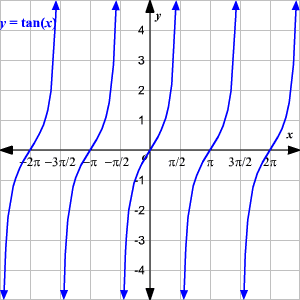
The regular repetition of the pattern for all three graphs is what makes these functions periodic.
Corollaries of Periodicity
Now, if we are considering rotations of the radius, how do these values relate to each other? That is if we double the angle, how does this affect the values of sine, cosine, and tangent? Before we can answer that question, we need to look at the more general case of adding two angles. So let us deal with that.
Sum and Difference of Angles
The question we are asking is, “How do the sine, cosine, and tangent of A+B relate to the sines, cosines, and tangents of A and B? Here, it is possible for us to derive the following formulas

If you are interested in knowing how these are derived, below are the proofs.

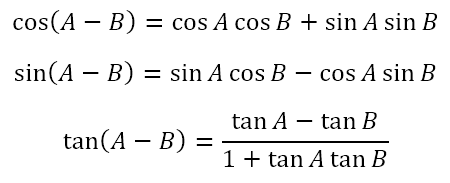
If the above proofs are difficult to follow, please do ask me for an explanation. Of course, having obtained the values of sine and cosine for the sum of angles, we can obtain the values for the difference of angles as below
Double and Half Angle Formulas
Using the expressions for the sum of angles and putting A = B, we can obtain the following expressions for the sine, cosine, and tangent of the double angle 2A. This is shown below

Going in the reverse direction and using the expressions for cos 2A, we can obtain

Triple Angle Formulas
Using some of the above results, we can obtain an expression for the cosine of a triple angle as follows
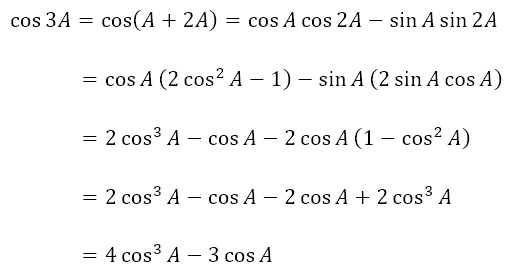
In a similar way, we can obtain an expression for the sine of a triple angle as shown below
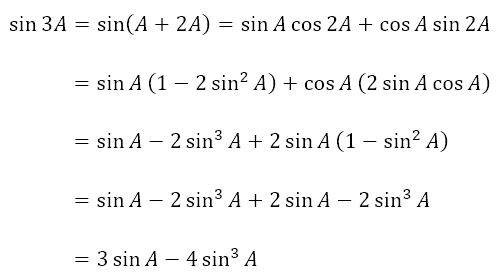
Finally, we can obtain the expression for the tangent of a triple angle as follows
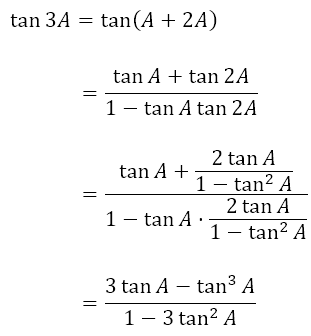
Given the fact that the trigonometric functions are periodic and that there are expressions for the trigonometric functions of sums, differences, multiples and sub-multiples of angles in terms of the trigonometric functions of their component parts, there are an indefinite number of results that can be obtained. However, what we have so far is sufficient for our journey dealing with the study of complex numbers.
Getting Back on Track
However, in case you are wondering why we took this pit stop, recall that we have a geometric interpretation of a complex number on a two dimensional plane in which the horizontal axis is the real axis and the vertical axis the imaginary axis. We had dealt with this in It’s Not Rocket Surgery! and Modulating an Invariant Metric. Recall that, it was immediately after the latter that we began our pit stop.
Recall that we can depict the numbers 3 + 2i, -4 + 4i, and -2 – 3i as shown below.
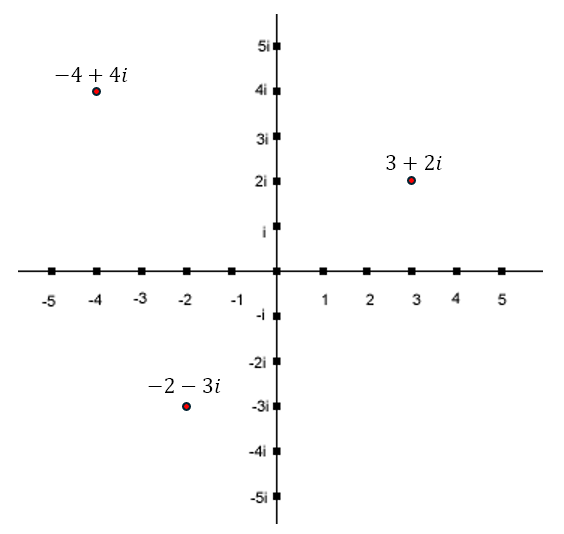
We had also introduced ourselves to the ‘size’ of a complex number, which is called the modulus. This is nothing but the length of the line joining the origin to the point representing the number. This line, however, has a well defined orientation with respect to the positive real axis. Hence, we can specify the complex number in terms of a distance from the origin (i.e. its modulus) and an orientation with respect to the positive real axis. This orientation has a technical term, of course. However, we will deal with it and some other aspects related to operations on complex numbers in the next post. I know this may bug you, especially if you are the impatient sort. But from you I will accept no argument!


Leave a Reply