
Arithmetic Blasphemy

In one of the first posts in this blog, My Unbounded Mathematical Trauma, I had shared about my trauma when students says something like, “One divided by zero equals infinity.” Unfortunately, this is something that I have heard repeated by mathematics teachers too. And I shudder when I hear such blasphemy! I say ‘blasphemy’ because division by zero is the ‘unforgiveable sin’ in mathematics and a statement like “One divided by zero equals infinity” gives the impression that it is possible to divide one by zero and obtain a number.
However, if it is possible to divide one by zero, then the result must be a number since operations performed on numbers must yield numbers. If the result is infinity, where do we locate it on the number line? After all, the number line is a mathematical artifact that is supposed to be a visual representation on which we can locate every real number. If we are able to locate infinity on the number line, then either that must be where the number line ends, meaning that the number line itself is not unbounded, or there are numbers to the right of infinity, meaning that infinity is not something that is greater than any number.
What we realize is that infinity is not a number, but an idea, a construct, if you will, to denote unboundedness rather than quantity, which is what every number must denote.
Strange Infinite Series
When we take this to the area of infinite series, we have seen that there are series that converge and those that diverge. While I haven’t discussed tests for convergence either formally or comprehensively, I think posts like Infinitely Expressed and Serially Expressed have given us a reasonable idea that infinite series need to have certain properties for them to be convergent.
With this in mind, let us consider the series
S = 1 – 1 + 1 – 1 + 1 – 1 + 1 – 1 +…
This is an infinite series. What is its sum? Does it converge? If so, to what value does it converge?
Now, we can add grouping symbols that should not alter the sum. Hence, we can have
S = (1 – 1) + (1 – 1) + (1 – 1) + (1 – 1) + … = 0 + 0 + 0 + 0 + … = 0
Alternately, we could have
S = 1 – (1 – 1) – (1 – 1) – (1 – 1) – (1 – 1) – … = 1 – 0 – 0 – 0 – … = 1
So grouping the terms changes the sum! Of course, we could use the formula for the sum of an infinite geometric series with the common ratio being -1. This would give us
S = 1 ÷ (1 – (-1)) = 1/2
We could have obtained the same result as follows
S = 1 – (1 – 1 + 1 – 1 + 1 -…) = 1 – S ⇒ 2S = 1 ⇒ S = 1/2
Clearly adding up the terms of this series is not straightforward. There is no clear indication that it diverges. But there is no clear value to which it converges. However, if we consider the partial sums of the series we get the following:
S1 = 1, S2 = 0, S3 = 1, S4 = 0, S5 = 1, S6 = 0
Since the partial sums alternate between 1 and 0, we say that the series is alternating.
However, we can get even curiouser results with such infinite series. Consider the following
S = 1 – 2 + 3 – 4 + 5 – 6 + …
Here, the partial sums are as follows
S1 = 1, S2 = -1, S3 = 2, S4 = -2, S5 = 3, S6 = -3
If we group the terms we can get
S = (1 – 2) + (3 – 4) + (5 – 6) + … = -1 – 1 – 1 -…
It is clear that this way the series diverges toward negative infinity. However, we can also group the terms as follows:
S = 1 – (2 – 3) – (4 – 5) – (6 – 7) – … = 1 + 1 + 1 + 1 + …
In this case, the series diverges to positive infinity! Of course, the partial sums did indicate this since they alternated in signs while increasing the magnitude.
Since all the methods give us different answers, what we realize is that, with divergent or alternating series, grouping of terms does not help a bit.
Of course, infinity leads us to some additional strange results. For example, we know that the set of natural numbers is
N = {1, 2, 3, 4, 5, 6, …}
We also know that the set of even numbers is
E = {2, 4, 6, 8, …}
However, for every natural number, it is possible to multiply it by 2 and obtain an even number. In this sense the set mapping elements in N to elements in E can be listed as
M = {(1,2), (2,4), (3,6), …}
It is clear that no element in N will be excluded and that every element in E will be included. In other words the number of elements in N is the same as the number of elements in E even though it is clear that E excludes the odd numbers!
The Infinity of Rational Numbers
In fact, even the rational numbers can be mapped to the natural numbers. Let us arrange the rational numbers in a grid as shown below.
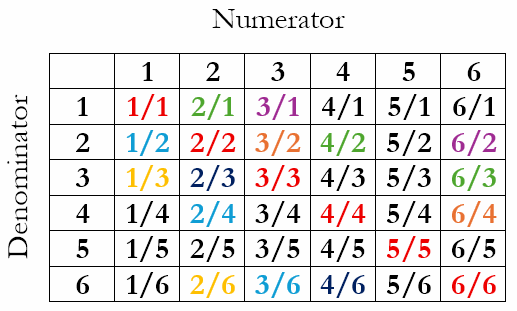
Here, the numerator corresponds to the column while the denominator corresponds to the row. Hence, the element in row 5 and column 3 will be 3/5. Of course, we can have rational numbers that are equal but appear in different cells. This is because we have equivalent fractions. These are indicated above with the same color. Hence, all numbers in red are equivalent to , while all in light green are equivalent to 2, and so on. Now, since each row and each column has an infinite number of elements, we cannot simply go down a row or a column and hope to reach all the rational numbers. For example, if we simply choose to go down the first row, which simply includes all natural numbers, we will never get to row 2! However, as can use a process of diagonalization as shown below
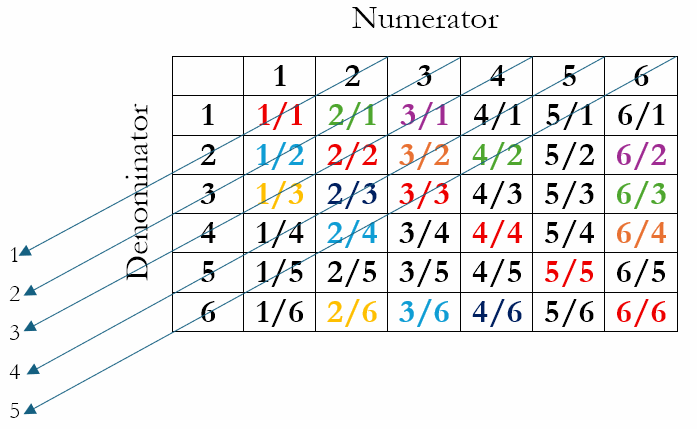
Here we go down the diagonals in the order indicated by the numbers on the left. With this order, the rational numbers are reached in the following order

If we eliminate all the equivalent fractions, we will get
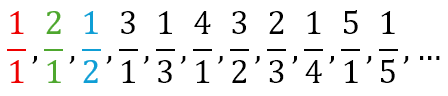
Since the numbers are being reached diagonally, every cell will be reached after a finite number of moves. It is crucial to recognize that the numbers are not arranged in any numerical order. If we include negative numbers, we could do something like

Hence, we can map every rational number, without repetition, to the natural numbers, meaning that the number of rational numbers and the number of natural numbers is the same!
This is obviously counter-intuitive. After all, suppose we consider two consecutive integers, say 1 and 2 for convenience. We can generate rational numbers between 1 and 2 as follows
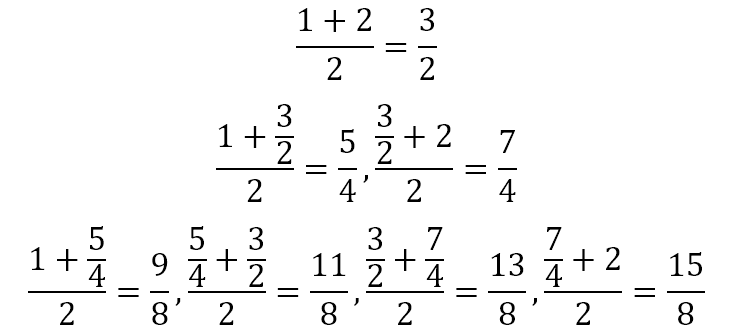
This means that between any two consecutive natural numbers there are infinitely many rational numbers. Despite this, as we have shown, it is possible to map every rational number to a natural number. Let the weirdness of this sink in. Though there are infinitely many rational numbers between any two consecutive natural numbers, there is a way of mapping every rational number to a natural number.
Brief Introduction to Cardinality
The property that between any two rational numbers it is possible to generate at least one more rational number between them constitutes the set of rational numbers as a ‘dense’ set. However, it is clear that the natural numbers are not ‘dense’ since there is no natural number between consecutive natural numbers. Hence, it is strange that a one to one mapping from the rational numbers to the natural numbers exists. In set theory, all sets that share this one to one mapping with the natural numbers are said to have the same cardinality of ℵ0, aleph-nought. Here, ‘cardinality’ gives us a measure of the ‘size’ of the set and ℵ0 is the ‘smallest’ cardinality that a set with infinite members can have. Other sets that have cardinality of ℵ0 are integers, square numbers, cube numbers, constructible numbers, algebraic numbers, etc. If we take the union of all these sets, even this union set would have cardinality of ℵ0 since we can rotate between different sets, ignoring any duplications along the way.
However, cardinality of the real numbers is different because they include other numbers, like the transcendental numbers, making it impossible to map the real numbers to the natural numbers. The cardinality of the real numbers is hypothesized to be ℵ1, the next larger element in the set of alephs. As of now, this is still a hypothesis.
The Perils of Infinity
What we can see is that ‘infinity’ is much weirder than we might ever have imagined. Not only have we seen that it is possible to map one ‘infinity’ (the natural numbers) to an ‘infinity of infinities’ (the rational numbers) but also that there are ‘infinities’ that are ‘infinitely larger’ than the intuitive ‘infinity’ obtained simply by counting upward without end. When students and (shudder) teachers treat ‘infinity’ in a trivial manner as though it were simply a very large number that can be located on the number line, for example by repeating or condoning statements like, “One divided by zero equals infinity,” they reveal that they have failed to understand the fact that the term ‘infinity’ is not used to denote a number but a conglomeration of idea that is itself ‘infinitely’ rich.


Leave a Reply