
The Riddle of the Name
When I was in school, one of my English teachers (unfortunately I do not recall which one) taught us about the punctuation mark known as the ellipsis. An ellipsis is three dots (…) that indicate something is missing. It could a lack of words, such as…, well…, you see…, indicating a person doesn’t have the words to fill up his/her thoughts clearly. Or it could indicate words that are actually missing, such a words in an ancient document for which only a fragment exists. An ellipse, however, is a conic section, a geometric figure. But consider the figure below, which indicates why the conic sections are called ‘conic sections’.
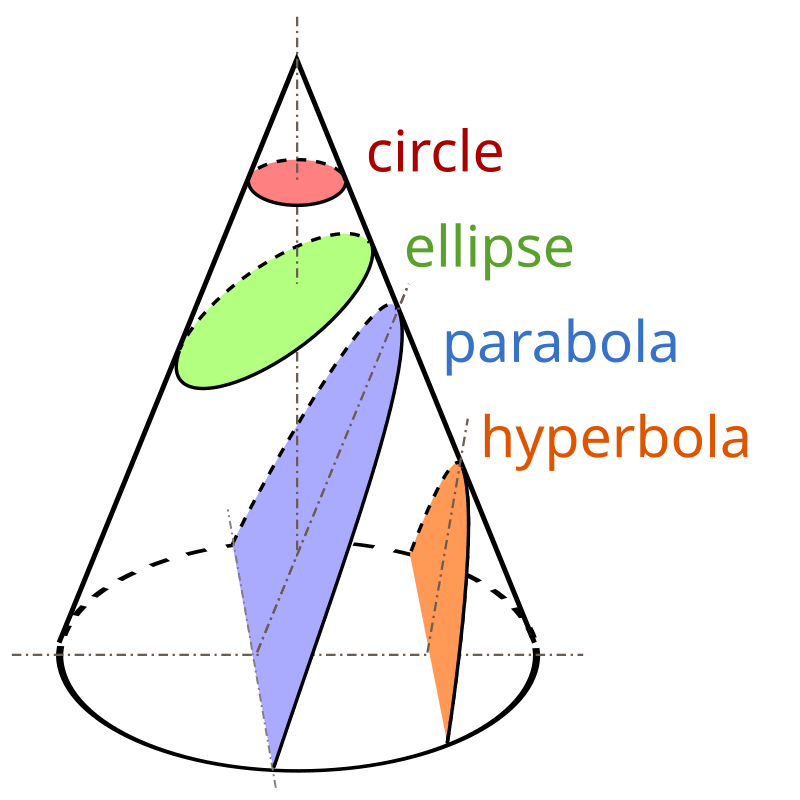
The circle represents a sectioning of the cone at right angles to the axis of the cone (the vertical line in the figure above). The parabola represented a sectioning that is parallel to the edge of the cone. An ellipse represents a ‘falling short’, in that its sectioning is neither at right angles to the axis nor parallel to the edge. And guess what? Both words ‘ellipsis’ and ‘ellipse’ come from the Greek word ἔλλειψις (élleipsis), meaning ‘fall short’ or ‘leave out’.
Defining the Ellipse
As we continue with this series on conic sections, we reach the ellipse. Recall that a conic section is defined as the set of points such that the ratio of the distance of the point to a fixed point, called the focus, to its distance from a fixed line, called the directrix, is a constant. The constant ratio is called the eccentricity of the conic section. We saw that the parabola has an eccentricity equal to 1. An ellipse has an eccentricity that is between 0 and 1.
The Equation of the Ellipse
Let us begin our exploration of the ellipse by deriving its equation in standard form as we did for the parabola. Consider a point, S, given to be the focus of an ellipse and a line, L = 0, given to be the directrix of the ellipse. Let e be the eccentricity of the ellipse. Drop a perpendicular from S onto L and let the foot of the perpendicular be X. Let A divide SX internally in the ratio e:1. Hence, by definition of the ellipse A lies on the ellipse. Let A‘ divide SX externally in the ratio e:1. Hence, by definition of the ellipse A‘ lies on the ellipse. This is shown in the figure below.
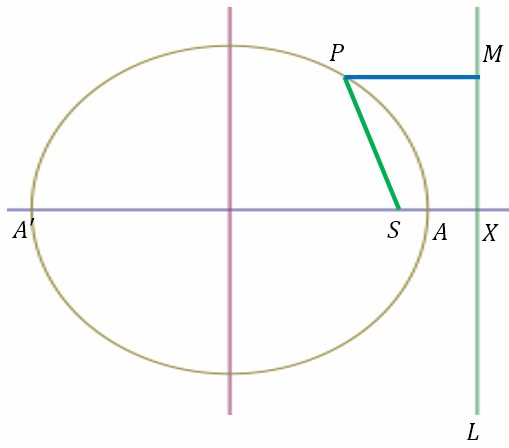
Now, the ellipse has two axes of symmetry, one longer than the other. The longer one is called the major axis and the shorter one the minor axis. Let AA‘ be the major axis of the ellipse. Let O be the midpoint of the ellipse, which we take to be the origin. Let OA produced form the positive x axis. Let the length AA‘ be 2a. Hence, the coordinates of A are (a, 0) and of A‘ are (-a, 0). Let the coordinates of X be (p, 0) and the coordinates of S be (q, 0). Then by section formula for internal and external division in the ratio e:1.

This gives ep + q = a(e + 1) = ae + a and ep – q = –a(e – 1) = –ae + a.
Adding the two equations we get p = a/e and subtracting them we get q = ae. Hence the coordinates of X are (a/e, 0) and the coordinates of S are (ae, 0). Also, the equation of L is x – a/e = 0.
Let P(x, y) be any point on the ellipse. Let M be the foot of the perpendicular from P onto L. Then the coordinates of M are (a/e, y). Then by definition of the ellipse SP = e⋅PM.
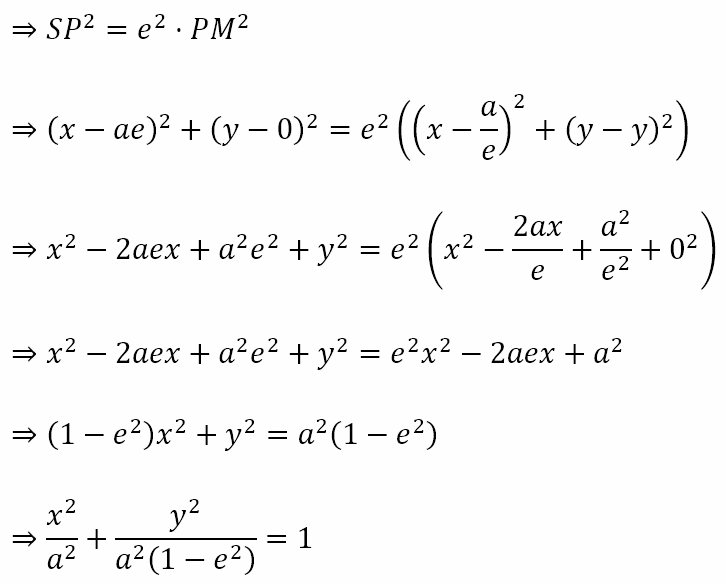
Since this equation is a little cumbersome, let us make the substitution
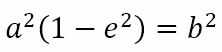
Hence, the equation of the ellipse becomes
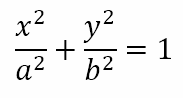
We can observe that the figure is symmetric about both axes. Hence, there will be a second focus and a second directrix. The other focus is S‘ (-ae, 0) and the other directrix is L‘ = x + a/e = 0.
Now, the chord through the focus and perpendicular to the major axis is called the latus rectum. Since, the ellipse has two foci, it will also have two latera recta, whose equations are x – ae = 0 and x + ae = 0.
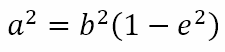
Also, putting x = 0 we get the coordinates of B and B‘, where the ellipse cuts the y axis, to be (0, b) and (0,-b) respectively. Now, here we have assumed that a > b. However, even with a < b we will get the same equation. However, in this case
The Auxiliary Circle
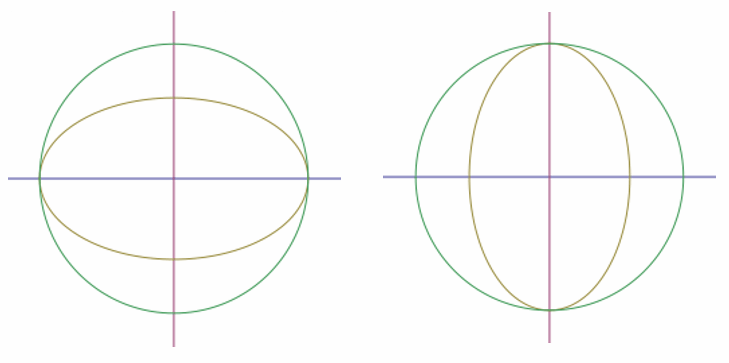
Now, the circle described with the major axis of the ellipse as its diameter is known as the auxiliary circle. For the ellipse with a > b (figure on the left above) its equation is x2 + y2= a2. For the ellipse with a < b (figure on the right above) its equation is x2 + y2= b2.
Parametric Coordinates
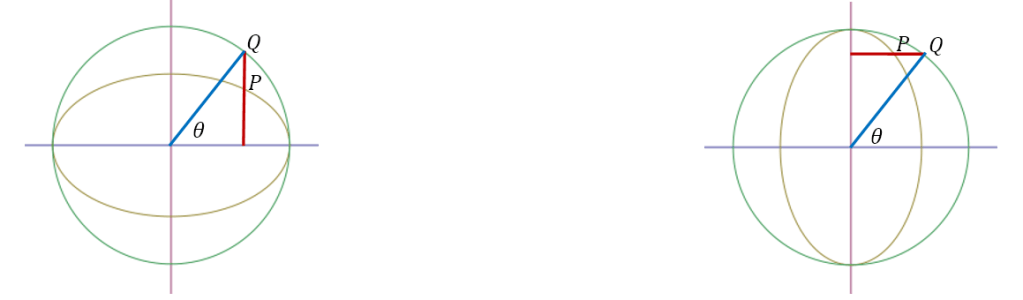
Consider the ellipse x2/a2 + y2/b2 = 1, a > b. Consider a point P on the ellipse. Let the perpendicular to the major axis of the ellipse (here the x axis) meet the auxiliary circle at the point Q(a cosθ, a sinθ ). It is clear then that the x coordinate of P is a cosθ. Substituting this for the x coordinate in the equation of the ellipse we get that the y coordinate is b sinθ. Hence the coordinates of P are (a cosθ, b sinθ), where θ is called the eccentric angle of the point P.
Hence for the ellipse x2/a2 + y2/b2 = 1, a > b, the parametric coordinates are (a cosθ, b sinθ), where θ is the angle made by the radius formed by the point on the auxiliary circle corresponding to the point P (left figure below). Similarly, for the ellipse x2/a2 + y2/b2 = 1, a < b, the parametric coordinates are (a cosθ, b sinθ), where θ is the angle made by the radius formed by the point on the auxiliary circle corresponding to the point P (right figure below).
Equation of the Tangent
Let us proceed to obtain the equation of the tangent at a point on the ellipse. Consider the ellipse x2/a2 + y2/b2 = 1. Differentiating this equation with respect to x we get
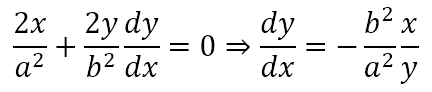
Hence, at the point (x1, y1)
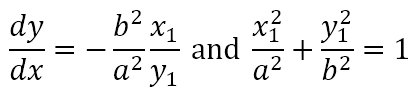
Hence, the equation of the tangent would be
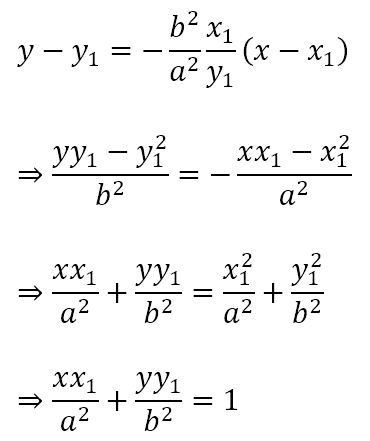
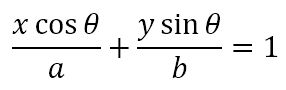
We have already shown that the point (a cosθ, b sinθ ) satisfies the equation x2/a2 + y2/b2 = 1. Hence, the point always lies on the ellipse. Substituting these coordinates in the tangent equation just derived we get
Condition for Tangency
Consider the line y = mx + c and the ellipse x2/a2 + y2/b2 = 1. Solving the two equations we get

If the line is a tangent to the ellipse, the above quadratic equation should have a repeated root which means its discriminant must be zero. Hence,
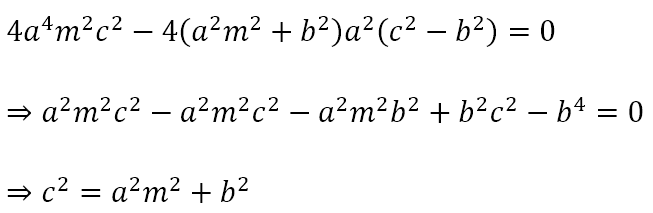
So the line

will always be a tangent to the ellipsex2/a2 + y2/b2 = 1
Return of the Riddle
What we have seen is that the ellipse has similarities to both the parabola and the circle. Its parametric coordinates are very similar to those of the circle. Hence, the condition for tangency is also quite similar to what we saw for the circle. However, given that the circle is a degenerate conic section, we could not derive the equation of the ellipse as we did the equation of the circle. Rather, we had to use the focus and directrix, as we did with the parabola, to obtain the equation of the ellipse. Probably, the fact that the ‘ellipse’ is a ‘shortfall’ between the parabola and the circle is why some of the results related to it use methods similar to those used for the parabola while other results use methods similar to those used in the context of the circle.
In the next post we will look at some more properties of the ellipse, including the chord of contact and the polar. If you have forgotten what those words mean, please refer to Contacting Circular Polarity. And may you not experience any shortfall, except perhaps to be bifocal and hence bidirectional. Make of that what you will!


Leave a Reply