
There are many ill-informed ideas about mathematics. One is that there is a solution to every problem, as suggested by the meme above. This is not true. There are problems that have no solutions. Then there are problems which have solutions, but whose solutions cannot be solved without significant computational power. And there are problems which have solutions but the solutions to which are difficult, if not impossible, to reach even with sophisticated computational power.
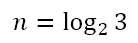
Of course, there are problems which have solutions that can be reached with minimal computational resources but which can also be reached by means of educated guesswork. Note the important qualifier ‘educated’. I’m not talking about taking potshots in the dark, but of a process through which a solution, which would normally elude us through regular analytical approaches without a computer, can be reached quickly with a couple of well-thought-through guesses. In order to explore this, consider this equation I recently came across:
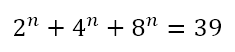

We have to solve for n. Of course, using the laws of exponents, we can write this as
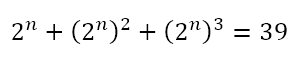
So we want a number the sum of whose first three powers is 39. We can proceed by trying various numbers like
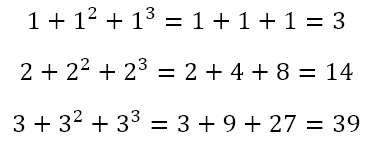
Now we can simply solve the equation

to give
Of course, there was no guarantee that the sum of the first three powers of a natural number would be the value on the right hand side of the equation. After all, the graph of
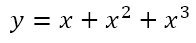
looks like
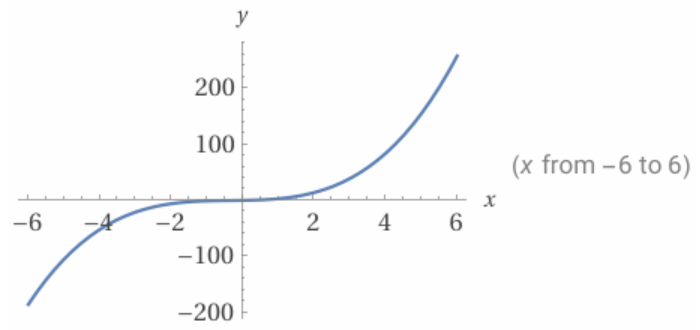
While I have only shown the region from x = -6 to x = +6, the domain of the function is all real numbers. Moreover, the derivative of the function is
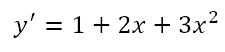
The discriminant of this function is

Since the discriminant is negative, the function is strictly increasing in its domain. Since the function is a cubic, we can conclude that the range is all real numbers. In other words, the equation
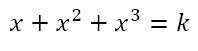
will have a real solution for all real values of k. Hence, we were simply lucky that k = 39 gave us the solution x = 3. What this means is that our guesswork, while in this case fruitful, could have simply been a case of never ending frustration as we tried different values. For example, suppose we had k = 20. Then we would proceed as follows
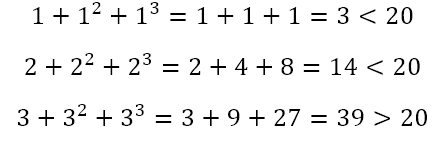
This would mean that the solution is between x = 2 and x= 3. So we can check x = 2.5 to get

This means that the solution is between 2 and 2.5. So we can check for x = 2.25 to get

This means that the solution is between 2.25 and 2.5. So we can check for x = 2.375 to get

We can continue on an on. The exact solution to the equation is

while the solution to 14 decimal places is x ≈ 2.31127130571219. It should be clear that this kind of solution is not practical for a generic equation of the form
Of course, we recognize that the original equation
supposedly appeared in an exam and the students were expected to solve it without using any calculating or computing device. Hence, a numerical solution such as the one I used to solve

is not on the cards. Rather, we recognize that, for a non-calculator question, the value of k must be the sum of the first three powers of some natural number. With this in mind, we could attempt to proceed in a different way. We can first recognize that x, x2, and x3 form a geometric sequence. Hence, we can use the formula for the sum of terms of a geometric sequence to obtain
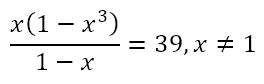
Rearranging this we get
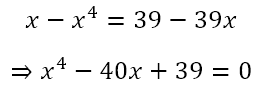
Now, since the sum of the coefficients of this equation is zero, it means that x – 1 is a factor of the left hand side. This gives us

Of course, this means that one of the expressions in parentheses is equal to zero. However, x cannot be equal to 1 since that is excluded as seen above. This yields

which is the same as
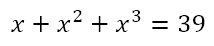
Hence, the method of using the geometric sequence has not led to anything useful. Is there another approach? We can check for patterns by listing the results for the first few natural numbers as seen below.
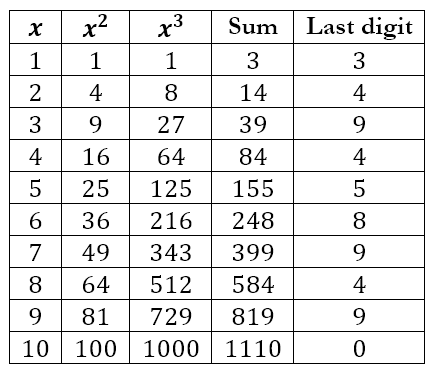
This pattern for the last digit will always be repeated since it depends only on the last digits of each value of x. Hence, we can summarize the table above as follows
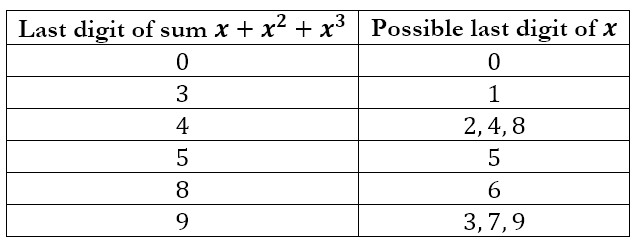
What this tells us is that, if the last digit of k is 1, 2, 6, or 7, then the solution must necessarily be obtained by using some computational device since x will not be a natural number. Of course, this does not guarantee that x will be a natural number if the last digit of k happens to be 0, 3, 4, 5, 8, or 9.
But let us consider some examples that will allow us to make a good informed starting guess. Suppose we are given
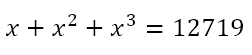
From the last table, we can conclude that, if there is a natural number solution for x, then it must end in 3, 7, or 9. We can also see that 203 = 8,000 and 303 = 27,000. This means that the only possible solutions, if there is a solution, are 23, 27, or 29. Since 12,719 is closer to 8,000, we can guess that x = 23. And if we check this, we will see that it is indeed the solution.
Now suppose we are given
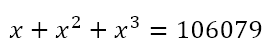
Again from the table, we can conclude that the solution, if it exists, must end in 3, 7, or 9. Also, 403 = 64,000 and 503 = 125,000. Hence, the solution is 43, 47, or 49. Since 106,079 is closer to 125,000 than to 64,000, we can guess that the solution is 47. After all, 49 is so close to 50 that we would expect a sum that is even closer to 125,000 than 106,079 is. And indeed 47 is the solution.
Let’s try one more example. Suppose we are given

From the table we can conclude that the solution, if it exists, must end in 2, 4, or 8. Now 603 = 216,000 and 703 = 343000. Hence, the solution must be 62, 64, or 68. Since 266,304 is about a third of the way between 216,000 and 343,000, we guess 64, which turns out to be the correct solution.
But what if we are given

The table would suggest that the solution, if it exists, must end with 1. Also, since 403 = 64,000 and 503 = 125,000, we might think that the solution would be x = 41. Moreover, since 68,073 is quite close to 64,000, we might think that this confirms that x = 41. However,

meaning that x = 41 is not the solution. With a computing engine we can obtain x ≈ 40.4924277600178.
Now, the original equation was
Keeping this form, suppose we consider the equation

Making the substitution
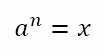
we can convert the equation to
Now, we can use the method we have discussed above to guess a likely solution for x. If it so happens that we are given an appropriate value of k, which is actually the sum of the first three powers of a natural number, then we will be able to find the solution for x without too much trouble. Then we can obtain
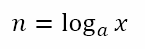
as the solution to the given equation.
Why don’t you try it? You are given

What is the exact value of n? There is a natural number solution to this. Can you reach it with just one guess as indicated in the process above?
 Acutely Obtuse
Leave a comment