
My annual stint of grading IB papers started this week. So I will tackle only a relatively simple problem today. I will take a break for about three weeks while I am grading papers and resume after that. I recently came across the problem depicted below.
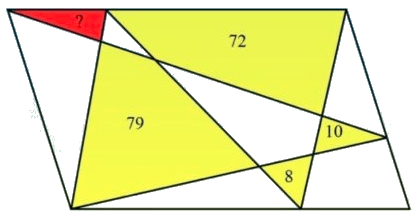
We are given that the external quadrilateral is a parallelogram and have to determine the area of the red region. Let us begin by labeling some of the vertices and the different regions. This is shown below.
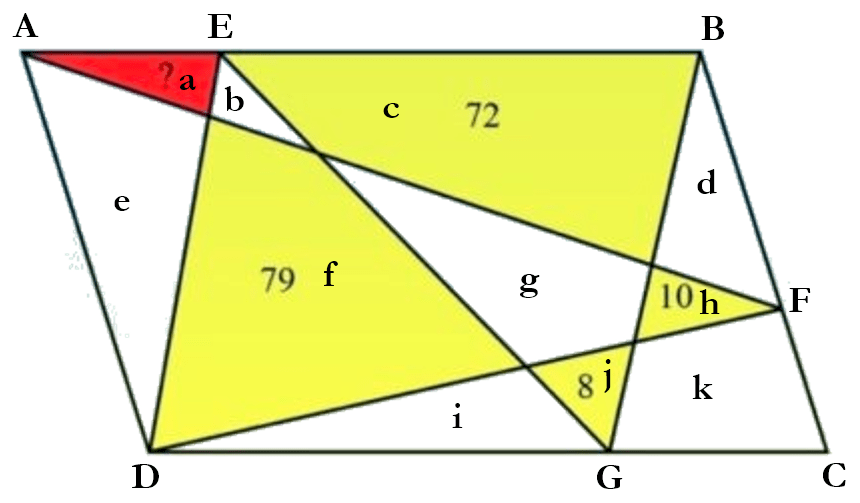
In the figure above, the lower case letters represent the areas of the regions. Hence, the region labeled ‘a’ has an area equal to a.
Now, the area of ΔAFD will be half the area of the entire parallelogram. Similarly, the areas of ΔABF and ΔDFC will add up to half the area of the parallelogram. Hence, we can obtain
a + b + c + d + i + j + k = e + f + g + h (1)
Also, the areas of ΔAED and ΔEBG will add up to half the area of the parallelogram. And the same can be said about the sum of the areas of ΔEDG and ΔBGC. Hence, we obtain
a + c + e + g + j = b + d + f + h + i + k (2)
Adding the two equations gives us
2a + b + 2c + d + e + g + i + 2j + k = b + d + e + 2f + g + 2h + i + k
Cancelling the terms that appear on both sides of the equation gives us
2a + 2c + 2j = 2f + 2h
This means that
a = (f + h) – (c + j) = (79 + 10) – (72 + 8) = 9


Leave a Reply