
We continue with our study of triangles in this post. We will consider a few elementary rules related to triangles. I will also give some comments on what we can glean from some of the rules. Here, I wish to apologize to the reader. Typesetting mathematical formulas using HTML is too tedious. Hence, I have typeset them using MS Word and have just included images of the derivations.
Sine Rule
The first set of relations we will derive are known as the sine rule. We use the properties that
- the angle subtended by a chord of a circle at the center of the circle is twice the angle subtended at the circumference of the circle and
- the altitude from the apex of an isosceles triangle to the opposite side bisects the opposite side.
We first consider the case of an acute angled triangle, shown below.
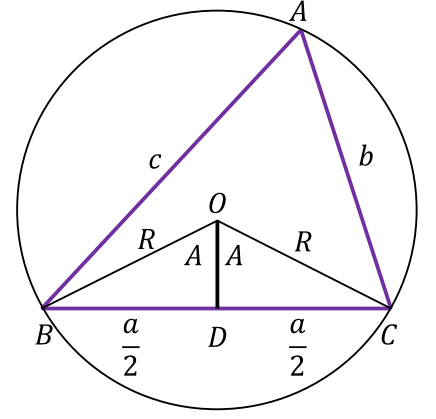
Here, ABC is the triangle and the circle is its circumcircle, meaning that O is the circumcenter. We consider the chord BC and hence ∠BOC = 2 ∠BAC. Also, since OB and OC are radii of the circle, triangle OBC is isosceles. Also, since OD is the altitude from O to BC, BD = CD. Hence, triangle OBD is right angled at D. This gives us
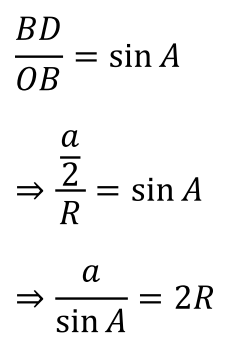
In a similar way we can prove
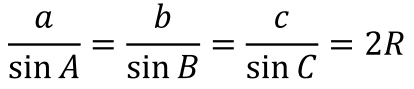
If triangle ABC is right angled at A, we get the following diagram
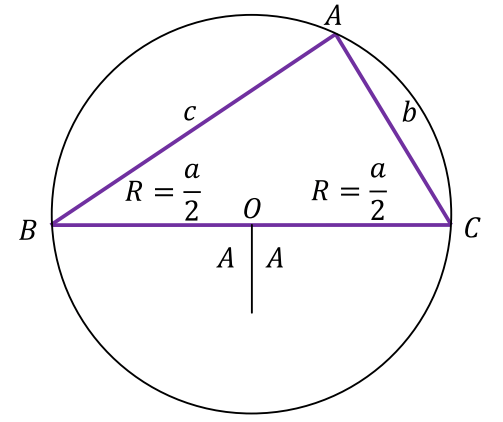
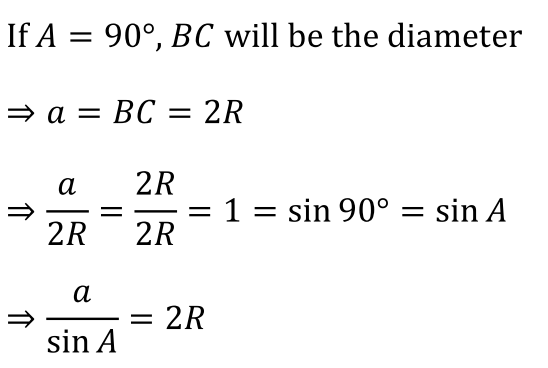
The other relations can be derived in similar way when the right angle is at B or C.
When triangle ABC has an obtuse angle at A we get the following diagram
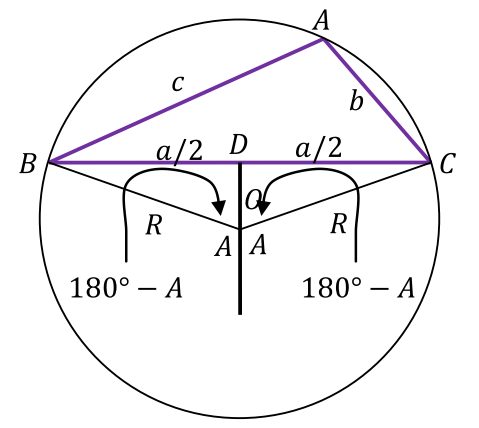
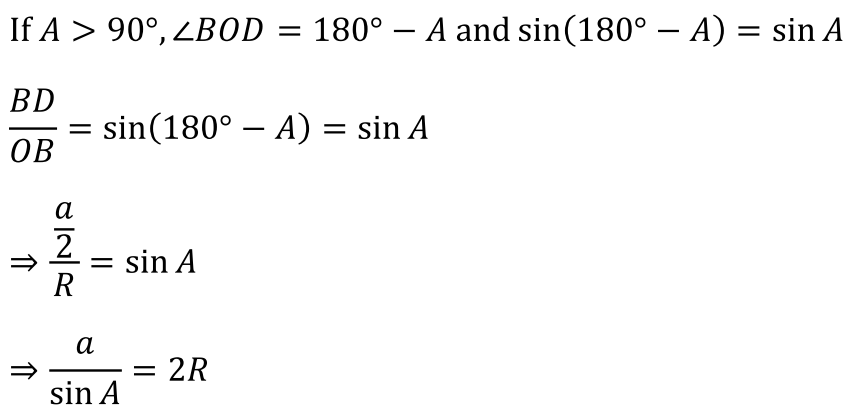
The other relations can be derived in similar way when the obtuse angle is at B or C.
In all three cases, whether the triangle is acute, right, or obtuse angled, we have obtained
The sine rule indicates that the ratio of the length of a side to the sine of the angle opposite the side is a fixed for a given triangle. This means that the longer the side the larger must be the sine of the angle opposite the side. And since the sine function is an increasing function, this means that the side opposite larger angles must be longer, which is a fundamental theorem of geometry.
Cosine Rule
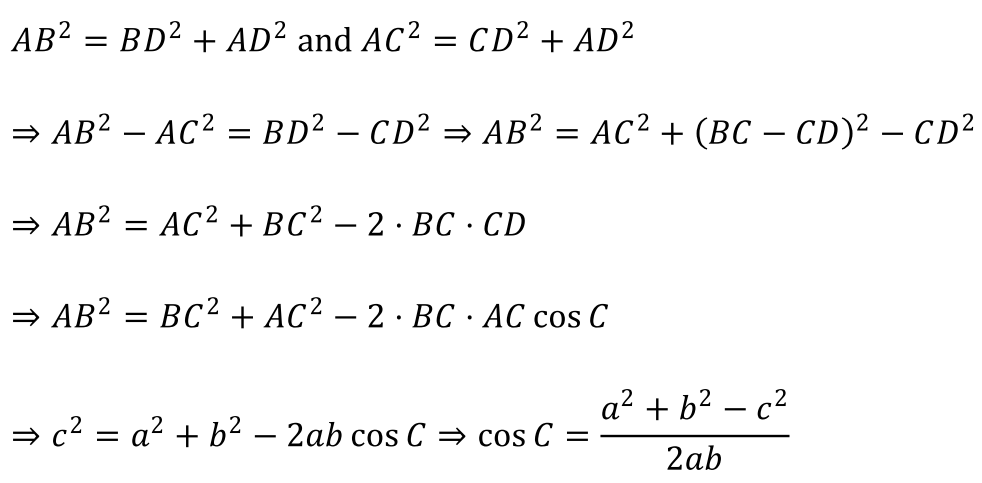
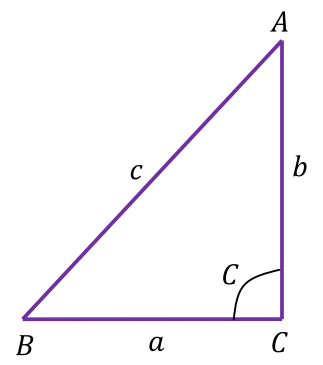
The second set of rules is known as the cosine rule. Again we have three cases.
If C is an acute angle then, with reference to the figure below
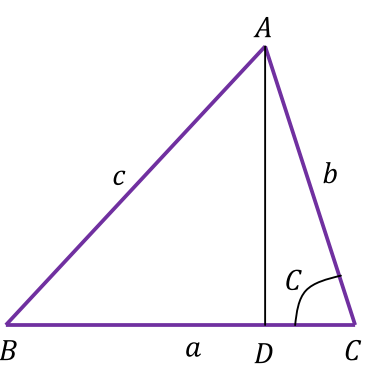
If C is a right angle then, with reference to the figure below,
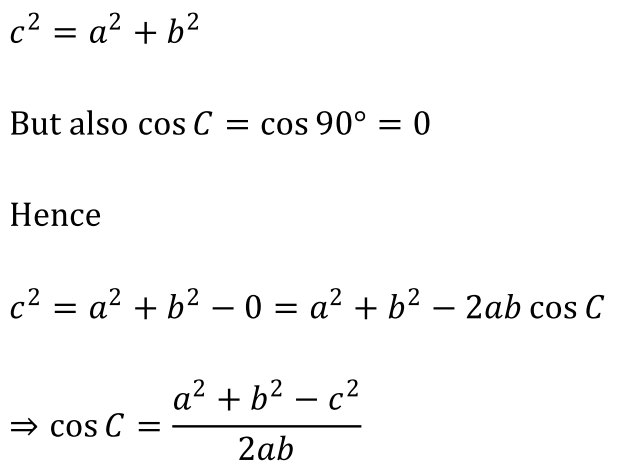
If C is obtuse then, with reference to the figure below,
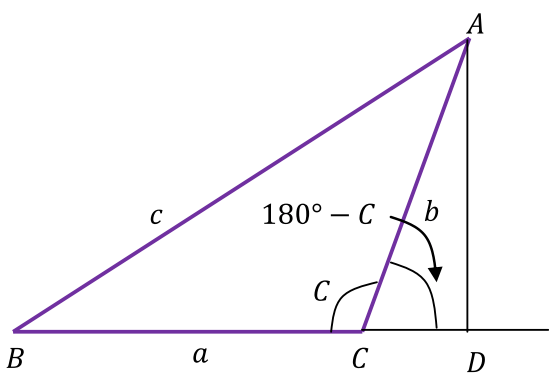
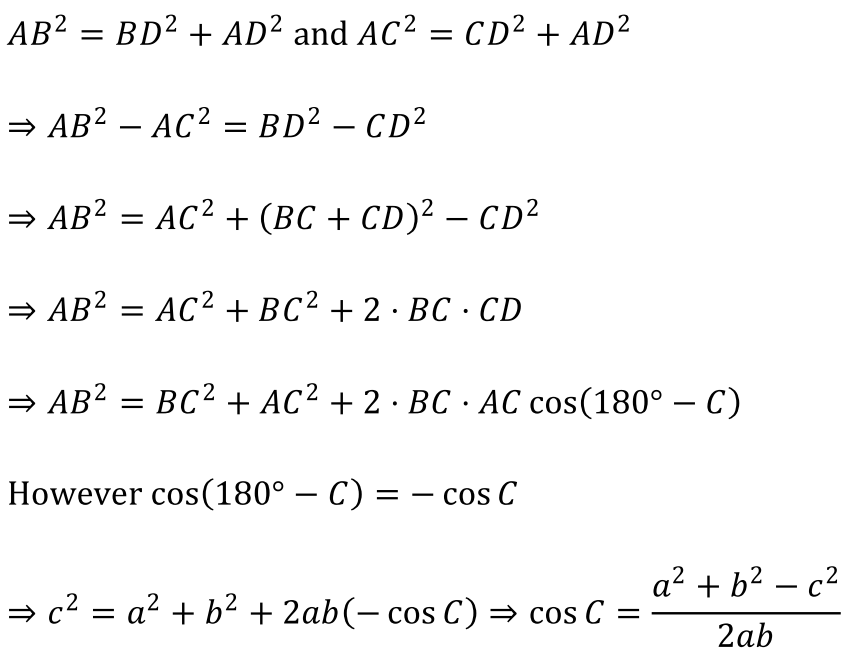
The cosine rule can be summarized as

The cosine rule has the square of the side opposite an angle being subtracted in the numerator. This means that the longer the opposite side, the smaller the cosine. And since the cosine function is a decreasing function, this means that the smaller cosine maps to a larger angle. In other words, the cosine rule too tells us that the side opposite the larger angle is the longer side.
Projection Rule
The third set of rules is the projection rule. Again, we have three cases.
If C is acute then, with reference to the figure below,
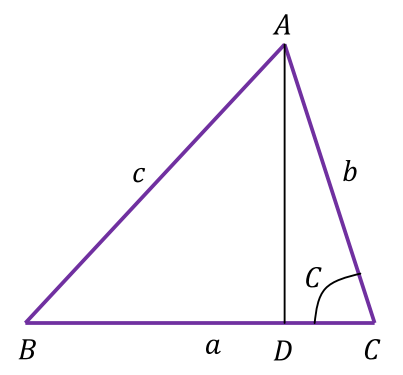
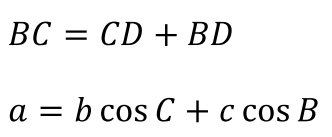
Here, CD is the ‘projection of CA onto BC, while BD is the ‘projection’ of BA onto BC, which is why this rule is so named.
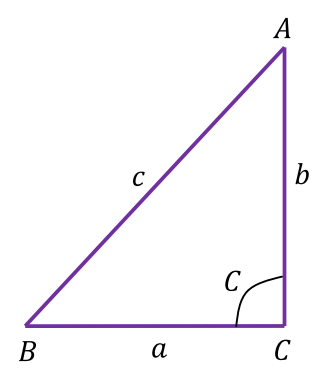
If C is a right angle then, with reference to the figure below,
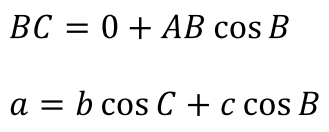
If C is an obtuse angle then, with reference to the figure below,
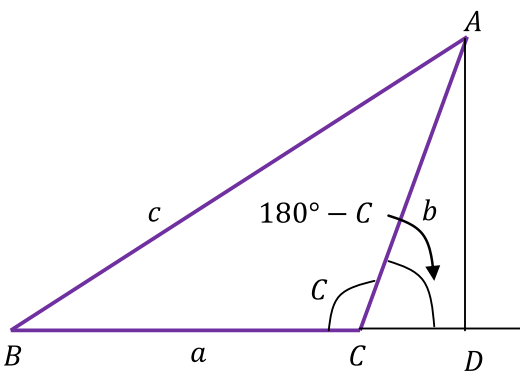
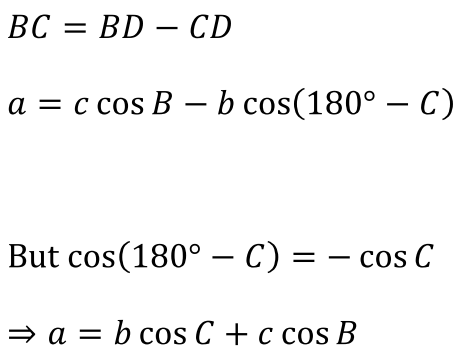
We have proved the projection rule for all three cases for C. Hence, we can obtain

Napier’s Analogy
The fourth set of rules is known as Napier’s analogy. Now, by the sine rule we have
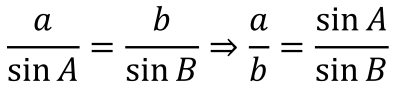
We now use an algebraic process known as componendo-dividendo. Let me explain this briefly.
Suppose we know that

Then, we can conclude that
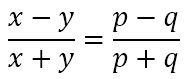
Let us prove this before we proceed with Napier’s analogy.
Suppose
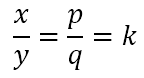
Then
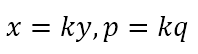
This gives us
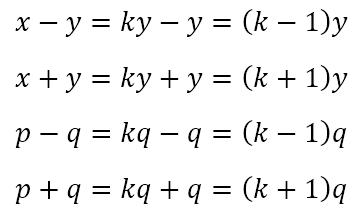
From this we can obtain
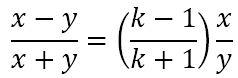
and
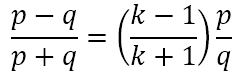
Since
we can conclude that
Now, returning to Napier’s analogy, we have
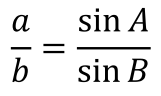
This means that
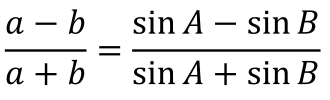
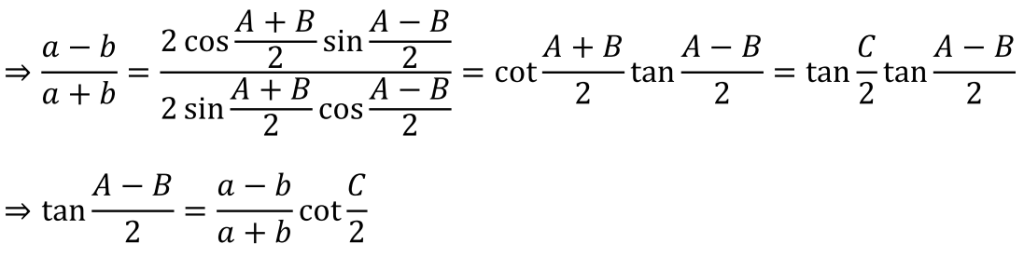
Hence, we can conclude that

Half Angle Formula – Sines
The fifth set of rules are the formulas for the sines of half the angles of the triangle. Using the cosine rule we can obtain
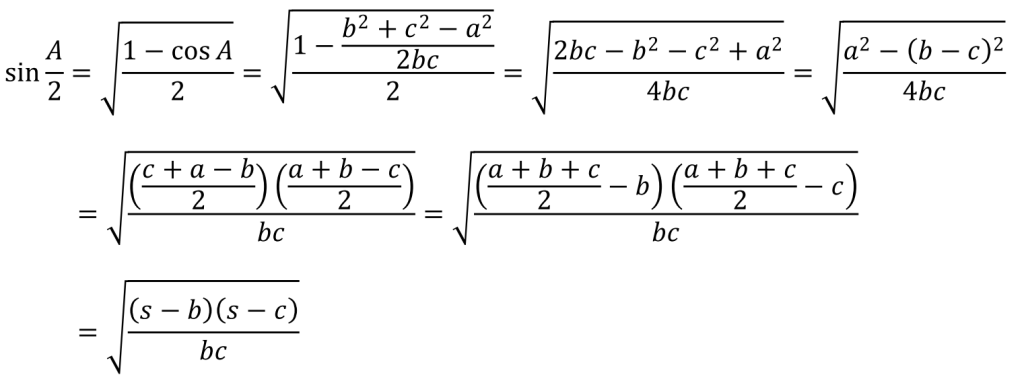
Hence, we can collate this as

Half Angle Formula – Cosines
The sixth set of rules are the formulas for the cosines of half the angles of the triangle. Once again, using the cosine rule we get
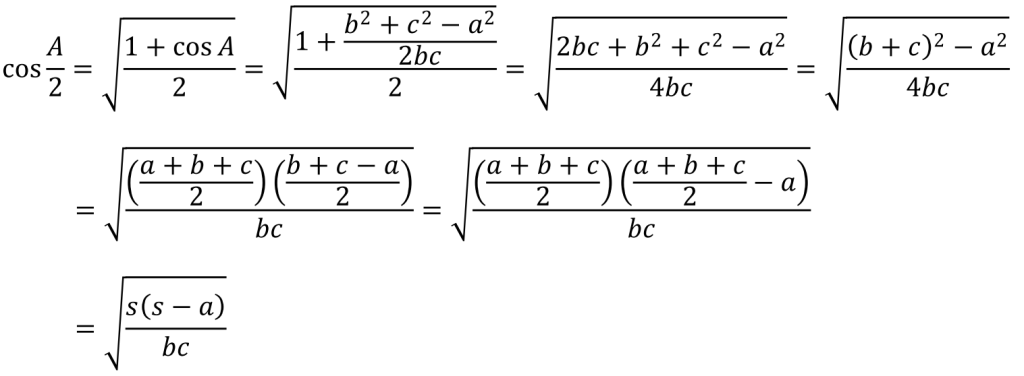
We can collate this as

Half Angle Formula – Tangents
We can combine the previous two results to get
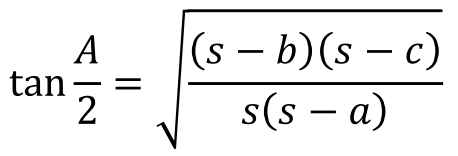
This gives us

Area of Triangle
We know that the area of a triangle is half the product of its base and its height. The figures below show the cases where C is acute, right, and obtuse. In each case it is clear that the height of the triangle is b sin C = c sin B, which is simply a rearrangement of the sine rule. The base of the triangle is a. Hence, the area of the triangle is
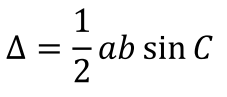
We can understand this as half the product of two sides and the sine of the angle included between the two sides. This gives us

Also, since

which gives us
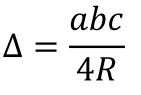
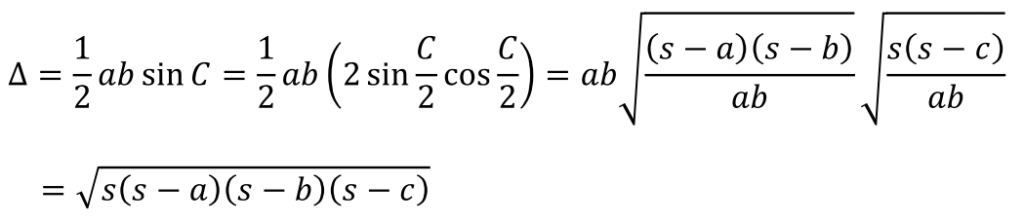
We can also obtain Heron’s formula as follows
We have obtained many basic formulas related to triangles in this post. In the next post, we will obtain formulas relating the radii of various circles to the lengths of sides and trigonometric ratios of the angles of the triangle. However, since I am traveling this week, I will not be posting anything next week. I will resume on 30 October 2026.


Leave a Reply