
In the previous post, Primer to Properties of Triangles, I had solved a geometry problem based on properties of the equilateral and right-angled triangles. I promised that I would use that as a launching pad for a series on Properties of Triangles. Students of mathematics are introduced to triangles and circles quite early in their schooling. And these geometric figures recur over the years with deeper concepts being introduced every time. Hence, even though students are introduced to the name and some basic properties of these figures as early as Grade 1, they find themselves still learning about them in Grade 12! I would like us to go on that journey, albeit in a much more accelerated manner, and beyond, addressing some arcane properties that are rarely taught in school. This series deals with triangles. We will consider circles in a later series. In this post, I only wish to take us though the nomenclature we will follow while discussing the various features related to the triangle ABC.
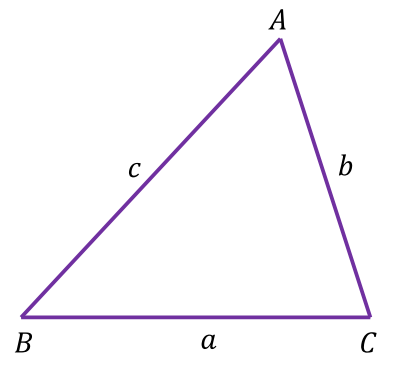
A triangle, of course, is a simple closed geometric figure composed of three line segments that form three angles. We will use the following convention when speaking of sides and angles of a triangle. For the triangle ABC, the vertices will be denoted using the corresponding letters A, B, and C. The measures of the internal angles of the triangle will also be denoted with the italicized upper case A, B, and C. The sides will be denoted using the letters of the vertices that form the endpoints of the side. The length of the side opposite a given vertex will be denoted with the lower case a, b, and c.
Hence, a is the length of BC, b the length of CA, and c the length of AB. Note that I denoted a side as CA rather than as AC. This is to preserve the cyclical order of the vertices, which will become important later when we need to memorize increasingly complicated formulas. Using this convention, we have the following figure.
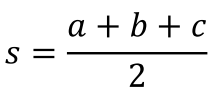
In many of the formulas we will derive, another quantity, namely the semi-perimeter will feature prominently. The perimeter of a triangle, of course, is the sum of the lengths of the three sides. The semi-perimeter, therefore, is half the perimeter. In particular, we have
Of course, each triangle has three sides and three angles, leading to some relationships between them. Due to this, triangles can be classified either by the relationships between their sides or their angles.
If all three sides of a triangle are equal in length, then the triangle is said to be equilateral. If two sides of a triangle are equal in length, then the triangle is said to be isosceles. And if all three sides are of different lengths, the triangle is said to be scalene.
If all three angles of a triangle are acute, it is said to be an acute-angled triangle. If one angle of a triangle is a right angle, it is called a right-angled triangle. And if one angle of a triangle is obtuse, it is an obtuse-angled triangle.
Now, this series on Properties of Triangles will require a considerable amount of trigonometry. Hence, I suggest you read My Trigger, No Metric, Beginnings, A Mathematical Partnership, Round and Round, Trigonometric Identity Crises, The Trigonometric Turntable, and Concluding Uncomplex Pitstop, in which I took a pitstop in the series on complex numbers to introduce us to the basics of trigonometry.
We will also be dealing with some ‘centers’ of triangles in our exploration. Let us proceed to define these.
A perpendicular bisector of a side of a triangle is the line passing through the midpoint of the side and that is perpendicular to the given side. By definition, any point on the perpendicular bisector is equidistant from the vertices that form the side. Hence, any point on the perpendicular bisector of AB will be equidistant from A and B. Now, the three perpendicular bisectors of the sides of a triangle intersect at a point called the circumcenter, which we will denote with O. It is called this because, with O as the center and radius equal to the distance between O and any vertex, you can draw a circle that circumscribes the triangle. That is, every part of the triangle will be inside the circle, with the vertices on the circumference of the circle. This circle is known as the circumcircle and its radius is the circumradius, denoted with R.
Similarly, an angle bisector of an angle of a triangle is the line passing through the corresponding vertex that divides the internal angle at the vertex into two equal halves. By definition, any point on the angle bisector is equidistant from the arms that form the angle. Hence, any point on the angle bisector of angle A is equidistant from CA and AB. (Note again the order in which I chose to list the sides. Always A to B to C to A.) The three angle bisectors of the angles of a triangle intersect at a point called the incenter, which we will denote with I. It is called this because, with I as the center and radius equal to the perpendicular distance between I and any side, you can draw a circle that inscribes the triangle. That is, every part of the circle will be inside the triangle, with the three points of tangency lying on the triangle. This circle is called the incircle and its radius is the inradius, denoted with r.
Now, if we join a vertex of a triangle to the midpoint of the opposite side, we get a median. We will denote the midpoints with letters D, E, and F, D being opposite A, E opposite B, and F opposite C. Hence, the three medians are AD, BE, and CF. The three medians intersect at a point known as the centroid, which we will denote with G. A property of the centroid is that it divides each median in the ratio 2:1, with the large part being between the vertex and the centroid. Hence, G divides AD such that AG:GD = 2:1.
Now, a line passing through a vertex and perpendicular to the opposite side is called an altitude. The three altitudes of a triangle intersect at the orthocenter, denoted with H. The points where the orthogonals meet the opposite side are known as the feet of the perpendiculars, denoted with L, M, and N. Hence, AL, BM, and CN are the altitudes of triangle ABC.
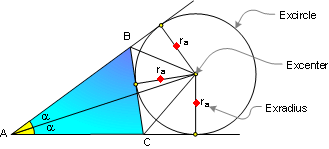
Now, if we produce the line from a vertex beyond the next vertex, we form external angles of a triangle. For example, producing AB beyond B forms an external angle outside the triangle with BC as one of its arms. Similarly, producing AC beyond C forms a second external angle outside the triangle with BC as one of its arms. The bisectors of these two external angles and the bisector of angle A intersect at an excenter, denoted by IA. Similarly, the excenters opposite B and C are denoted by IB and IC respectively. With I1 as center and radius equal to the distance of IA from BC, a circle can be drawn that touches the two produced arms. This circle is known as an excircle. A triangle has three excircles. The radii of these three circles will be denoted as rA, rB, and rC.
If you wish to see how the various centers and circles change, check out this Geogebra app. All the centers and circles are there except the excenters and excircles. Enjoy!


Leave a Reply