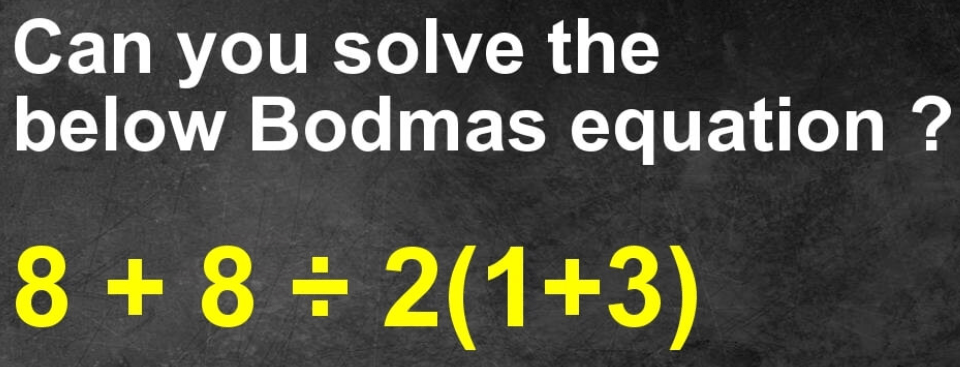
• Order! Order!

    Common BODMAS/BEDMAS ‘conundrum’ (Source: Genius Puzzles)

    As a mathematics teacher, I primarily teach students in high school, preferring, within this group, to teach grades 11 and 12. There are two reasons for this. First, mathematics taught in grades 11 and 12 is complex enough to allow for interesting nuancing of the ideas and also blending of the various areas like algebra, geometry, trigonometry, statistics and probability, and calculus. Prior to that the concepts are too superficial to allow for such unrestrained exploration. Second, I really do not know how to handle students who are younger than 14.

    Anyway, one year I was feeling somewhat adventurous and agreed to teach students in grade 6. This was the academic year 2016-2017. The kids were, as expected, difficult to handle. However, what I was surprised with was the fact that most of them were very weak with order of operations. For those of you who are confused about this terminology, perhaps BODMAS or PEMDAS or some such six letter variation might prove to be a reminder.

    In the above, ‘M’ stands for ‘multiplication’, ‘D’ for ‘division’, ‘A’ for ‘addition’, and ‘S’ for ‘subtraction’. Those are the letters that do not change, even though D and M often swap positions. We will see why shortly. However, the first two letters have some variety. The first letter varies between ‘B’ for ‘brackets’, ‘P’ for ‘parentheses’, and ‘G’ for ‘grouping’. The second letter varies between ‘O’ for ‘orders’, ‘E’ for ‘exponents’, and ‘I’ for ‘indices’. So, we can get 18 variations of these letters, all of which essentially give the same sequence for performing operations. However, whether we call it BODMAS or PEMDAS or GIDMAS, whatever does it mean? And, more importantly, why do we have such an ordering?

    Mathematics aims for consistency. In other words, if 2 people perform the same set of operations accurately, we expect them to obtain the same answer. We will see how this desire for consistency is at the root of BEDMAS. I will use BEDMAS because I think ‘O’ for ‘orders’ is weird since we never call the exponentiation operation by that name anywhere else. Also, ‘G’ for ‘grouping’ is vague and is also not common terminology. So how does BEDMAS give us the consistency we aim for?

    Testing for Consistency

    We begin with the most basic operation – addition. And we know that 2 + 3 and 3 + 2 gives us 5. We call this property the commutative property. Hence, we say that addition is commutative. This means that, given any two numbers, say a and b, a + b = b + a. When we consider subtraction, however, we get a different result because 2 – 3 is not the same as 3 – 2. In fact, the first is -1 while the second is 1. We can actually generalize this to say that ab and ba are negatives of each other. We often say that subtraction is anticommutative.

    When we move to multiplication and division, we see quite similar things. For example, we realize that multiplication is commutative because a × b = b × a. However, we say that division is noncommutative because a ÷ b and b ÷ a are not negatives of each other but reciprocals of each other.

    We have, therefore, seen how the four basic operations function. Now we have to ensure that our sequence of operations maintains this feature.

    So let us consider 2 + 5 × 3. Since we normally perform operations from left to right, let us do this here. Let us also give preference to the addition operation and perform it before multiplication. With this approach, we will first add 2 and 5 to get 7 and them multiply by 3 to get 21. However, we know that addition is commutative. Hence, if it was true that we should do the addition first, we should get the same answer if we did 5 + 2 × 3. This does prove to be the case. However, we know that multiplication is commutative. So swapping the 3 and the 7 (from 2 + 5 or 5 + 2) should give us the same answer. Now we have 3 × 2 + 5. But this gives us 6 + 5 = 11. And if we swap the 2 and 5 we have 3 × 5 + 2, which gives us 17.

    Since we are getting different answers with different approaches, let us now give precedence to multiplication over addition. Hence, if we are given 2 + 5 × 3, then we need to perform the multiplication first, to get 2 + 15, which then gives us 17. But again, we recognize that addition is commutative. So, we could write 5 + 2 × 3, which gives 11 if we perform the multiplication first.

    What we can see is that there is no sequence that is inherent to the operations themselves. After all, multiplication itself is ‘repeated addition’! So one would not expect anything inherent to the two operations than can actually make a distinction between them.

    An Alternate Convention

    But what this means is that we need to decide upon a ‘convention’ that all of us will follow, which will remove the ambiguity concerning which operations need to be done first and which ones last.

    For example, we could propose an alternate order, namely SAMD, just for the four primary operations. Then if we have to calculate 4 – 5 × 6 + 8, we would perform the subtraction first, to get -1 × 6 + 8. Then we would perform the addition, resulting in -1 × 48. Finally, we would perform the multiplication to get -48. Similarly, if we had 6 – 2 × 3 ÷ 4, we could get the following steps 4 × 3 ÷ 4 = 12 ÷ 4 = 3. As long as everyone followed the convention we would all get the same answer all the time.

    The Need for Conventions

    Conventions are crucial in any area of knowledge. For example, in the sentence, “The cat climbed the tree” it is only by convention that we accept that ‘the cat’ is the subject of the verb ‘to climb’, which ‘the tree’ is the object. There is nothing inherent to the order of the words that tell us this. That is why in many languages, the adjective comes after the noun it qualifies, while in English it comes before.

    Similarly, in chemistry we may come across the symbol Na2CO3. Only convention tell us that Na represents Sodium, C represents Carbon and O represents Oxygen. Only convention tells us that the subscripted 2 and 3 indicate the number of atoms of the element preceding it that constitutes the molecule.

    The same is true about mathematics. The symbols do not interpret themselves. We need to accept conventions that everyone agrees to follow in order to communicate mathematical knowledge reliably.

    Unfortunately, most of us mathematics teachers do not recognize the complete arbitrariness of the order of operations since we have become so used to the convention that we cannot see it as arbitrary. However, as I have attempted to show, mathematicians could have adopted another convention for the order of operations without there being any confusion. I think that, if mathematics teachers spent some time asking students to arrive at a new convention they could follow for a time, it might be a good exercise in helping students realize that there is a consensus that has been adopted, which everyone needs to follow so that we can communicate mathematical ideas reliably and without confusion.
  • Down Memory Lane

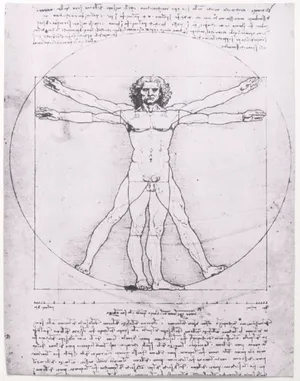
    The Vitruvian Man by Leonardo da Vinci (Source: Britannica)

    Just recently, while introducing me for a talk, someone stated that I have two loves – theology and mathematics. This is a reasonably accurate statement and I blog about these two areas regularly. I have been quite open about both of these with my students too. Hence, even though I am their mathematics teacher, they all know that I am also a pastor and that I think about theological issues. As a result many students often ask me questions related to issues outside the immediate sphere of mathematics.

    Hence, way back in 2006, shortly after the movie was released, some students asked me about my take on The Da Vinci Code. Some of them, inspired by the movie, had started reading the novel by Dan Brown and had observed some differences between the book and the movie. They wanted to know which version was correct.

    I had to disabuse – or at least attempt to disabuse – them of the notion that either the book or the movie had anything that could be considered historically reliable. Secret societies and hidden genealogies are all well and good for a novel, but they hardly hold up to rigorous scrutiny.

    In 2006 I had neither seen the movie nor read the book. My work schedule only permitted time for one ‘distraction’ and, at that time, J. K. Rowling was regaling me with the adventures at Hogwarts, both on the page and on the screen. Having had a late start with the adventures of Harry, I was attempting to catch up and finish reading till the Half Blood Prince before the Deathly Hallows was scheduled to be published the next year.

    One of my student expressed disbelief that I had not read the novel by Brown. She showed me the illustration of The Vitruvian Man in the novel and asked me how I, as a mathematics teacher, was not intrigued by the proportions of the human body that the drawing indicated. I had to tell her that, since humans come in all shapes and sizes, there is no ideal proportions for the body. After reading a bit about the Vitruvian man, I had to tell her that this was some idealized set of proportions that might have held some appeal for da Vinci, but that this does not mean it was some universal principle.

    The Golden Ratio

    She also expressed some interest in learning about the Golden Ratio, which she believed to reside in the drawing. But I had to tell her that this was impossible since da Vinci was working with ratios of whole numbers, which meant that he was not working with the Golden Ratio since the ratio is an irrational number. In this blog, I have dealt with two other irrational numbers at length – e and π. The Golden Ratio is a different sort of irrational number. Unlike e and π, which are both transcendental irrational numbers, the Golden Ratio is an algebraic irrational number.

    Of course, here we come across something very strange. There are people who claim that the Golden Ratio has some inherent aspect of beauty to it and that, therefore, many artists use it in their art. Let me be very blunt. Even if it is the case that the work of some artists might seem to indicate that there are some ratio similar to the Golden Ratio, and even if some artists today might be intentionally trying to include the Golden Ratio in their work, there is absolutely no justification, from a mathematical perspective, to think that there is any truth to such claims. In order to justify my assertion, let us consider what the Golden Ratio is.

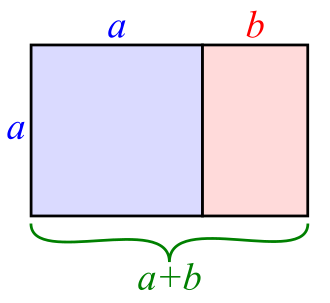
    Suppose we have a rectangle with smaller side of length a and larger side having a length a + b. Now suppose we cut off a square of side length a from the rectangle. This would leave a rectangle with sides of length a and b. This is shown in the diagrams below

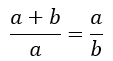
    Now if the ratio of the lengths of the sides of the original rectangle is the same as the ratio of the lengths of the sides of the smaller rectangle, then we say that the ratio of the lengths of the sides is the Golden Ratio. This gives us the equation

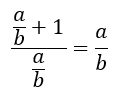
    Dividing the numerator and denominator of the left fraction by b we get

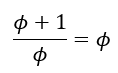
    Denoting a/b as ɸ we get

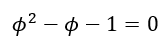
    This can be rearranged to give the quadratic equation

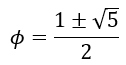
    Using the quadratic formula, we can obtain

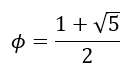
    Since ɸ is a ratio of lengths, it cannot be negative. Hence, ignoring the negative root above we get

    Using a calculator, we can obtain ɸ = 1.618033989…. The presence of the square root of 5 in the expression for ɸ indicates that it is an irrational number, as I claimed earlier.

    An Oft-Repeated Claim

    However, the irrationality of the ratio cannot be the only reason for which I reject the claims about its prevalence in art. After all, the diagonal of a unit square is 2, which is also irrational. Similarly, the ratio of the distance between parallel sides of a regular hexagon to the length of the sides is 3. While artists, in general, may not use geometric figures in their art, it would be fallacious for me to discount the presence of some ratio simply on the grounds that it is irrational.

    The claims about art do not come on their own. Rather, there is the prior claim that the Golden Ratio occurs often in nature. This is a bald-faced lie. After all, what can we observe in nature but discrete occurrences of phenomena? That is, we can count certain things. For example, it is claimed that, if we count bands of fruitlets on pineapples, we will count 5, 8, or 13 bands for small pineapples or 8, 13, and 21 bands for larger ones. So what?

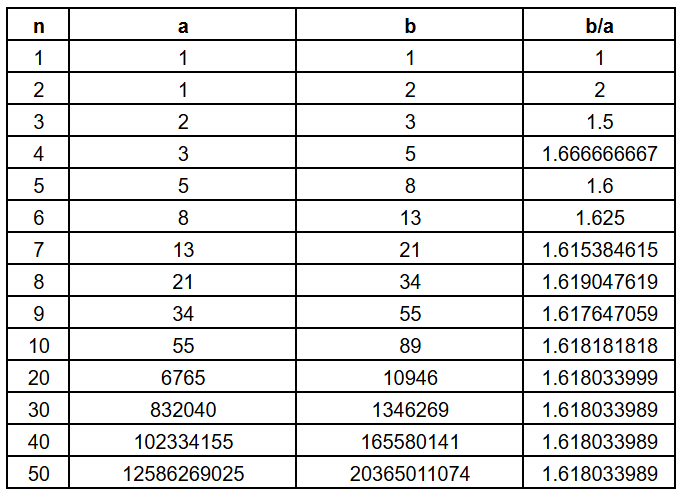
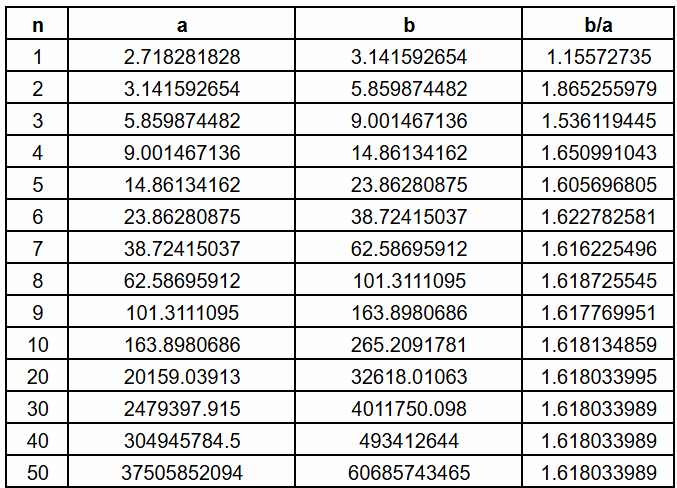
    Well, these numbers are consecutive numbers in the Fibonacci sequence. And if we take the ratio of consecutive terms in the sequence, the ratio will turn out to more closely approximate ɸ. For example, see the table below

    I have collapsed many of the rows so that the table could fit and be readable in a single screen. However, the table shows that the terms in the fourth column converge to the value of ɸ indicated earlier. It is crucial, however, to note that, while the ratio in the fourth column do converge to the value of ɸ, they will never be equal to ɸ because the ratios are rational numbers while ɸ is irrational.

    Debunking the Claim

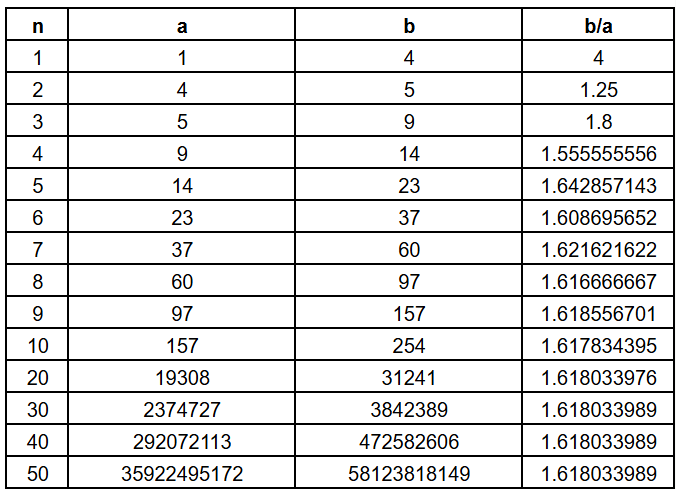
    But that’s not my beef with the earlier claims. Let us start the sequence with different numbers. Instead of the first two terms being 1 and 1, let us start with 1 and 4. Note that 4 does not appear in the original sequence. With these two as the starting point, we will get the following table

    Since the starting terms are different, all the terms in the new sequence differ from the original one. However, the ratios quickly converge to the same value!

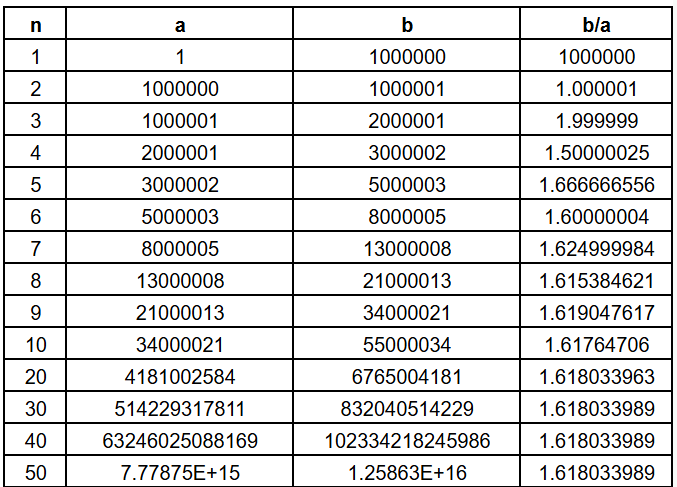
    Now let us change the second term quite drastically. Let’s make it 1,000,000! Now we get the following table

    We observe the same thing, namely that, while the individual terms are the ratios converge to the same value.

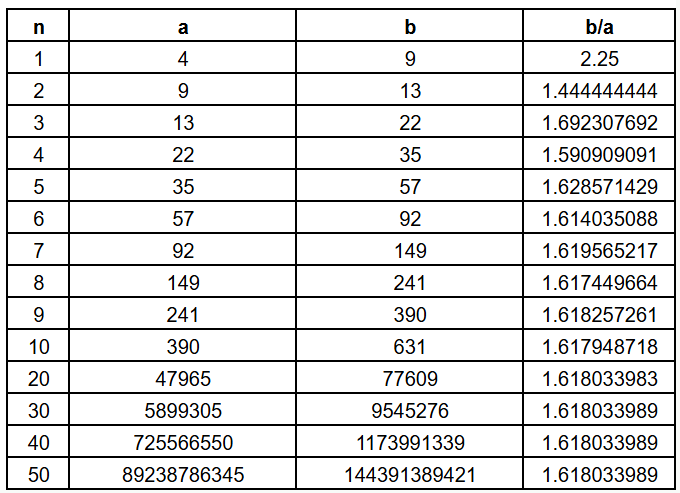
    We could take a different first term also and see what we get. Choosing a = 4 and b = 9 we get the following

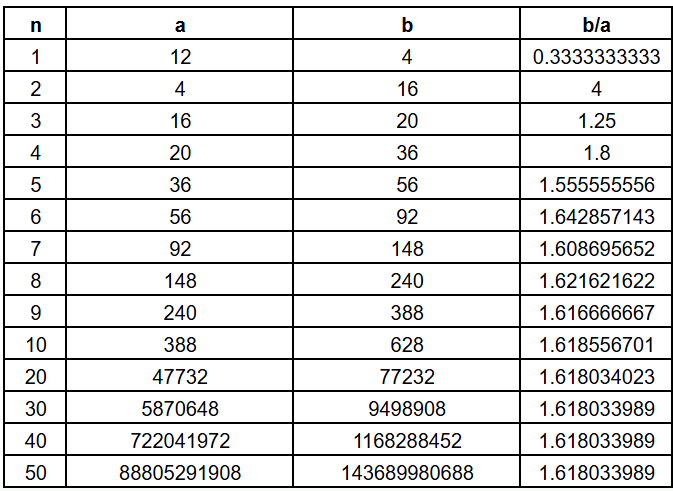
    There is no change to the ratio to which the terms of this sequence converge. Indeed, we can start with a value of a that is greater than b and get something like

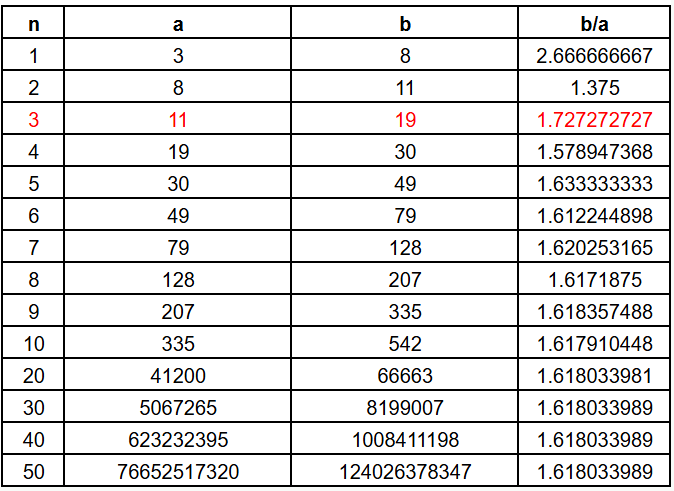
    In other words, no matter what numbers we choose to start with, the resulting ratio of consecutive terms converses to the value of ɸ. Hence, if you give me any two starting numbers, I can confidently assert that they are part of a sequence where the ratios of consecutive terms converges to ɸ. For example, if you gave me 11 and 19, I could form the sequence as below

    Here, I have shown the third row in red so you can see where in the sequence the given numbers lie. And since the sequence of ratios converges to ɸ, I can confidently state that, if we find the numbers 11 and 19 in nature, then this must be an approximation to ɸ. But the careful reader will recognize this as quite spurious reasoning. After all, every pair of starting numbers will yield a sequence of ratios that converges to ɸ. Hence, there is nothing extraordinary in finding any such pairs of numbers anywhere.

    Freedom to Explore

    Over my career as a teacher, which spans more years than I would care to admit, I have come across the claim that the Golden Ratio appears in nature many more times than I would consider acceptable. Most of these are from excited young students, who have just been introduced to the Golden Ratio or the Fibonacci sequence. However, a fair number are from teachers, some very experienced in terms of years. They point to the fruitlets of the pineapple and to the petals of various flowers to give their students examples of these presumed occurrences. However, as I have shown in this post, any starting point, as long as both numbers are positive, will result in a sequence of ratios that converges to ɸ. Here is one that starts with the transcendental number e and π.

    By pointing to numbers in nature and asking their students to draw conclusions that nature has examples of the Golden Ratio, such teachers are stunting the mathematical acumen of their students because they make the students think that something is special when in case it is nothing more than run of the mill. Instead of asking their students to wonder why every sequence of numbers defined as

    has a corresponding sequence of ratios defined as

    that converges to ɸ, the teachers make students think that the example of the Fibonacci sequence is unique in that regard.

    Don’t get me wrong. I am not saying that the Fibonacci sequence does not represent something insightful about mathematics. What I am saying is that we should not claim any distinction for it that it actually does not have. But for this to happen the teachers should have the time to explore various ideas both individually and in groups. However, given how content heavy the high school mathematics curriculum is, teachers in the lower grades also have a lot to cover.

    As a result, most mathematics teachers are perpetually scrambling to complete the syllabus for the year, with hardly any time for the kind of exploration that would result in robust learning for the students. Because of this, most teachers are forced to use prepackaged material, such as from a textbook or online platforms. But prepackaged materials can never cater to the unique requirements of a class of students, each of whom has a uniquely expressed curiosity, unless, of course, we wish to quench that curiosity!

    If we are serious about teaching students to be adept at mathematics, we must reduce the content of our curriculums and syllabuses and focus instead on the development of a small set of skills that can be transferred not just to different areas within mathematics but also to other disciplines. And we must allow our students – and teachers – the freedom to explore the subtleties of mathematics without which their understanding of mathematics would be superficial at best.

    Note: I will be taking a break next week and will return with new posts in January 2025. Have a happy holiday season.

  • The Presenting Problem

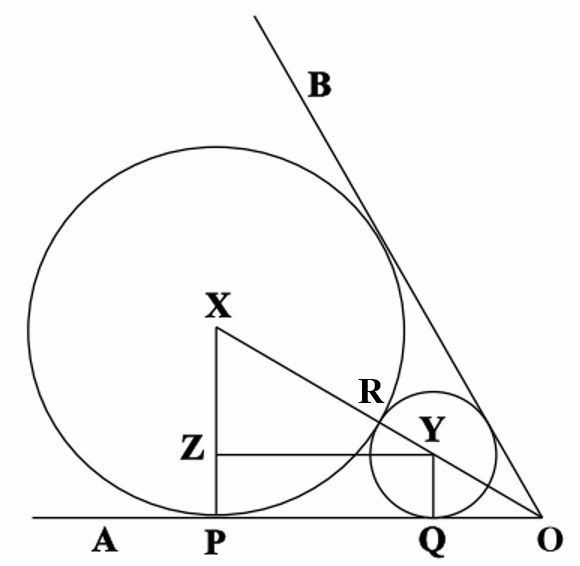
    In this post, I wish to continue with some geometry along with some insights from sequences and series. Consider the figure below

    It is given that ∠AOB = 60°. Also, the radius of the largest circle is 1 unit. The successive smaller circles are tangential to the circles on either side. This continues indefinitely. In other words, there are infinitely many circles. We are asked to find the total area of all the infinite circles.

    If you are inclined to solve this, please pause here before proceeding.

    Introducing Infinite Geometric Series

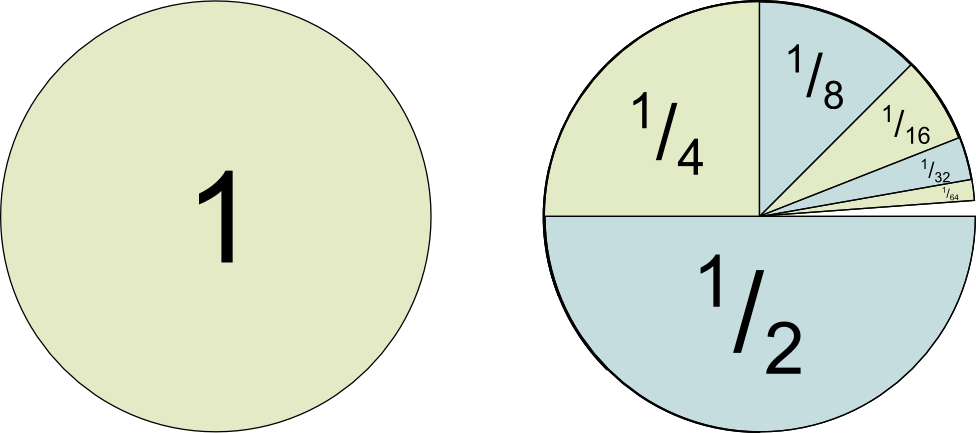
    No relevant caption to maintain some suspense! (Source: Science4All)

    Ok. I hope those who attempted the solution have obtained a satisfactory answer. Now, some of you may be wondering how the sum of the area of infinite circles could be determined. Should the finite area of infinite circles also be infinite?

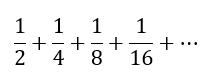
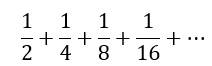
    Let us take a brief detour into the marvelous world of infinite series. Consider the series

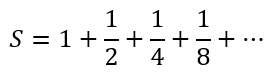
    The ellipses (i.e. ‘…’) at the end indicate that the pattern continues. We encountered an expanded version of this series in the post Naturally Bounded. There we considered the infinite series

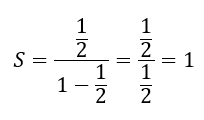
    After some nifty algebraic manipulation we showed that S = 2. Since the sum we are considering in this post only lacks the starting 1, we can conclude that the sum of the infinite series for this post is 1.

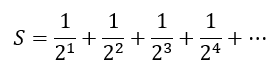
    However, let us spend some time understanding why this is the case. What in the world is the pattern in our series? We can recognize that all the values in the denominator are powers of 2. Let us designate the sum with S. Then we can write

    Now let us try to see why the sum turns out to be 1. As in the earlier post, we can multiply both sides by 2 to get

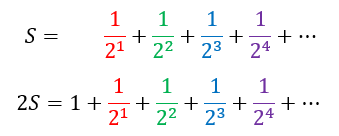
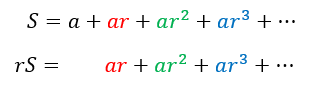
    Let us make this colorful. We can write the above two equations one below the other as follows

    We can see that, if we subtract the first equation from the second, the LHS will yield Sn, while the RHS will reduce to 1 since all the terms in red, green, blue, and purple will cancel out. This gives us S = 1.

    But why does this work. We can see that, in the series we are considering, every term is obtained by multiplying the preceding term by 1/2. Such a series is known as a geometric series.

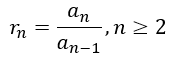
    In order to understand geometric series, let us start with a general case. Let’s say that we have a starting term, a, and that each subsequent term is obtained by multiplying by r. The multiplier, r, is called the common ratio because it is the ratio of any term to the term before it. Anyway, we can see that our geometric series up to n terms will be

    Note that the nth term is arn-1 because the first term, a, is actually ar0 and as the power of a starts from 0, the count after n terms will be n – 1. We can multiply the above equation by r and arrange a similarly color coordinated set of two equations one below the other as follows

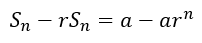
    Now, when we subtract the second equation from the first, the red, green, blue, and purple terms will vanish, leaving us with

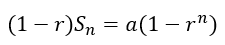
    Both sides can be factorized to give

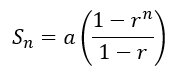
    Now, if we divide the entire equation by 1 – r we will obtain

    The first thing we can observe is the denominator 1 – r. Since the denominator cannot be zero, we can conclude that this formula will not work for r = 1. Further, we can take a look at the rn term. When the value of r is either greater than 1 or less than -1, multiplying by r results in a number that has a greater magnitude. In this case, it is obvious that we cannot find a sum of infinite terms of the series since subsequent terms have larger and larger magnitudes.

    But what happens when the value of r is between -1 and 1? In this case, multiplying by r results in a number that has a smaller magnitude. Hence, the more times we multiply by r, the closer the result gets to zero. We can see this in the original series

    We can see that each term is closer to zero than the one before it. So we can potentially consider an infinite series for these values of r and write

    Once again we can multiply this equation by r and stack the two equations as follows

    Now, when we subtract the second equation from the first, the red, green, and blue terms will vanish giving us

    Dividing the equation by 1 – r we get

    Now, we can return to our original series. For this series, we observe that a = 1/2 and r = 1/2. Plugging these values into the above formula gives us

    Return to the Problem

    This matches with our earlier result and puts us in a position where we can actually attempt the problem with which I started the post. Let me reproduce the figure so we can recall what the problem was.

    Starting with the largest and second largest circles, we can obtain the following figure.

    Here, X and Y are the centers of the larger and smaller circles respectively. XP and YQ are perpendiculars drawn from X and Y respectively to AO. YZ is a perpendicular drawn from Y to XP. Since we were given that the largest circle has a radius of 1, this means that XP = 1. Also, R is the point of tangency of the two circles, which is also the point where the line OX intersects both circles.

    Now, we are given that ∠AOB = 60°. From symmetry, it follows that ∠AOX = 30°. Using some basic geometry, we can see that OX = 2 XP. Similarly, since the triangles OXP, PYQ, and YXZ are similar, we can obtain OY = 2YQ and XY = 2XZ.

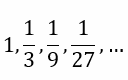
    Suppose we say that YQ = r. This gives us OY = 2r. Also, since XP = 1, we can conclude that OX = 2. But OX = OY + YR + RX. This gives us 2 = r + 2r + 1, yielding r = 1/3. However, r is the radius of the smaller circle. Since, with the use of geometry, it turns out to be a constant (i.e. 1/3), this means that the radius of each successive circle in the series will be 1/3 times the radius of the previous circle. In other words, the radii of the circles form the following sequence

    Now, the area of a circle is πr2. This gives us the infinite series for the area is

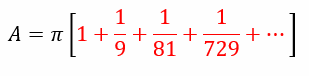
    Taking π common we can express this as

    Here, the terms in red form an infinite geometric series with a = 1 and r = 1/9. Using the formula we earlier derived for the sum of an infinite geometric series we can obtain

    Reflection

    While solving the problem we have used both algebra and geometry. In an earlier post I have bewailed the unfortunate trend in some countries of offering distinct mathematics subjects like Algebra 1, Geometry, and Pre-Calculus. In another post I demonstrated that one’s understanding of mathematics is furthered when we consider algebra and geometry together. I have done this in this post too. Mathematics is a coherent body of knowledge. By introducing artificially defined segments of mathematics as stand-alone bodies of knowledge, we convey the idea that the whole is the sum of its parts. However, mathematics is much greater than the sum of its branches. And I will continue to harp on this till my dying breath!

  • Recap

    In the previous post, from two weeks ago, I had addressed a development in Maharashtra, according to which they have lowered the pass mark in mathematics and science from 35 to 20. I had concluded that post with three questions. First, what is the relationship between a pass mark in an exam related to the purpose of primary and secondary education? Second, how does the mathematics curriculum reflect or fail to reflect this purpose? Third, how are teachers being equipped to promote student learning? I will deal with the first two questions in this post. The third I am shelving for now. So let us proceed to address the first two questions.

    The Dictates of Prior Knowledge

    Let us be very honest. Apart from probably giving students some choice of a second and/or third language, most primary school education is quite rigid. I do not mean that primary school teachers are not able to be quite creative in their classes. Of course, they can. And especially in the last school I worked at, I saw this on a regular basis. However, there are certain curriculum requirements that teachers are expected to fulfill. For example, in the context of mathematics, the students are expected to learn addition by a certain grade. Similar standards are set for the other operations and concepts. Indeed, while many schools may move aspects of the curriculum around to suit their specific contexts, every syllabus document released by boards for subjects in grades 11 and 12 has a section called ‘Prior Knowledge’ or something similar. In other words, every board expects every student to have acquired some body of common knowledge before continuing with mathematics in Grades 11 and 12.

    This is not true for most other subjects. In English, there is some sort of unwritten rule that students should have studied English language till Grade 10, but even here there is no clear indication of the body of knowledge that a student is expected to have before embarking on a study of English in Grades 11 and 12. Of course, conscientious teachers know that, if a student is expected to be able to comprehend unseen passages of a complex nature, then the student should have been introduced to many grammatical and rhetorical devices prior to that. In other words, even though the Grade 11 and 12 syllabus may not be explicit about prior knowledge, the syllabus itself would be impossible to complete without quite a bit of prior knowledge. Of course, in the case of mathematics the situation is quite different, where most boards list a set of concepts that students are expected to know before commencing studies in mathematics in Grades 11 and 12. What we see, then, is that, in the case of the first language and mathematics, there is an understanding that students should have some knowledge before continuing studies in Grades 11 and 12.

    What this means is that there is some sort of consensus, even if unwritten, that students of English and mathematics ought to possess some body of knowledge by Grade 10. This is, in a very real sense, non-negotiable or the idea of requiring prior knowledge would be pointless.

    The Purpose of Primary and Secondary Education

    Granted, then, that students are expected to have some body of knowledge by Grade 10, what can we ascertain concerning the purpose of primary and secondary education?

    Presumably, education serves the role of helping people navigate through life. I mean, if education mostly produced social misfits we would question its role even more than some of us do. Hence, in some way we are declaring that knowledge of the first language and mathematics is essential for a person to navigate life.

    Most students see through this ridiculous assumption. When they ask me why they are studying geometry or algebra and where they would use it, they reveal the lie we tacitly tell them, namely that what we are teaching them in primary and secondary school is essential for navigating life. You see, knowledge of how to prove two triangles are congruent or how to solve a quadratic equation is something very few people would ever need in life. I am a mathematics teacher and I can assure you that, outside my classes, I have never needed to solve a single quadratic equation. Neither have I had to demonstrate the congruence of any pair of triangles. In other words, as a mathematics teacher, I can assure you that the content we teach the students in primary and secondary school is mostly useless.
    Mind you, I said that the content is useless. However, mathematics is much more than the content we teach students. Rather, just like in a language, mathematics is primarily concerned with the development of skills. Just as it is pointless for someone to learn the meanings of thousands of words, as required by many ridiculous standardized tests like the SAT and GRE, without becoming adept at using those words appropriately and regularly in relevant contexts, so also it is quite pointless for someone to learn hundreds of mathematical formulas and algorithms without knowing when to use which ones and how.

    So what are the skills that we hope to develop in students by insisting that they study mathematics in primary and secondary school? Unfortunately, here we encounter a difficulty. High school mathematics curriculums are guided by what universities say they require students to have completed before beginning their programs. In some cases, this concerns the content of mathematical learning in high school. So, some universities may require the student to have studied some calculus by the end of Grade 12. Others may insist that some algebra or geometry is covered. In other cases, the universities specify the number of class hours (or credits) the student should have devoted to the study of mathematics in high school. So, some universities may require the student to have had 8 semesters of mathematics with at least 3 hours of classes per week or something of the sort.

    However, in what way does this equip a student who plans to study history or art? I mean, if there is some link between the study of mathematics and the study of history or art, what is it? Will understanding how to differentiate a function and hence interpret the mathematical idea of ‘change’ help the student improve his/her understanding of ‘change’ in history? Will a focus on geometry allow the student to better appreciate and produce art? If it quite obvious that the mathematical content will not help a student except in mathematical contexts. Yet, many universities require some high school mathematics even for programs in fields where mathematics is not required. Indeed, some exam boards require the study of some mathematics in order to award the student with the highest possible diploma or certificate after Grade 12. Why is this the case?

    Major Skills Developed Through Mathematics

    Unless we are able to determine some skills that are developed while studying mathematics, which are also useful in other fields, making the study of mathematics mandatory in high school will be an arbitrary decision that serves no better purpose than to fill the students’ time with irrelevant study. I do think there are many critical skills that are developed while studying mathematics and that these skills can be transferred to other fields. Here, let me briefly describe three.

    Mathematics develops the skill of problem solving. Please note that the skill of problem solving is markedly different from the task of solving problems. Mathematics makes us ask, “What have I been given?” and “What have I to find?” and “What are the concepts or ideas or formulas that link what I have been given to what I have to find?” and “What is the best route to get from what I have been given to what I have to find?” and “Is the answer I have obtained reasonable?” All of these questions help in the analytical process required for problem solving. It enables the student to break down a massive problem into bite size pieces.

    The second skill that mathematics develops is logical thinking. Quite often, when I read or watch some piece of argumentation, I come across statements that have the form, “It is known that, if proposition A is true, then proposition B must be true. Since A is false, therefore, we can conclude that B is false.” In case you do not find a problem with this line of reasoning, I invite you to read it again and think of different propositions (A and B) where there is some sort of causal relation between the two. In the mathematical context, we can think of A being the proposition, “This quadrilateral is a square” and B being the proposition, “All the interior angles of this quadrilateral are right angles”, we can see that proposition A implies proposition B. That is, if a quadrilateral is a square, all its interior angles will be right angles. However, a student of mathematics knows that if a quadrilateral is not a square, that is, if A is false, then it does not follow that its interior angles are not right angles, that is, that B is false. After all, the quadrilateral could very well be a rectangle!

    The third skill that mathematics develops is a sense of justice. Yes, you read that right. A student of mathematics knows that, given two positive quantities, x and y, such that x is less than y, doubling them or tripling them only expands the gaps between the resultant numbers. In other words, 2x and 2y are further apart than x and y. And 4x and 4y are even further apart. As an example, suppose x = $50,000 and y = $1,000,000. The difference between x and y is $950,000. But if we doubled this the difference becomes $1,900,000. In other words, just giving everyone double their income actually hurts those who are poor because the rich are now able to have a much, much higher standard of living, which makes it all the more difficult for the poor to make ends meet.

    Appraisal of Curriculums

    Unfortunately, mathematics teaching is so heavily focused on the procedural aspects of mathematics, which are necessary, mind you, that there is no room to step back and appreciate what one has learned. Our curriculums are so bloated with non-essentials that teachers in high school are almost always scrambling to complete the syllabus, leaving little or no time to actually hone the skills that mathematics helps students develop. With regard to the first skill, we spend so much time giving students more and more problems to solve that we do not leave any room for allowing them to ask the questions I highlighted above. Where the second skill is concerned, the questions framed in textbooks and exams are so ridiculous that they further the misconception that mathematics has no relevance on its own in the real world. Please note the italicized words. Due to its power, mathematics has found uses in almost every walk of life. Hence, its usefulness for its own sake has somehow taken the backseat. Most damning, however, is my conviction that few, if any, teachers are even aware of the third skill that I have highlighted here. That mathematics has something to say about truth and justice is something that probably has not even entered the minds of most teachers, let along curriculum designers.

    As mentioned earlier, very few of the mathematical concepts are relevant to students except in the mathematics class. On account of this, what mathematics education in primary and secondary school must aim to deliver is not familiarity with these concepts but the development of skills that transcend the realm of mathematics. That must be the purpose of mathematics education in primary and secondary school. Therefore, given the fact that our primary and secondary school mathematics curriculums are obscenely bloated with non-essentials, I can confidently state our curriculums do not reflect the purpose of mathematics education.
  • A Recent Development

    Late last month, around 23 October 2024, many newspapers carried the story that the State Council of Educational Research and Training (SCERT) in Maharashtra has decided to reduce the pass mark for mathematics and science from 35 to 20. The caveat is that students who have scored at least 20 marks but less than 35 will be declared as having passed that subject. However, their mark sheet will indicate that they no longer qualify to take further studies in mathematics or sciences. Quite naturally, there were mixed responses to this move. In this post we will look at some of these responses to which I will offer my own critique. In the next post, which will be two weeks from today, since I will not post next week, I will suggest what I think is the purpose of primary and secondary education. In that context I will raise two problems we currently face with mathematics in primary and secondary school. So let us look at the views expressed by some people about the lowering of the pass mark.

    Introducing Common Pitfalls

    According to Rahul Rekhawar, director of SCERT, “Failing in mathematics or science, and in effect in SSC, often leaves students with no opportunities to continue their education, even if their strength lies elsewhere. This change is designed to ensure that students are not unfairly pushed out of education system and can pursue their academic and career aspirations.” An educator called Heramb Kulkarni is reported to have said, “These subjects serve a purpose beyond mere academic scoring. Lowering standards might adversely affect the overall quality of education in the state.” However, another educator called Vasant Kalpande argued, “There are students who cannot understand mathematics. Many great writers like Munshi Premchand and Hari Narayan Apte dropped out of their respective courses because of mathematics. Hence, if a student wants to pursue arts or humanities, why force them to take up science and maths which they have no aptitude for?”

    Pitfall 1: Reliance on Ad Hoc Reasoning

    Each of these responses reflect a certain understanding of the purpose of secondary education and of the role of learning mathematics for a student. Rekhawar’s response has a prima facie logic to it until you realize that it is the determination of the exam board to indicate a pass or fail for a subject. This move seems to be helping students who are not doing too well in mathematics and sciences.

    But what about students who do not do well in, say, history? If student A scored 34 in history, he would be declared as having failed the exams. Another student B, who scored 20 in mathematics, would be declared as having passed the exams. How would the first student get admission to a mathematics course, when in fact he does not need history beyond Grade 10? You see, if the goal is to ensure students are not unfairly pushed out of the education system, then such a determination must be made after a student decides what he/she wishes to study after Grade 10. So student A could decide, after the exams, that he is not suited to study history and should obtain a pass certification for that subject with an indicator that he should not be permitted to pursue history in the future.

    We can see that this is simply an ad hoc approach. The SCERT is not doing anything to favor the students. Rather, in my view, it is simply attempting to jack up the pass percentage so that it appears to be doing a better job.

    It is more likely that this move has been made because more students are finding it difficult to understand mathematics in the primary and secondary schools. This means that, either the curriculum is not suited for the purpose of primary and secondary education or the teachers are not teaching in a way that enables student learning. We will return to these twin ideas in the next post.

    Pitfall 2: Teaching for Pass Statistics

    Kulkarni’s claim that this will lower the quality of education in the state is appalling and my heart goes out to his students. In my view, it does not matter if the pass mark is 35 or 20 or 60. The goal for me when I teach is not to just push a student over some arbitrary line that some bureaucrats have drawn. No! My goal is to ensure that each student learns as much as he/she can from me. My goal is to ensure that each student’s understanding of mathematics is better today than it was yesterday. Teachers who teach based on an arbitrary pass mark are teachers I would not trust because their goal is not the student’s learning but the student’s passing. Lowering the passing mark from 35 to 20 may make it easier for a teacher to push a student over the line. However, if that determines the quality of teaching that a teacher delivers, then we are not doing right by our students.

    It is likely that Kulkarni is simply telling us what would happen in some classrooms rather than what would happen in his classroom. In other words, may be he is simply warning us about a possibility he fears might become a reality in the classrooms of less dedicated teachers. But those teachers are anyway only teaching to the current pass mark of 35. Do we really think that their students are actually learning anything? Do we think that a student who is scoring 90 marks in a class taught by a teacher who teaches based on a pass mark is actually learning anything? Is it not more likely that the 90 marks are artificially inflated to prop up the teacher’s performance? And if the 90 marks are genuine, is it not more likely that this reflects the student’s innate mathematical competence?

    In other words, if we are afraid that lowering the pass mark will lower the quality of teaching, then we must admit that we have a much bigger problem of accepting teachers who do not care about their student’s learning but more about their own pass statistics.

    Pitfall 3: Appealing to the Absurd

    Kalpande’s argument is completely an appeal to the absurd. Pointing out someone for whom the system did not work does not mean that the system should be jettisoned. While I do think the system needs a massive overhaul, mentioning great writers like Munshi Premchand and Hari Narayan Apte for whom the system did not work does nothing.

    No system will work for everyone. Anyone who thinks he/she can make a system that will work for everyone is smoking something I would not recommend to my students! Every system, precisely because it forms a ‘box’, will result in being unfit for those who do not fit into that ‘box’. The solution is not to arbitrarily change the dimensions of the ‘box’ but to find another ‘box’ in which these people can fit. The very fact that Premchand and Apte succeeded as writers means that they found another ‘box’ that could accommodate their skills and talents.

    Moreover, Premchand and Apte are part of a very tiny and exclusive minority. Not every who aspires to become a successful author succeeds in achieving that goal. Perhaps Premchand and Apte were forced to find their true calling precisely because they were pushed out of the ‘box’. In that case, one could possibly argue that, if the pass mark had been 20, neither Premchand nor Apte would have become authors because they would have passed mathematics and would have found some other run of the mill profession within the ‘box’.

    Looking Ahead

    We have taken a look at some of the common responses in addressing the issue of determining a pass mark for mathematics. It is quite likely that the newspapers, not known for their research rigor, have only interviewed people with loose lips who were willing to shoot from the hip. In other words, it is quite likely that the newspapers have not managed to interview any educator who is willing to think deeply about the issue.

    Nevertheless, I am certain that the three responses above are not quite aberrant. However, all the responses reflect a failure to address three crucial issues. First, none of them address the issue of how the pass mark for a subject relates to the purpose of primary and secondary education. After all, if this pass mark is to be reflective of the culmination of the student’s learning over ten years of schooling, in what way does it provide us a measure of that learning? Second, assuming we understand what the purpose of primary and secondary education is, how does the mathematics curriculum reflect or fail to reflect this purpose? Third, in what way are teachers being equipped to teach the subject so that student learning is prioritized? We will look at these three questions in the next post, which, as I announced earlier, will be two weeks from today.

  • The Presenting Problem

    There is one big problem with being a mathematics tutor. You aren’t the students’ main teacher and hence you get to hear what the students have actually learned from their main teacher. Why is this a problem? Well, it exposes me to the ways in which we mathematics teachers regularly let our students down. It is an indictment of the self and no one likes that.

    Today, I wish to highlight one area in which we mathematics teachers often fall short – the area of terminology. I am a stickler for terminology. Technical terms in a field are essential for succinct and precise communication. Without these technical terms, we would have to use many more words. Not just that, when the number of words needed to refer to something increases, the possibility of paraphrasing also increases, thereby making the meaning dependent on the vicissitudes of the language in use. Hence, the communication becomes verbose and imprecise, leading to inefficiencies and possible lack of understanding. The use of correct terminology enables precise and succinct communication and facilitates understanding.

    I am fed up, for example, of hearing students ask, “Do I minus the two?” Hello! Hello? What’s that? The word ‘minus’ is not a part of English grammar but a way of vocalizing the mathematical symbol that indicates subtraction. Similarly, hearing a student say that 1/x is the ‘inverse’ of x, has as bad an effect as it would have had if the student dragged his nails across the wall because there is a difference between an ‘inverse’ and a ‘reciprocal’. And finally, hearing a student tell me she wants to ‘bracket the terms’ when she means ‘factorize’ is pure agony.

    Introduction to Nomenclature

    I had a good early mathematics education. I don’t mean that all my mathematics teachers were capable teachers. I don’t remember most of them. And even the ones I remember weren’t all capable. But I remember being taught terminology from a very early age. While I do not remember ever using ‘addend’, ‘minuend‘, or ‘subtrahend‘, I clearly remember using ‘multiplicand‘, ‘dividend‘, ‘divisor‘, ‘quotient‘, and ‘remainder‘. The former set was probably never learned because addition and subtraction are covered very early. By the time multiplication and division were learned I guess I was old enough to learn bigger words.

    But today I find that many students cannot recognize even the terms in the latter set. So instead of saying, “When you divide the dividend by the divisor, the result is the quotient with a remainder” we would have to say something like, “When you divide one number by another, the result is the largest number by which the second number should be multiplied without exceeding the first with the difference if any between the first number and the largest multiple of the second.” So instead of 16 words, in which most of the non-technical words are simply connectors of sorts, we would have to use 39 words, where many of the additional words describe the operation of division and the role of the different. And since others may phrase it differently, we would never be sure that we are communicating with accuracy.

    Case in Point

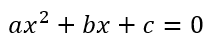
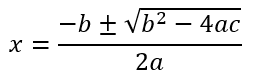
    One of the terms that causes me most pain is the ‘discriminant’. For those of you who do not know or do not remember or have conveniently suppressed the memory, when you attempt to solve a quadratic equation of the form ax2 + bx + c = 0, the solutions are given by

    Here the quantity under the radical sign (i.e. ‘‘) is called the ‘discriminant’. Of late, many students come to me, having learned quadratic equations in grade 9 or 10, but having never heard the term. Why do I say this term is important? Because its name, like most mathematical terms, tells you what it does. The ‘discriminant’, you see, allows us to ‘discriminate’ between the kind of solutions a given quadratic equation has before we attempt to solve the equation. It can tell you if the equation has two different real solutions, only one real solution, or no real solutions. Give that this expression is so critical and that it is named to reflect what it does, a failure to teach students the term can only be viewed, at least according to me, as indicative of a failure of mathematics teachers to pass the baton of knowledge to the next generation. I even have textbooks written for high school students that do not have the term.

    I can understand the reluctance that some teachers in the elementary school have concerning teaching some of the technical terms. Mathematical jargon can get to be quite heady. However, the failure to teach students these terms results in a lax approach to conversing about mathematics. However, even if we grant that many of these terms are too daunting to be taught in the elementary school, it is irresponsible to avoid teaching them at least in middle school.

    Contextual Nomenclature

    After all, soon after they enter high school, they will be introduced to contextual terminology. What do I mean? Consider the expression

    Most people who have done some middle school mathematics would be able to say that, in the expression above, x is the base. But what do we call n? When this notation is first introduced, it is called a ‘power’. Later, the students are told that it is an ‘index’. Still later, they are told to call it an ‘exponent’. And after they are introduced to functions and their inverses, they are told that n can also be called a ‘logarithm’. Four different terms for the same quantity! But mathematics is an austere field. It does not do ‘synonyms’! So why do we have so many ways of naming the same thing? It has to do with the context within which the quantity is being referred to. A student who understands the contextual naming of the quantity will also understand the reason behind it. In other words, by introducing the student to contextual terminology, we facilitate his/her fluency in mathematical discourse and depth of mathematical understanding.

    Giving No Quarter

    But someone may wonder why I am so adamant that teachers should consistently use and teach their students to consistently use correct mathematical terminology. After all, would not a rose by any other name smell just as sweet? Indeed it would! But no one goes around describing a rose. We choose a name by convention and use it so that everyone understands what we mean. Hence, since the mathematical community has landed on a set of naming conventions, it behooves teachers to teach their students that convention of nomenclature.

  • Looking Back, Looking Ahead

    The response to last week’s post on geometry was heartening. So I thought I would give the readers another small dose of geometry. Some of the ideas that arise from geometry are simple, yet so profound that it is hardly surprising that geometry was considered the pinnacle of human wisdom by many early mathematicians and philosophers. In the previous post I had expressed by consternation at the fact that, in some countries, mathematics is split into independent siloes, thereby rendering it difficult, if not impossible, for students to fully appreciate the subject. Here I wish to consider two geometry problems that demonstrate how connected the different branches of mathematics actually are, focusing today only geometry and algebra.

    Areas in a Quadrilateral

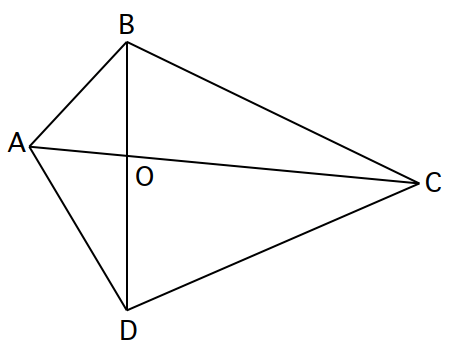
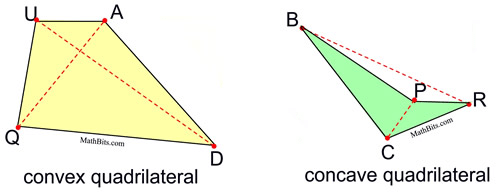
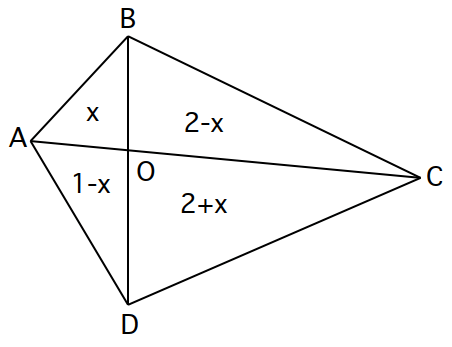
    Let ABCD be the convex quadrilateral, as shown, and let O be the point of intersection of its two diagonals. Suppose the area of △ABD is 1, the area of △BCA is 2 and the area of △DAC is 3. Find the areas of △CDB and △ABO.

    As usual, I suggest the reader pause here and try to solve this question before proceeding.

    (Source: Mathbitsnotebook.com)

    We can start by assuming the area of △AOB is x. This would mean that the area of △AOD is 1 – x and that of △BOC is 2 – x. This would mean that the area of △COD is 2 + x. This is shown below.

    We can quite easily see that the area of △CDB is the sum of the areas of △BOC and △COD. Hence, the area of △CDB is 2 – x + 2 + x = 4.

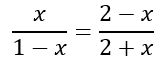
    Now △AOB and △AOD have the same height. Their bases are OB and OD respectively. Similarly, △BOC and △COD have the same height and their bases are OB and OD respectively. Hence, the ratio of the areas of △AOB to △AOD is equal to the ratio of the areas of △BOC and △COD. This gives

    Cross multiplying, expanding, and rearranging we get

    Hence, the area of △AOB is 2/5.

    Another way of solving the problem is to recognize that △ABC and △ADC have the same base AC. Hence, their areas (2 and 3 respectively) will be in the ratio of the lengths of BO and DO. Hence,

    We can see that both solutions are relatively straightforward. However, it is clear that we have used algebra to solve the geometry question. Hence, if the mathematics curriculum is divided into separate study of algebra and geometry it will adversely affect the student’s ability to make both branches ‘speak’ to one another.

    Stacked Trapeziums

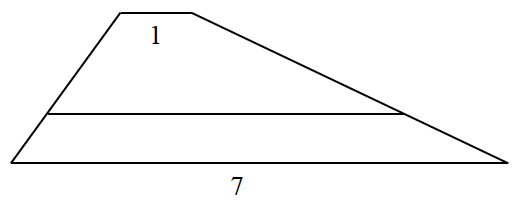
    The parallel sides of a trapezium have lengths 1 and 7, and the area of the trapezium is divided into two equal parts by a line segment parallel to those two sides. Find the length of that line segment.

    I urge the reader to pause here and attempt the question before proceeding.

    The Bent Pyramid at Dahshur. (Source: Wikipedia)

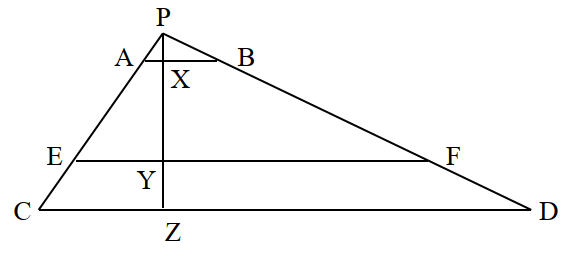
    We proceed by extending the oblique sides until they meet at P. In this way they form triangles as shown below. We have also dropped a perpendicular from P intersecting AB, EF, and CD at points X, Y, and Z respectively.

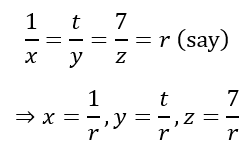
    Now it is clear that △PAB, △PEF and △PCD are similar. If we set EF = t, PX = x, PY = y, and PZ = z, we can obtain

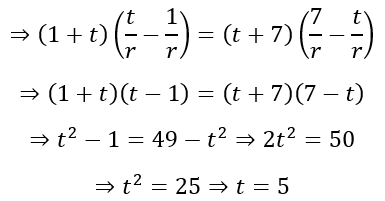
    Now the heights of the trapeziums ABFE and EFDC are XY = yx and YZ = zy respectively. We are given that the areas of the two trapeziums are equal. Hence, we can conclude

    Using the earlier expressions for x, y, and z we get

    Hidden Gems

    In both problems we see that a little algebra gets us a long way. While it is certainly possible to solve both questions without algebra, given the ‘nice’ numbers involved, the use of algebra simplifies things quite a bit. More to the point, though I did not mention it, the two solutions to the first problem actually rely on the commutative property of multiplication. That is, when we say that the area of a triangle is half the product of the base and the height, it does not matter which side we take as the base and which measure as the height (as long as it is truly a height corresponding to the chosen base). Specifically, whether AC is the base and BO and DO proportional to the height or BD the base and AO and CO proportional to the height makes no difference.

    In the case of the second problem, the completion of the triangle allowed the comparison of similar triangles. While this is a stock move in geometry, the result that involves the difference of squares is something that might not have been easy to predict. Despite this, the significance of the difference of squares, where the sums represent the lengths of the parallel sides and the differences represent the heights of the corresponding trapeziums is something that only the interplay between the geometry and the algebra could have revealed. If, however, the student is allowed to play with ideas from both branches, it is highly likely that she will make the links herself and understand the meaning of what she is doing.

    These insights are examples of hidden gems of mathematical knowledge that will remain hidden if we do not allow the different branches to ‘speak’ to each other. If we treat the different branches as independent fields of inquiry, however, we will give students the impression that it is possible – or, God forbid, preferable! – to study the branches in isolation from each other and still be able to obtain deep insights about the subject and the ideas it contains.

  • Mathematical Cardiac Arrest

    As my readers should know by now, I teach mathematics, focusing mainly on students in high school and there too preferring to focus on students in grades 11 and 12. Hence, when students reach me, their foundation in mathematics has, for the most part, been laid, for good or ill. Unfortunately, very often this foundation is weak. At times, the students reach me with strange ideas about mathematics and mathematical operations. And I wonder at the kind of mathematical education they had prior to reaching me.

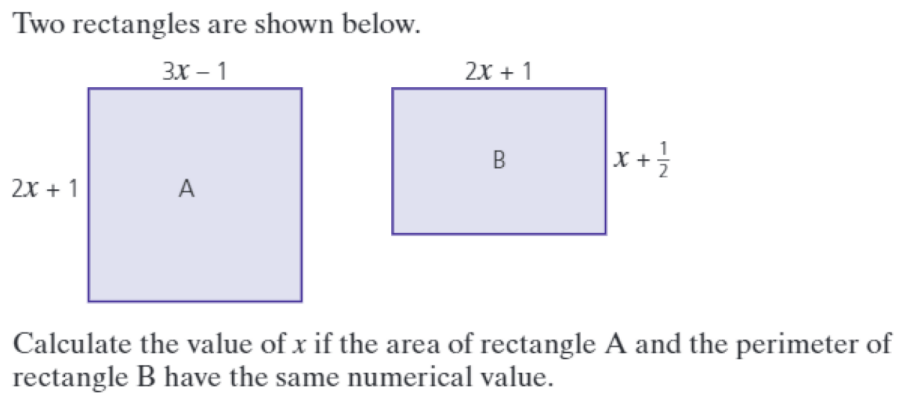
    So just recently, I was teaching a student in grade 10 how to form an equation given some data. The question we were dealing with is below:

    The student struggled for many minutes to form the equation. When I offered help by saying that the area of rectangle A is (3x – 1)(2x + 1), the student expressed confusion, asking me, “Why is that the area?” I said, “The area of a rectangle is length multiplied by width, isn’t it?” to which I received a period of awkward silence, which was broken when the student finally told me that this had not been covered in school. It was my turn to become silent. I then asked, “But you know that the perimeter of B is twice the sum of 2x + 1 and x + 1/2, right?” Again silence. This too had not been covered in the student’s school.

    Diagnosis of the Problem

    Now you may tell me that the student was probably not interested in mathematics and had probably zoned out when the teacher was teaching the class about the area and perimeter of rectangles. I would accept this if we were talking about a student who was in, say the fifth grade or even the sixth grade. After all, in most curriculums, this is taught in the third or fourth grade. So having a lag time of about a year or two could be granted. However, here we are talking about a student in grade 10! Am I to believe that not once in the five years from fifth grade to ninth grade the student had to use these results? If this is the case, then the school has completely failed the student.

    However, this student is reasonably quick with new concepts. And also displays quite a bit of interest in learning new things. So I had to come away with the conclusion that the student just had not been taught these concepts.

    I wondered about this. How could a student reach grade ten and not have learned about the area and perimeter of a simple figure like a rectangle?

    After a little research, I realized that, in North America, where the student is from, they divide mathematics into siloed subjects like Algebra 1, Algebra 2, Geometry, Trigonometry, Pre-calculus, etc. Depending on what the student intends to do after high school, the student may or may not take all siloed subjects. What happens when the discipline is divided like this is that each such subject it treated quite independently from the others. While this segregation happens only in high school, the effects bleed downward into middle and elementary school. This is because, in most schools, teachers teach ‘to the test’, aiming to have students score high in exams, rather than teaching them in order to help them understand and appreciate mathematics.

    This results in a downplaying of the importance of geometry in elementary and middle school. After all, pure geometry is conceptually heavy and not readily applicable, unlike algebra and trigonometry. However, geometry was considered the heights of mathematical understanding in the past. And this is because it uses pretty much all other areas of mathematics, except statistics and probability. It is sad, therefore, that some countries and even some global exam boards, like the IB and CAIE, have relegated geometry to being a footnote or option when studying mathematics. And in order to show you the beauty of geometry, I am considering two simple problems that yield remarkable insights.

    Problem 1: Area of a trapezium

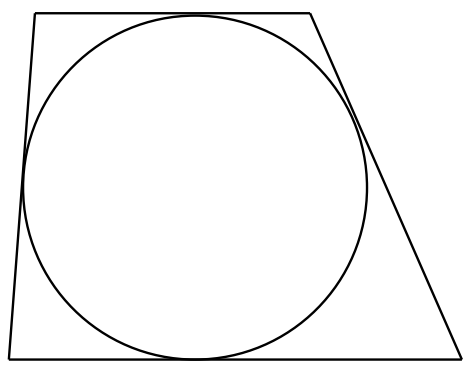
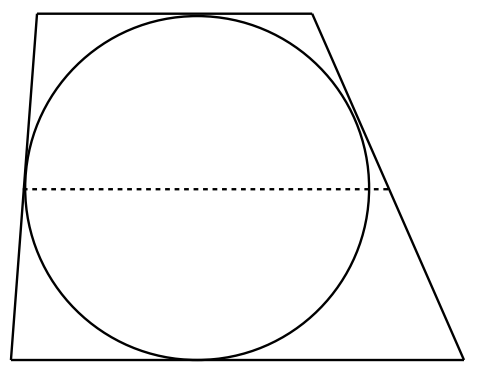
    Each side of a trapezium is tangent to a circle of radius 1, as shown. Prove that the area of the trapezoid is at least 4.

    First, a note of the terminology. I am calling this figure a trapezium because that is what it is. In North America it is called a trapezoid, which is strange since the ‘oid’ suffix means “resembling” or “like” and the figure is not “like” a trapeze! To the contrary, the English word ‘trapeze’ derives from the French trapèze, which in turn derives from the Latin trapezium, which means ‘table’.

    I encourage the reader to pause here and attempt the problem before proceeding.

    A trapeze artist swinging on a trapeze.

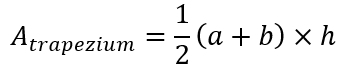
    Anyway, let’s proceed. In solving this problem, I presume that the reader knows that the area of a trapezium is given by half the product of the sum of the lengths of the parallel sides and the distance between the parallel sides. In symbolic terms

    The distance between the two parallel lines is the diameter of the circle, which is 2 units. Now let’s draw a line parallel to both parallel sides and halfway between them as shown below.

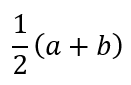
    The length of the dotted line is

    It is easy to see that the dotted line cannot be shorter than the diameter of the circle. If it were shorter, then one of the oblique lines would actually be a secant rather than a tangent. Hence, the length of the dotted line is at least 2 units. It follow, then, that the area of the trapezium must be at least 2 × 2 = 4.

    We can see that a small insight, namely that the length of the dotted line is half the sum of the lengths of the parallel sides yields the answer. The fact that a polygon that circumscribes a circle cannot have any part of it inside the circle also played a role.

    Problem 2: Hexagon and triangles

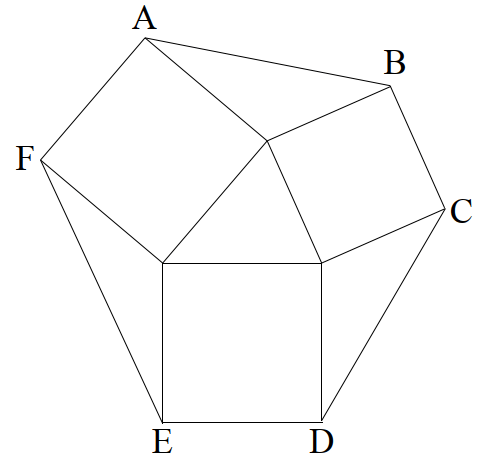
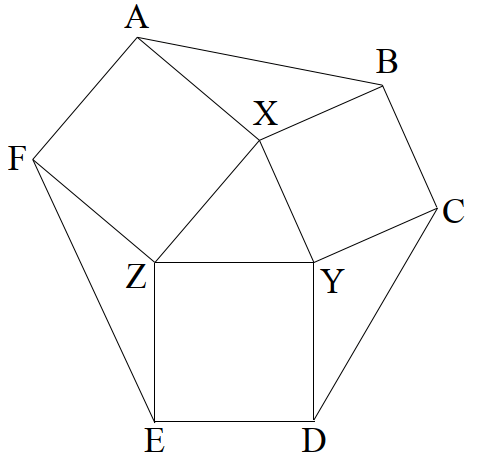
    In the figure below, hexagon ABCDEF is divided into three squares and four triangles. Show that the areas of all four triangles are equal.

    Once again, I suggest that the reader pause here and attempt to solve the problem.

    Hexagonal shapes forming a honeycomb. (Source: Nature Back In)

    Ok, let’s get started. We begin by naming the vertices of the triangle as shown below.

    Now, since AXZF, BXYC, and DEZY are squares, all their internal angles are 90°. Specifically, ∠AXZ = ∠BXY = 90°. This means that ∠AXB + ∠ZXY = 180° since the angles around point X must add up to 360°.

    We now rotate triangle XYZ anticlockwise until XY coincides with XB. Remember, both XY and XB are sides of a square and hence are equal. This would mean that XZ rotated anticlockwise by 90°. Let the new position of Z be Z’. Hence, ∠AXZ would have increased in magnitude by 90°, making ∠AXZ’ = 180°, meaning AXZ’ is a straight line.

    So now, ABZ’ is a triangle with X being the midpoint of AZ’. Hence, BX is a median of the triangle through B. Hence, the areas of triangles XAB and XZ’B must be equal since the median divides the triangle into two smaller triangles with equal areas. But triangle XZ’B was formed by rotating triangle XYZ. And rotation does not change the area of a triangle. Hence, the triangles XYZ and XAB have the same area.

    We can follow the same process by rotating triangle XYZ about the vertices Y and Z to show that the other two triangles have the same area. Here we have used the property that the sum of the angles about a point is 360°, that the sides of a square are equal, that the median bisects a triangle, and that rotation does not alter the area of a geometric figure.

    An Indication of Failure

    In both problems we have used geometric ideas that are taught in middle school. There isn’t a single idea that actually is taught in high school, at least not where the mathematics curriculum takes seriously the importance of geometry. Yet, we have seen that these ideas are put together in ways that would require considerable immersion into the world of geometry.

    What both problems needed was some sort of spatial reasoning. In the first, it was crucial to understand that the sides of the trapezium could not intersect the circle but had to be tangential to it, meaning there was a lower bound to its length. In the second, the fact that rotating the triangle XYZ would result in a larger triangle with a median was crucial to the solution.

    These are not ideas that would have occurred to a student who has only started studying geometry seriously in grade 9 or 10 or even grade 8. Rather, this kind of intuition can only be developed over many years. This is why in India students are introduced to geometry as early as in elementary school. A curriculum that only introduces students to geometry in high school or at the end of middle school ensures that students will only always have a superficial understanding of geometry. And since geometry includes spatial reasoning as well as other kinds of reasoning that occurs in mathematics, a superficial grasp of geometry means an enduring inability on the part of the student to integrate different areas of mathematics, resulting in an impoverished understanding and appreciation of mathematics.

    Hope for the Future

    The only reason I can think of for the curriculums in North America to divide mathematics into artificially segregated siloes is the need to have learning fit into discrete semesters. However, this prioritizes an artificial external constraint over the nature of the subject and reflects a failure on the part of those who created the curriculum to prioritize the learning of the students.

    However, as I hope I have shown, geometry is an integral part of mathematics and its importance should not be denied. It is time that curriculum designers in North America took seriously the nature of the subject and the learning of the students and designed a curriculum that does not segregate a subject artificially.

  • The Presenting Problem

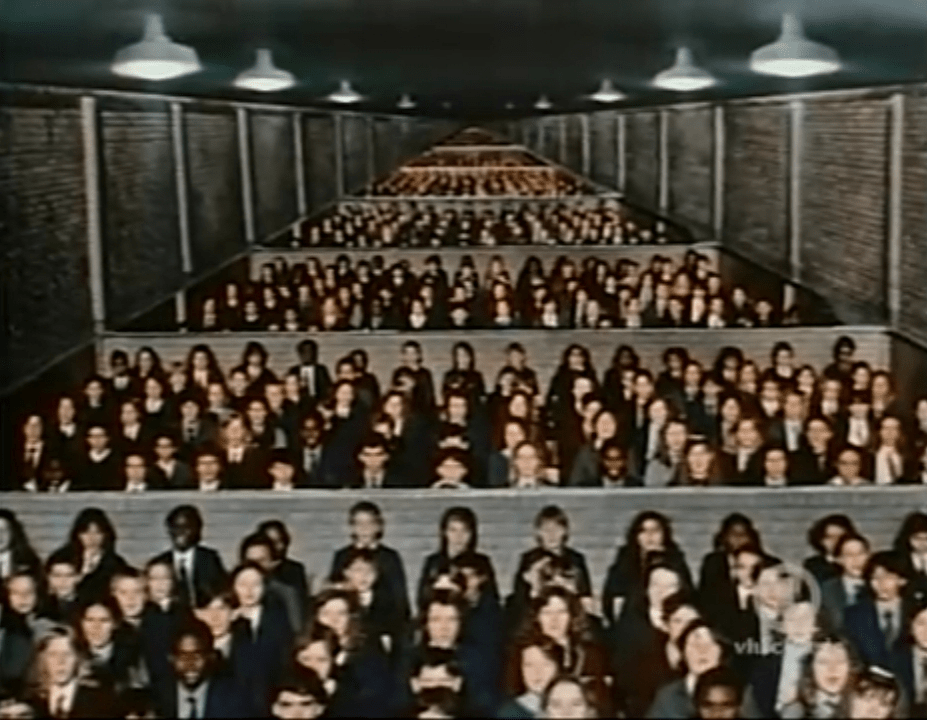
    Screengrab from The Wall by Pink Floyd.

    In response to the previous post, in which I had categorically declared that the use of calculators in mathematics education is a hindrance to students, a former student asked me, “Do you think it would be feasible or even beneficial to move mathematical assessments from the current manipulation & computation to something that focuses more on formulation and derivation from first principles from a given context (similar to IB DP AA HL paper 3)?”

    To decipher the last few characters of the student’s question, ‘IB‘ stands for International Baccalaureate, ‘DP‘ for Diploma Programme, ‘AA’ for Analysis and Approaches, and HL for Higher Level.

    In what follows, I will be addressing specifically what the IB does. However, this should not be taken as a critique of the IB alone, but of all the major exam boards around the world, like CAIE, Edexcel, AP, CBSE, and CISCE, just to name a few international and Indian boards. If you are reading in a country other than India, the UK, or the USA, please think of the exam boards that exist in your country.

    What is Paper 3 Like?

    Anyway, returning to my student, he was asking if I thought that the kind of questions that often appear in paper 3 for that syllabus would be something I considered ‘feasible’ and ‘beneficial’. Of course, many of you may be in the dark about what kind of questions might appear in this paper. If so, please click here to be taken to one example of paper 3.

    If you read the paper, you will discover the following:

    1. The question paper consists of 2 questions for a total of 55 marks and a duration of 1 hour.
    2. The first question is worth 27 marks and combines geometry, sequences and series, and mathematical induction.
    3. The second question is worth 28 marks and combines polynomials, complex numbers, coordinate geometry, and calculus.

    As someone who loves mathematics, I must concede that I do find the Mathematics AA HL Paper 3 to be quite an interesting ‘animal’. As just mentioned, it gives the student problems in which different areas of mathematics are made to relate to each other. While the situations are contrived, the student is exposed to the possibilities that a little imagination can introduce to us.

    Zoning Problems

    Now, the IB has different papers for different time zones. In time zone 2 the students would have received this paper. If you read the time zone 2 paper you will discover the following:

    1. The question paper consists of 2 questions for a total of 55 marks and a duration of 1 hour.
    2. The first question is worth 28 marks and combines coordinate geometry, functions, and calculus.
    3. The second question is worth 27 marks and combines polynomials, theory of equations, and complex numbers.

    You may be wondering, “So what?” Of course the papers have to be different. Otherwise, the IB would not be able to administer different papers in different time zones, thereby risking the security of the question papers. And I fully agree.

    But note that the time zone 1 paper has a significant number of marks devoted to mathematical induction, while the other one has marks devoted to the theory of equations. Mathematical Induction is a stand-alone topic that is somewhat weird to boot. So many students often decide to skip it and hedge their bets on it not being tested for too many marks. Theory of equations on the other hand is an integral part of mathematics and links with many other topics.

    So consider four students, P, Q, R, and S. P and Q write exams in time zone 1, while R and S write in time zone 2. P and R regularly get a grade of 7 (the highest possible), while Q and S are borderline between 5 and 6 and have both chosen to ignore mathematical induction. Q, having ignored mathematical induction, will have a low score in paper 3 because he is writing a paper that tests that topic, while S, who also ignored the same topic, will not be affected since she is writing a paper that does not test that topic. P and R are not affected negatively in terms of their raw score. However, there will be little to distinguish between R and S since both are writing tests that do not include topics that S chose to ignore. Since many students writing exams in time zone 2 might have ignored mathematical induction without being negatively affected, the grade boundary for a 7 in time zone 2 will rise, thereby disadvantaging student R, who, for no fault of his own, is clumped with student S, who had hedged her bets. So what we have is some students, like S, in time zone 2 being unfairly favored, while others, like R, being unfairly disfavored.

    The Problem of Grade Descriptors

    Of course, the IB, like many exam boards around the world, claim to assess students on the basis of grade descriptors. But this is a hoax. There can be no grade descriptors when we are assigning final grades based on some numerical grade boundaries. If it were actually possible to relate grade descriptors to grade boundaries, we would actually not need both because everyone would automatically know how to translate from one to the other.

    You see, I have experience marking IB mathematics exams and internal assessments. I know the difference between the two. The internal assessments are indeed marked according to a set of grade descriptors for each assessment criterion. However, the exam papers are not. In fact, if we are being honest, it is impossible to have a rigid mark scheme and also grade according to student achievement based on grade descriptors. You can do one or the other. You cannot do both. And the hoax that exam board the world over attempt to make us believe is that it is possible to do not just both, but also to be fair to all the students.

    You see, the very idea of numerical grade boundaries that are determined after the exams are written and graded is that there is a post hoc determination of what separates the 6 from the 7. Why is this a fallacious approach?

    The Problem of Grade Boundaries

    It is impossible for every question to assess the student on every criterion. In other words, question 1 may assess a student on criteria A, B, and C, while question 2 may assess a student on criteria B, D, and E. However, when we say there is a grade boundary, we are saying that only the final mark matters and not where the student earned the mark. Hence, if criterion C is weighted more heavily than criterion D and E, then the student who gets a total of 40 marks with 25 marks question 1 and 15 in question 2 should receive a higher grade than a student who scores 15 in question 1 and 25 in question 2. All this is ignored when we assign grade boundaries based solely on the raw score.

    What I am saying is that, for all their claims to assign grades based on some assessment criteria, the major exam boards are doing nothing of the sort. They have some highfalutin jargon that confuses people and dupes them into thinking the boards are actually assessing the students on criteria rather than relative to others. You see, what we all want is to know what a student has achieved because that tells us how much the student has learned. We do not want to know how she did relative to others because that tells us very little about her own learning. After all, if she is in the 95th percentile when the average was 50 with a standard deviation of 10, then her raw score would be 66, meaning that she has ‘mastered’ about two-thirds of the syllabus. However, if she is in the 90th percentile when the average was 70 with a standard deviation of 8, then her raw score would be 80, meaning that she had ‘mastered’ more than four-fifths of the syllabus. However, since the grade boundaries are based on the performance of the cohort, the board will determine that only a small fraction, say 8%, of the students should get the highest grade. Hence, the student who had only ‘mastered’ two-thirds of the syllabus would get a grade of 7 while the student who had ‘mastered’ four-fifths (i.e. 20% more) would get a grade of 6. You can check my working using the online inverse normal calculator here.

    In other words, assigning grades based on numerical grade boundaries does precisely what the major international exam boards tell us they are not doing, that is assigning grades in a relative manner. If the grades are indeed criteria based, how is it that the criteria map so perfectly onto the raw marks that students achieve? Further, the practice of having different papers for different zones may mitigate against candidate malpractice for sure. But it seems it opens the door to ‘exam board malpractice’, something no one wishes to talk about! When I say ‘exam board malpractice’, I mean the practice of equating two things that appear equivalent only in the eyes of the exam board, but not to the students. If the exam boards are serious about grading the students on the basis of assessment criteria, then it is imperative that they move away from exam focused assessments.

    The Proposed Revolution

    Mind you, this is not the case of sour grapes. I am an exceptionally good test taker. And I have done well as a teacher to prepare my students not just with the knowledge to succeed at exams but also with the mental resilience that exams need.

    However, for more than two decades now I have found that exams are dehumanizing. Yes, I have used a strong word. But I do this because no one ever finds themselves in ‘exam conditions’ outside school. The exam rooms are made pristine and silent, thereby placing at a disadvantage students who thrive in situations of controlled chaos and those who like to listen to music as they learn. Movement is prohibited, thereby disenfranchising those students who like to think as they walk or dance. Food is forbidden even though some students like a regular calorie burst to stimulate their minds. Everything that makes us human – food and movement and music – are forbidden from the exam room. Rather, the only acceptable involvement of the body is to hold a pen and move it along a piece of paper, something that humans have been doing only for the last 1% of their existence on this planet. The exam room forces humans to become just a bodiless head moving a torsoless hand. Exam rooms suit people like me – those who are able to concentrate in quiet environments and who are able to be seated for long stretches of time and who can go without food for ages.

    Teaching and learning is a local affair. Even in this age of online classes, there is a ‘proximity’ of the student and the teacher. Exams strip the student of this support structure even though, in every job I can think of, one is free to consult with a more knowledgeable colleague or a mentor. Further, except in the most time sensitive jobs, one always has the freedom to ask for an extension, something that the very nature of an exam precludes.

    But if teaching and learning are local affairs why should the assessment of learning not also be predominantly a local affair between a teacher and a student? That was how it was before the Industrial Revolution made us accept the production of graduates on an assembly line. That was how is was before we decided that large exam boards were better at gauging a student’s learning than the teachers who had taught the student.

    I think it is time for a revolution in education. It is time we reaffirmed the agency and responsibility of the teacher not to teach to some predetermined syllabus but to teach what is relevant for the student’s plans and hopes for his/her future in accordance with the unique skills and talents and proclivities of each student in her/his care.

  • Tools that Help

    There are tools that enhance one’s ability to understand. And there are tools that are a hindrance to understanding. For example, when I first came across a Phillips head screw and the screwdriver that accompanied it, I was blown away. I was intuitively able to see why this screw head was superior to the regular flat screw head. And I was intuitively able to understand why the screwdriver was shaped the way it was.

    I experienced a similar sense of euphoria when first paito the tables of logarithms and antilogarithms. I was able to see that the numbers in the logarithm tables increase rapidly at first before tapering off to a crawl, while, in the case of the antilogarithm tables, it was the reverse, starting at a crawl and speeding up exponentially. Hence, when my teacher later told me that the antilogarithm function is actually the exponential function and that the exponential function and logarithm function were inverses of each other, I had already intuitively grasped it through years of poring over the tables.

    A Tool that Hinders

    One tool, however, that is actually a hindrance to student learning is the calculator. As a mathematics teacher, I loathe calculators because they obscure the calculations that they perform and because they do not allow the student to see the larger picture of mathematical beauty and reality. For example, it is almost impossible for any student using a calculator to realize that the logarithms begin with rapid increases and then taper off, something that a couple of intentional glances at the tables would readily make evident to the same student.

    Similarly, the periodicity of the trigonometric functions, something that is easily grasped through the simplicity of the unit circle, is rendered quite opaque when a student uses a calculator. Moreover, if a student obtains 0.78539816339 or 2.09439510239 as the answer to a trigonometry question, it is all but impossible for the student to realize that the first answer is actually π/4 and the second 2π/3. Given that these are important angles in geometric and trigonometric settings, including the setting of complex numbers, the obscuring of these angles is detrimental to the student’s learning.

    In a similar way, the calculator may easily give answers like 0.36787944 or 0.69314718056, but if the student doesn’t recognize these as 1/e and loge2, something crucial is lost in terms of mathematical understanding.

    What the calculator does is elevate a decimal representation of numbers over all others. For example, calculators regularly give the first few digits of the decimal representation of irrational numbers. So, for example, π will be given as 3.14159265359 or something like that, depending on the number of display digits the calculator may have. Similarly, the square root of 2 may be given as 1.41421356237. However, what the calculators do not tell the user is that these are only the first 12 digits of the decimal representation of these irrational numbers and that this representation continues indefinitely and without patterns.

    At the same time, students are introduced to ways of representing rational numbers in decimal format. Hence, students are taught how to show that 1/7 = 0.14285714285. And they are taught to do the reverse. Hence, they know how to demonstrate that 0.25 = 1/4.

    With the calculator display misleading the students by obscuring the fact that the number is irrational, students often do the reverse process and conclude that, since the calculator shows only 12 digits, this must mean that the decimal representation of π either terminates at the twelfth digit or repeats in some pattern after the twelfth digit. But this would mean that π is a rational number!

    The problems with calculators are compounded when we actually get to solving questions. For example, by the time students reach the ninth grade, they are introduced to quadratic equations and are told that the roots of the equation

    are

    Now let us say the student is asked to solve the equation

    From this equation the student will be able to obtain

    Then she can plug the values of a, b, and c into the calculator to get

    Actually, most calculators would give -1.66666666667 and 1.5, but I’m presuming the student is astute enough to know that these are rational numbers.

    The presence of the calculator makes the student reach for it, if she has become used to using it, much like an addict would reach for his next fix. And she would reach the correct answers if she pushed the right buttons. However, by doing this, the student has lost an opportunity to learn something more about number patterns. Give then equation

    where

    we want two integers whose product is

    and whose sum is

    We can proceed by listing pairs of factors of -90 that multiply to give -90 and then check to see which pair also gives a sum of 1. This would give us

    A quick glance at these pairs would reveal that -9 and 10 are the numbers we need. This allows us to split the middle term and factorize as follows:

    The insights that two integers have a product of -90 and a sum of 1 and that the factors of the equation are 3x + 5 and 2x – 3 are totally obscured by the calculator. The greater insight that, if the product of two numbers is zero, then one of them must be zero is completely lost when we use the calculator.

    Calculators and Computational Engines

    Calculators have developed a lot since their now clearly humble beginnings as four function calculation devices. Not only do we have scientific calculators and the more advanced graphic display calculators, but also we have some calculators that can perform highly sophisticated symbolic manipulations. They are in effect hand held computational knowledge engines.

    I do not doubt nor wish to disparage the ingenuity of the people who have brought us to the stage where anyone can make an inquiry about a mathematics problem and get not just the answer, but also a step by step solution. For example, if you ask WolframAlpha to determine

    it will churn out

    as the answer in a fraction of a second. If you have a paid subscription, it will even give you the full sixteen step solution, where each step actually consists of sub-steps!

    But what have I gained by using WolframAlpha? I have obtained an answer to a reasonably involved question of integration, but I have not advanced my own understanding of integration nor of even more banal mathematical concepts like the addition of fractions. I have not learned how the trigonometry and the algebra interrelate in this question.

    Now place a similar, but lighter version, of this computational knowledge engine in the hands of a student in an exam. If the exam authorities do not permit the use of the symbolic manipulator, the student will have to place the calculator in exam mode. So what was the use of having this feature in the calculator? Absolutely none! But suppose the exam authorities do not have such restrictions. Then the student can simply use the symbolic manipulator to solve the questions. What then did the exam test except whether the students knows which buttons to press and in which sequence?

    Computational knowledge engines, in my view, showcase the wonderful human ability to program something as lifeless as a circuit to emulate human behavior in computational situations. However, as a learning tool, they fall abysmally short. Showing a solution, as WolframAlpha does, is not the same as teaching. As the solution reveals, there is not even the slightest attempt made to give a rationale for any of the steps, which is the essence of teaching and learning.

    Reneged Responsibility

    Calculators and computational engines, in my view, are worse than crutches to a student of mathematics. They deceive the user into thinking that he/she has accomplished something grand, when in fact all he/she was was functioning as a glorified button pusher. Unfortunately, humans have never shown the ability to decide whether our ability to do something means that something ought to be done or not. And it is here that our educators have failed us as well. Just because we have machines that can do certain tasks, does not mean we have to depend on them for doing those tasks. Indeed, if those machines are robbing us of some ability we should be quite circumspect about bringing those machines into our learning spaces.

    However, most educators in the world want to jump onto the technological bandwagon. We have surrendered our responsibility of curating what students should be exposed to in our classrooms and have allowed the wider world to dictate to us. Just a while back I realized that some of my students did not even know the names of the components of a geometry set, let alone know how to use them. Yet, they knew very well how to push buttons on a calculator. However, the geometry set develops a student’s hand-eye coordination, his/her fine motor skills, and his/her dexterity, while also inherently bridging the two hemispheres of the brain in a single activity.

    The calculator does none of this. Yet, we have privileged these electronic machines in our classrooms, depriving our students of invaluable learning experiences. It is a shame. It is time educators put their feet down and acted as what they truly as – custodians of our future knowledge. It is time we stopped our slavish dependence on technological innovation just for the sake of it and actually ask whether any innovation actually furthers student learning before allowing something new into the classroom.

    Mind you, I am not someone who is averse to technological developments. I readily adopt new technologies. However, as a teacher, I have to prioritize what will enhance the learning of my students above any other factor, including especially the lure of staying technologically current. If some technology hinders student learning, as I firmly believe calculators and computational engines do, then it is my responsibility to make my voice of opposition to them heard even if it means alienating myself from teachers who hold differing views.