• Infinite Regress

    Arithmetic Blasphemy

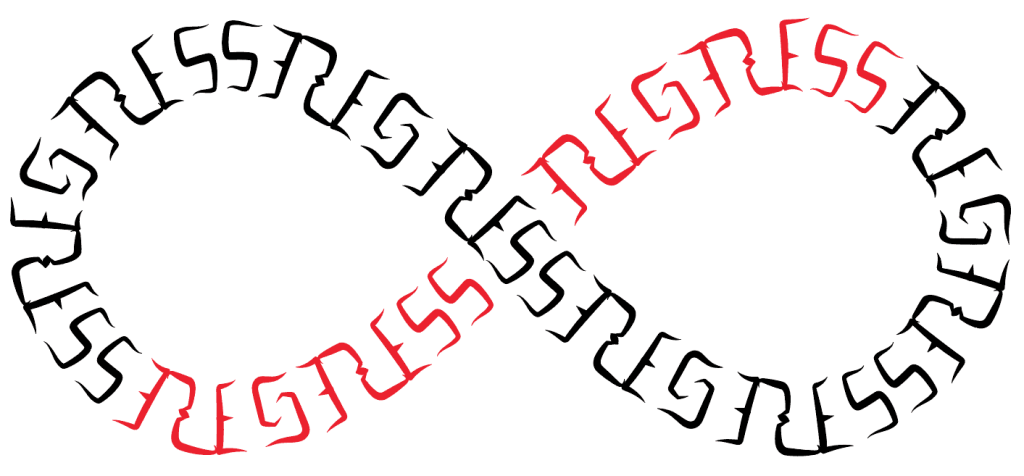
    Infinite regress ambigram (Source: Punya Mishra)

    In one of the first posts in this blog, My Unbounded Mathematical Trauma, I had shared about my trauma when students says something like, “One divided by zero equals infinity.” Unfortunately, this is something that I have heard repeated by mathematics teachers too. And I shudder when I hear such blasphemy! I say ‘blasphemy’ because division by zero is the ‘unforgiveable sin’ in mathematics and a statement like “One divided by zero equals infinity” gives the impression that it is possible to divide one by zero and obtain a number.

    However, if it is possible to divide one by zero, then the result must be a number since operations performed on numbers must yield numbers. If the result is infinity, where do we locate it on the number line? After all, the number line is a mathematical artifact that is supposed to be a visual representation on which we can locate every real number. If we are able to locate infinity on the number line, then either that must be where the number line ends, meaning that the number line itself is not unbounded, or there are numbers to the right of infinity, meaning that infinity is not something that is greater than any number.

    What we realize is that infinity is not a number, but an idea, a construct, if you will, to denote unboundedness rather than quantity, which is what every number must denote.

    Strange Infinite Series

    When we take this to the area of infinite series, we have seen that there are series that converge and those that diverge. While I haven’t discussed tests for convergence either formally or comprehensively, I think posts like Infinitely Expressed and Serially Expressed have given us a reasonable idea that infinite series need to have certain properties for them to be convergent.

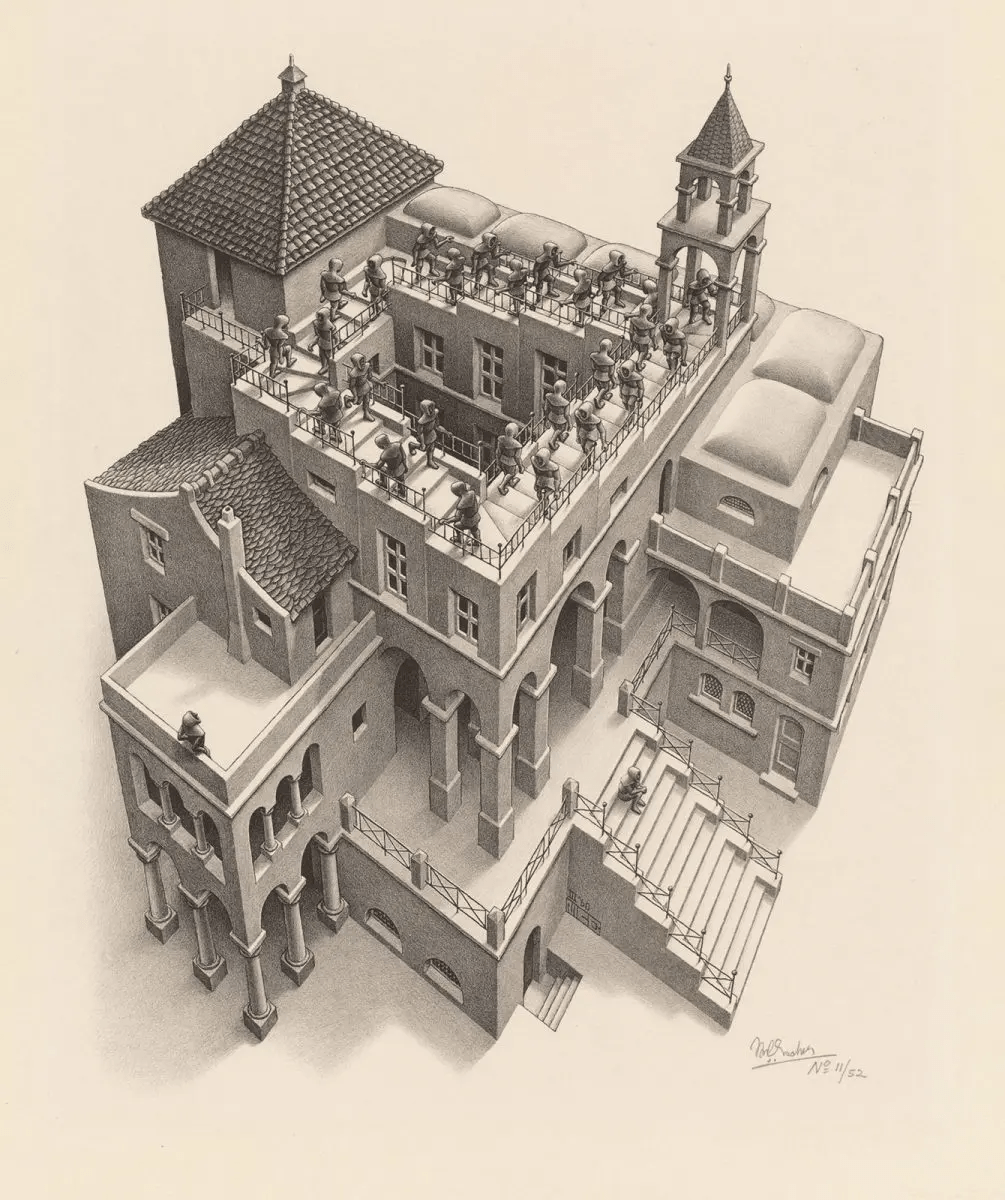
    Ascending and descending by M. C. Escher (Source: Escher in het Paleis)

    With this in mind, let us consider the series

    S = 1 – 1 + 1 – 1 + 1 – 1 + 1 – 1 +…

    This is an infinite series. What is its sum? Does it converge? If so, to what value does it converge?

    Now, we can add grouping symbols that should not alter the sum. Hence, we can have

    S = (1 – 1) + (1 – 1) + (1 – 1) + (1 – 1) + … = 0 + 0 + 0 + 0 + … = 0

    Alternately, we could have

    S = 1 – (1 – 1) – (1 – 1) – (1 – 1) – (1 – 1) – … = 1 – 0 – 0 – 0 – … = 1

    So grouping the terms changes the sum! Of course, we could use the formula for the sum of an infinite geometric series with the common ratio being -1. This would give us

    S = 1 ÷ (1 – (-1)) = 1/2

    We could have obtained the same result as follows

    S = 1 – (1 – 1 + 1 – 1 + 1 -…) = 1 – S ⇒ 2S = 1 ⇒ S = 1/2

    Clearly adding up the terms of this series is not straightforward. There is no clear indication that it diverges. But there is no clear value to which it converges. However, if we consider the partial sums of the series we get the following:

    S1 = 1, S2 = 0, S3 = 1, S4 = 0, S5 = 1, S6 = 0

    Since the partial sums alternate between 1 and 0, we say that the series is alternating.

    However, we can get even curiouser results with such infinite series. Consider the following

    S = 1 – 2 + 3 – 4 + 5 – 6 + …

    Here, the partial sums are as follows

    S1 = 1, S2 = -1, S3 = 2, S4 = -2, S5 = 3, S6 = -3

    If we group the terms we can get

    S = (1 – 2) + (3 – 4) + (5 – 6) + … = -1 – 1 – 1 -…

    It is clear that this way the series diverges toward negative infinity. However, we can also group the terms as follows:

    S = 1 – (2 – 3) – (4 – 5) – (6 – 7) – … = 1 + 1 + 1 + 1 + …

    In this case, the series diverges to positive infinity! Of course, the partial sums did indicate this since they alternated in signs while increasing the magnitude.

    Since all the methods give us different answers, what we realize is that, with divergent or alternating series, grouping of terms does not help a bit.

    Of course, infinity leads us to some additional strange results. For example, we know that the set of natural numbers is

    N = {1, 2, 3, 4, 5, 6, …}

    We also know that the set of even numbers is

    E = {2, 4, 6, 8, …}

    However, for every natural number, it is possible to multiply it by 2 and obtain an even number. In this sense the set mapping elements in N to elements in E can be listed as

    M = {(1,2), (2,4), (3,6), …}

    It is clear that no element in N will be excluded and that every element in E will be included. In other words the number of elements in N is the same as the number of elements in E even though it is clear that E excludes the odd numbers!

    The Infinity of Rational Numbers

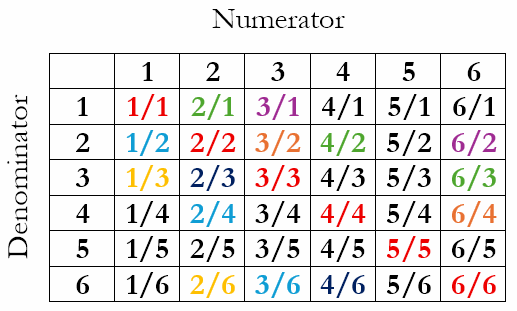
    In fact, even the rational numbers can be mapped to the natural numbers. Let us arrange the rational numbers in a grid as shown below.

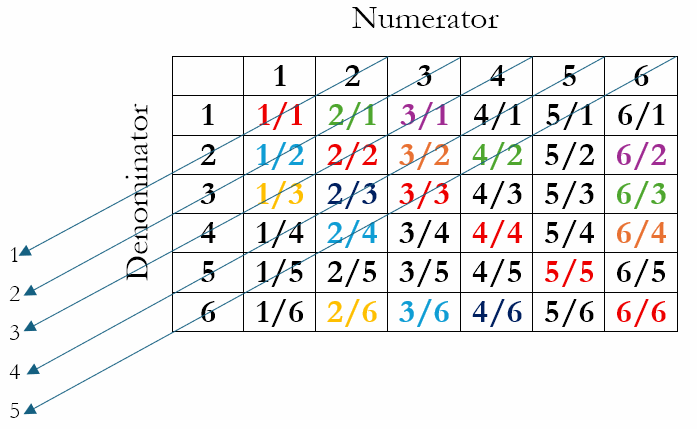
    Here, the numerator corresponds to the column while the denominator corresponds to the row. Hence, the element in row 5 and column 3 will be 3/5. Of course, we can have rational numbers that are equal but appear in different cells. This is because we have equivalent fractions. These are indicated above with the same color. Hence, all numbers in red are equivalent to , while all in light green are equivalent to 2, and so on. Now, since each row and each column has an infinite number of elements, we cannot simply go down a row or a column and hope to reach all the rational numbers. For example, if we simply choose to go down the first row, which simply includes all natural numbers, we will never get to row 2! However, as can use a process of diagonalization as shown below

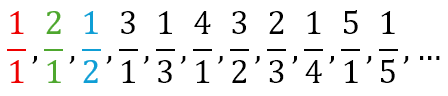
    Here we go down the diagonals in the order indicated by the numbers on the left. With this order, the rational numbers are reached in the following order

    If we eliminate all the equivalent fractions, we will get

    Since the numbers are being reached diagonally, every cell will be reached after a finite number of moves. It is crucial to recognize that the numbers are not arranged in any numerical order. If we include negative numbers, we could do something like

    Hence, we can map every rational number, without repetition, to the natural numbers, meaning that the number of rational numbers and the number of natural numbers is the same!

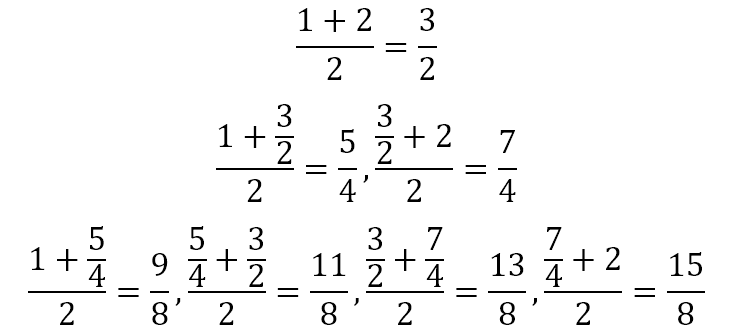
    This is obviously counter-intuitive. After all, suppose we consider two consecutive integers, say 1 and 2 for convenience. We can generate rational numbers between 1 and 2 as follows

    This means that between any two consecutive natural numbers there are infinitely many rational numbers. Despite this, as we have shown, it is possible to map every rational number to a natural number. Let the weirdness of this sink in. Though there are infinitely many rational numbers between any two consecutive natural numbers, there is a way of mapping every rational number to a natural number.

    Brief Introduction to Cardinality

    The property that between any two rational numbers it is possible to generate at least one more rational number between them constitutes the set of rational numbers as a ‘dense’ set. However, it is clear that the natural numbers are not ‘dense’ since there is no natural number between consecutive natural numbers. Hence, it is strange that a one to one mapping from the rational numbers to the natural numbers exists. In set theory, all sets that share this one to one mapping with the natural numbers are said to have the same cardinality of ℵ0, aleph-nought. Here, ‘cardinality’ gives us a measure of the ‘size’ of the set and ℵ0 is the ‘smallest’ cardinality that a set with infinite members can have. Other sets that have cardinality of ℵ0 are integers, square numbers, cube numbers, constructible numbers, algebraic numbers, etc. If we take the union of all these sets, even this union set would have cardinality of ℵ0 since we can rotate between different sets, ignoring any duplications along the way.

    However, cardinality of the real numbers is different because they include other numbers, like the transcendental numbers, making it impossible to map the real numbers to the natural numbers. The cardinality of the real numbers is hypothesized to be ℵ1, the next larger element in the set of alephs. As of now, this is still a hypothesis.

    The Perils of Infinity

    What we can see is that ‘infinity’ is much weirder than we might ever have imagined. Not only have we seen that it is possible to map one ‘infinity’ (the natural numbers) to an ‘infinity of infinities’ (the rational numbers) but also that there are ‘infinities’ that are ‘infinitely larger’ than the intuitive ‘infinity’ obtained simply by counting upward without end. When students and (shudder) teachers treat ‘infinity’ in a trivial manner as though it were simply a very large number that can be located on the number line, for example by repeating or condoning statements like, “One divided by zero equals infinity,” they reveal that they have failed to understand the fact that the term ‘infinity’ is not used to denote a number but a conglomeration of idea that is itself ‘infinitely’ rich.

  • The Seedbed of Mathematical Fecundity

    Playing around with numbers is something that many, if not most, people who are fascinated with mathematics engage in. Most of the playing around does not lead to anything ‘productive’ in the sense that the results could find some practical application in real life. However, this does not stop people from just playing around with numbers. In a few cases, the playing around leads to some insights, as we saw in Arithmetic Doodling. In some cases, the insights seem so profound or intriguing that the person who reaches these insights decides to formalize it in a form of a conjecture.

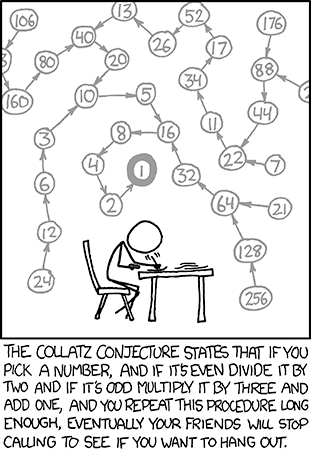
    (Source: xkcd)

    In mathematics a conjecture is a statement that is offered without a proof. Since there is no proof, a conjecture is not taken as true. Conjectures are normally the result of uncountable hours of play with numbers. It is, in fact, impossible to start with a conjecture since one must have sufficient evidence to formulate a hypothesis, which would then require many more trials to test the hypothesis before a ‘dabbler’ or ‘doodler’ feels confident enough to propose a conjecture.

    Once a conjecture is proposed it invites others to join in the play time by pooling their resources to proving or disproving the conjecture. Hence, conjectures have often been seedbeds for the development of other insights into mathematics and the properties of numbers. Indeed, if the conjecture is tantalizing enough, it can provide grounds for fruitful exploration of mathematics. Here, I wish to discuss two conjectures that have fascinated me for years.

    The Goldbach Conjecture

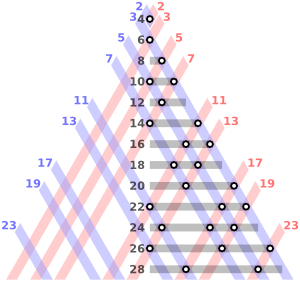
    On 7 June 1742, Prussian mathematician Christian Goldbach wrote a letter to Leonard Euler. In this letter he proposed the following: “Every integer that can be written as the sum of two primes can also be written as the sum of as many primes (including unity) as one wishes, until all terms are units.” At that time, 1 was considered to be a prime number. However, in Cooking the Books I discussed why it is no longer considered to be prime. Goldbach’s initial proposition is quite puzzling. I means, every integer can be written as the sum of a series of ‘1’s! Of course, Goldbach himself recognized this and, later in the same letter, wrote, “It seems that every number that is greater than 2 is the sum of three primes.” Removing the idea that 1 is a prime number, we get the following, contemporary version of the conjecture: “Every even counting number greater than 2 is equal to the sum of two prime numbers.”

    Sums of primes yielding even numbers. (Source: Wikipedia)

    We can check these for some even numbers. For example, 4 = 2 + 2, 6 = 3 + 3, 8 = 3 +5, 10 = 3 + 7 = 5 + 5, 12 = 5 + 7, 14 = 3 + 11 = 7 + 7, and so on. As we consider larger even numbers, we are also reaching regions of the number line where the prime numbers are more sparse. Hence, it would seem that the conjecture could break down for sufficiently large even numbers. However, as of 2013, the conjecture has been shown to hold for prime numbers as large as 4×10¹⁷.

    (Source: xkcd, for explanation see here.)

    Why would this be important? What kind of use could the conjecture be put to if it could be proven? Today, most methods of encryption rely on large primes. For example, if I gave you the number 19939 and you knew that this was the product of two primes, then a short search would yield 127× 157 = 19939. If I gave you 2991119, you would take a bit longer to realize that 1549 × 1931 = 2991119. If we instead used two large even numbers, the key could be enhanced to involve appropriate factorization of the product and then selecting the larger prime of the Goldbach decomposition of the larger even factor and the smaller prime of the Goldbach decomposition of the smaller even factor (or the other way around), thereby increasing the complexity of the decryption.

    The Collatz Conjecture

    The second conjecture I wish to deal with was proposed by German mathematician Lothar Collatz in 1937. The conjecture involves a starting number and operations performed on the number to get the next number in the sequence. If the number is even, it is divided by 2. If the number is odd, it is multiplied by 3 and 1 added to the result. The question is: Does the sequence reach 1 no matter what the starting number is?

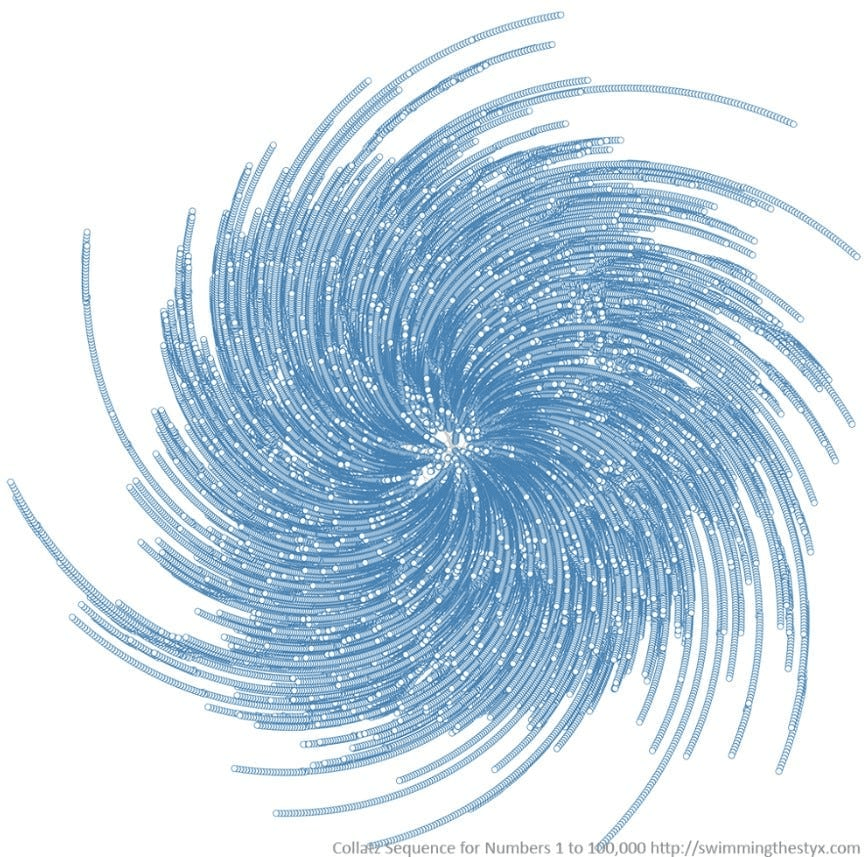
    Depiction of Collatz sequences. (Source: Cantor’s Paradise)

    For example, starting with 15, we get 15, 46, 23, 70, 35, 106, 53, 160, 80, 40, 20, 10, 5, 16, 8, 4, 2, 1. Similarly, starting with 29, we get 29, 88, 44, 22, 11, 34, 17, 52, 26, 13, 40, 20, 5, 16, 8, 4, 2, 1. And starting with108 we get 108, 54, 27, 82, 41, 124, 62, 31, 94, 47, 142, 71, 214, 107, 322, 161, 484, 242, 121, 364, 182, 91, 274, 137, 412, 206, 103, 310, 155, 466, 233, 700, 350, 175, 526, 263, 790, 395, 1186, 593, 1780, 890, 445, 1336, 668, 334, 167, 502, 251, 754, 377, 1132, 566, 283, 850, 425, 1276, 638, 319, 958, 479, 1438, 719, 2158, 1079, 3238, 1619, 4858, 2429, 7288, 3644, 1822, 911, 2734, 1367, 4102, 2051, 6154, 3077, 9232, 4616, 2308, 1154, 577, 1732, 866, 433, 1300, 650, 325, 976, 488, 244, 122, 61, 184, 92, 46, 23, 70, 35, 106, 53, 160, 80, 40, 20, 10, 5, 16, 8, 4, 2, 1

    The Collatz conjecture has been shown to hold to 2.36×10²¹. However, as of today, no proof has been forthcoming. Indeed, no one has even suggested what its applications might be should the conjecture be proven at some stage. Despite this, the Collatz conjecture highlights the complex behavior of numbers that can be obtained using the simplest rules.

    At its roots, the Collatz conjecture asks the question, “Can repeating the same sets of operations in an iterative manner always lead to the same result?” The fact that it is impossible to predict how many iterative steps it will take for a given starting number makes the Collatz conjecture particularly intractable.

    An Invitation to Play

    The two conjectures reveal how playing with numbers can yield deep insights. The Goldbach conjecture concerns the properties of numbers themselves. While it may have started in Goldbach’s mind as a simple though experiment, perhaps even a game, it has developed into something quite serious with possible applications in the protection of information. The Collatz conjecture concerns the properties of the basic operations on the numbers. It is still in the playful stage, with no real applications even being suggested. We can tweak the numbers to see if there are Collatz-like combinations of numbers and operations that share similar properties.

    Both conjectures germinated in the ‘what ifs’ asked by the mathematicians to whom they owe their existence. Both are extremely simple to state. Both are quite straightforward to test for any given starting number. However, their simplicity belies the deep complexity at the heart of the conjectures.

    Since conjectures are not theorems, they are not normally given the high place on a pedestal that theorems are given. However, once a theorem is proven, there normally isn’t much of a rush to find a different proof. There are, of course, some notable exceptions to this. However, conjectures, by their very nature, invite mathematical exploration. They present something that is still not settled and invite the dabbler or doodler to attempt to settle the matter one way or the other. I have briefly discussed just two such intriguing conjectures. I just hope I am alive when one of them is either proven or disproven.
  • A Mechanism of Domination

    Starting the Critique

    (Source: Euroschool)

    I don’t want you to get the wrong idea either while or after reading this post. At the risk of sounding like I’m blowing my own trumpet, let me just state that I have a really good test taking temperament. I have an excellent memory and am able to think on my feet. Moreover, I am rarely flustered by high pressure situations. However, I have reached a stage in life where I think that tests and exams are detrimental to student learning and health.

    During my career spanning a few decades now, I have encountered students who were exceptionally brilliant. However, closed spaces and proximity to others gave them the heebie jeebies, which adversely affected how they fared during testing conditions. Someone may argue that most exam boards now have accommodations for students with special needs, be these learning needs or mental health needs. This is true. However, in many parts of the world, special needs are either not diagnosed effectively or are too expensive for the school to accommodate. If a school only has funds for one designated exam room, then expecting it to provide a separate room for each student with different needs is not just ridiculous, it is unjust.

    Red Herrings

    Some people may say that exams and tests help students develop time management, stress management, and critical thinking skills. I find these claims to be quite disingenuous. First, if the testing environment itself is generating the stress, then it’s not an environment that is developing stress management skills. That’s like saying that a bully helps you develop the skills to stand up for yourself! Indeed, this argument fails to address the issue of stress itself. Why are we okay with environments that create stress? After all, to say that a student must develop stress management skills in the context of exams is to say that the kind of stress developed in an exam is like what we would experience outside the exam. But this is evidently not true. I have experienced many stressful exams, but none of them were in any way helpful in managing the kind of stress that visits us uninvited in life. Indeed, in the real world, many stressful situations can be diffused precisely by walking away, something that is just not available in an exam.

    Second, I do not know of any situation in the real world, apart from catching a flight or a train or making it for an interview or making an exquisite dessert, where management of time for a period of about 2 hours makes or breaks your future. Time management can be learned in many other ways. In fact, asking someone to make a batch of brownies would be a better way of teaching time management since you have to ensure that the butter is hot enough to stay melted but not so hot as to scramble the eggs when you break them into the batter! The idea of creating an artificial environment in which time management is critical is in my view only a way of exercising power over the student who has no say in the matter.

    Third, exams may help people develop the ability to think on their toes. However, flying by the seat of one’s pants is not critical thinking! That is winging it. Critical thinking must include the ability to reflect on the solutions one has reached and to critique them dispassionately with the intention of discarding unrealistic solutions and improving inefficient ones, which is not possible in the context of an exam. Asking someone to think clearly while they have a gun to their head is not developing critical thinking skills, but allowing survival responses to rule the day.

    Elevating Mediocrity

    However, the problems with tests go much deeper. As mentioned, the environment created is artificial. Each candidate is expected to think on their own within a limited time with no opportunity of seeking the wisdom and guidance of those who have gone before them. This creates a mentality in which collaboration, which is critical in the real world, is thrown into the rubbish heap and declared to be off bounds. Further, an exam, in which no breaks are permitted, is not how anything in life works. In a day at work, most people will have time for a coffee break or lunch with colleagues and friends. These breaks rejuvenate the mind and can even stimulate it. They allow us to step away from the problem at hand, which is often essential to getting the creative juices flowing again. This is proscribed in the exam environment. However, expecting someone – even a strong introvert like me – to sit for 2+ hours on a series of disconnected tasks, is a recipe for mediocrity, not excellence, because the creative process is not allowed to develop and flourish. It conveys the idea that problems can be fixed by a single person in a matter of minutes. It is no wonder that patience and perseverance are in short supply these days. In my view, any real world problem that is worth solving requires investment of time and collaboration between humans that the exam system belies.

    Choosing Conformity

    “Viewing the Pass List” Qiu Ying (仇英) (attributed) (Source: Wikipedia)

    Of course, we can understand that this would be the case if we just inquired about the origins of the exam system. The earliest known system of exams was the Imperial Examination, a civil examination administered in Imperial China for the purpose of selecting candidates who would serve in the state bureaucracy. A system of formal exams was introduced in England in the early nineteenth century, again with the intention of selecting civil servants. When the British took over in India, they introduced similar exams, all with the purpose of selecting civil servants.

    Now, let us ask ourselves a very pertinent question: Do governments select civil servants for creativity or conformity? Quite obviously the latter. We do not want civil servants to be engaged in creative bookkeeping or flights of fancy while interpreting the law of the land! No! In such situations, we desire and demand strict conformity. And there is no denying that exams conducted by governments are good at selecting candidates who will conform.

    However, human flourishing will not happen if conformity is given pride of place. Indeed, we almost certainly ensure that the creative impulses in most people are quenched when we tell them that the straitjacket of exams is the way to move ahead in life. It is no wonder that so many students emerge from high school and college completely jaded. After all, if we have killed in them what made them human, namely the impulse to create and speculate and imagine, then we should not be surprised if they emerge with a cynical view of the world.

    Lipstick on a Pig

    However, let us be brutally honest. The exam system was developed by governments to select people from the citizenry who would best execute and enforce what the government wanted in the nation. They were never designed to promote creative thinking or out of the box imagination. They were intended to be ways in which the nation controlled the masses, not empowered them. This is why memorization of arcane facts, accuracy with basic arithmetic, and repetition or identification of rules and regulations feature prominently in most exams.

    Exams may have changed their face today. Many do not require mere memorization and regurgitation of facts. Many include attempts at promoting creativity. Many include attempts at introducing real world application. However, creativity cannot be dictated by the clock and application often requires a good night’s sleep before the lightning bolt of an idea strikes. Of course, exams still deny the fact that we are human and can develop as humans only in collaboration with others. Expecting someone to think of a bunch of new ideas thrown at them at random in a span of a couple of hours is inhumane. However, if control is what we desire, then exams are the best way to ensure it. And so, all the sweeping changes in exams over the past decades are in reality nothing more than putting lipstick on a pig. The changes are superficial precisely because what the exams are intended to do cannot be aligned with the needs of most humans.

    Control Mechanism

    You may ask me what the way ahead might be. If I am so strongly opposed to exams, how do I think we should assess students? The question presupposes that assessing students is necessary. But what are we assessing them for? And what is the purpose of assessment? Why are high school students, for example, expected to write a series of exams toward the end of their program? Why is the student who just wants to become a field anthropologist expected to display competence in business or mathematics? Why is the student who wants to become an artist expected to demonstrate acumen in biology or geography? Why is the student who wants to become a hairdresser expected to show knowledge of physics or history? Why is the student who wants to undertake biochemistry research expected to indicate skill with economics or a second language? We have straitjacketed programs that do not actually serve most students. And then we complain that they lack motivation and throw up our hands in wonder.

    But someone may say that kids really don’t know what they want to do in life. Hence, we must give them exposure to a wide variety of options. This is simply a way of saying that we do not actually wish to invest the time and effort to mentor each child so that he/she can discover what most motivates him/her. We only want to give them a superficial overview of a whole gamut of human knowledge, but nothing to such a depth as would actually capture their imaginations and fire up their spirits. Expecting every student to learn the same thing is simply a way of throwing in the towel and reneging on our responsibility, as the adults in their lives, of providing meaningful guidance.

    However, if we devote time with each student to help them discover what drives them, we will realize that exams are precisely not the way to do it. Indeed, nothing that provides an external reward, in this case grades or college admissions or a job, can ever fire up the spirits. Our spirits, you see, are not need driven. The basic animal needs – food, shelter, clothing – do not inspire the spirit. Hence, anything that promises to put food on the table or a roof above our heads or clothes on a backs can never become something that captures our imagination. This is why most people consider their jobs just a drudgery to be endured, something that provides options for the weekend. However, what the dichotomy between the week and the weekend develops is the sense that the latter exists just so that we can ‘get away’ from what the former involves. This causes confusion because, with this paradigm, we are always unsure which our real life is, the five or six days of toil or the day or two of getting away from it.

    Straitjacket curriculums culminating in exams are designed to produce people who will conform to this dichotomy and confusion. They are designed precisely to ensure that most people will spend most of their time disliking what they are doing but doing it do that they have some respite from the drudgery for one or two days of each week. In other words, straitjacket curriculums and exams are precisely parts of a system of domination to ensure that very few of us will ever be able to truly flourish by enjoying what we do day in and day out.

    Breaking Free

    What I advocate is a system of mentorship between a student and a mentor in which the vast majority of adults play the part of mentor to some child or the other. The mentor is not a ‘know it all’ but someone who knows of people who have expertise in a wide variety of fields. If a student wants to learn about colonialism in India, the mentor can direct her to an expert. If the student wants to learn about the physiology of a horse, the mentor points her to an expert. In this way we get the modern equivalent of “it takes a village to raise a child.”

    What this means is that industry takes the onus of training the next generation of young learners. They do not merely profit from the investment of parents and teachers and schools over the years, but must actually contribute to the learning of the students who choose to be pointed in their direction. Hence, if a student expresses the desire to learn about designing cars, the mentor points her to an automobile company. And the company is expected to take the student on and show her how cars are designed. If another students wants to learn to cook Korean food then the mentor directs him to a chef who then teaches him the art of making Korean food. I expect there will be push back from many people here. Why should companies play such a role. Well, in the past, a blacksmith who hoped to expand his trade would have taken on an apprentice and shown him the ropes of the blacksmithy. The blacksmith would have invested the time and effort to pass on his skills to the apprentice. Those who hope to benefit from the skills of someone should be expected to contribute to the development of those skills in that person.

    Someone may say that this is impractical. Why? Are we not motivated enough to provide meaningful guidance to the next generation of humans, the ones who will carry the torch after our candles have been snuffed out? Some may say that it makes things very complicated. Of course it does! Each child is different! How can we say that a straitjacket curriculum will ever be beneficial to most of them? However, our responsibility to the next generation cannot be sacrificed on the altar of expediency. Expediency, however, is the way a system of dominance functions. Everyone has to be treated the same way. This ensures that control by the powers that be is possible. If everyone is made to pass through the same doors, then supervision of the majority by a minority is possible.

    Of course, this is done, deceptively in my opinion, under the banner of equality. However, equality is not equity. Equality denies the idiosyncrasies and circumstances of each person while equity recognizes them. A unilateral decision by the powers that be that a child who wants to draw must learn his numbers or that another who wants to play with numbers must make her drawings is not equity. It is actually not even equality. It is oppression. And for too long we the masses have allowed governments, prestigious universities, large companies, and publishing houses to place us in situations of oppression whose quintessential element during our formative years is the examination.

  • Reading Recommendations

    For today’s post, I wish to briefly two books that delve into mathematical themes. So here goes.

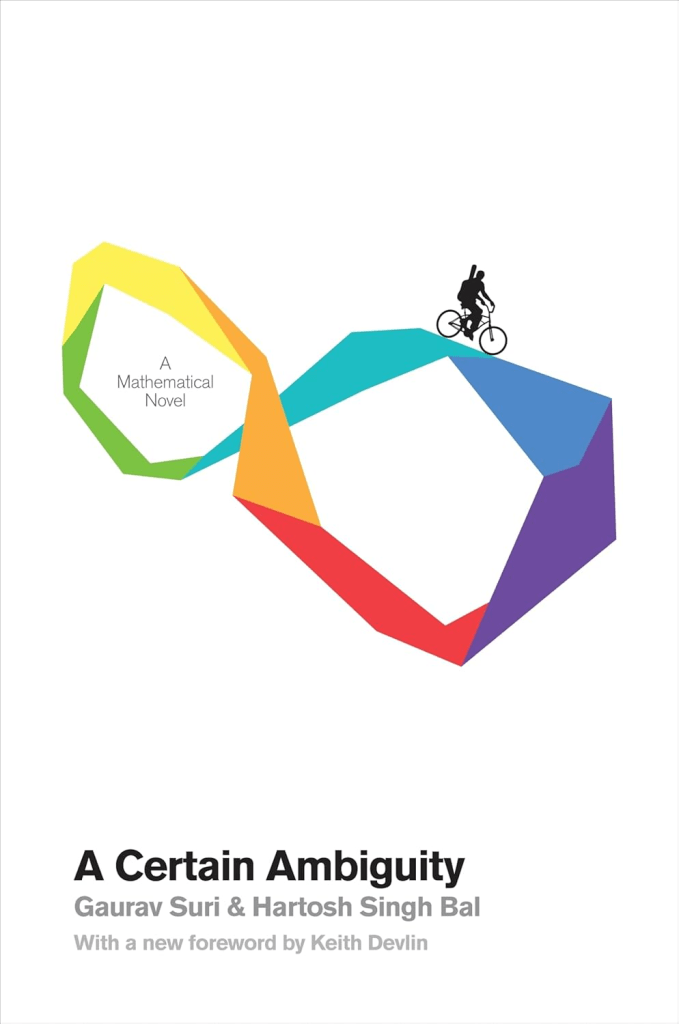
    Book Review: A Certain Ambiguity by Gaurav Suri and Hartosh Singh Bal

    Gaurav Suri and Hartosh Singh Bal. A Certain Ambiguity: A Mathematical Novel. (New Delhi: Penguin, 2007). Available on Amazon.

    Quite out of the blue, a colleague of mine gifted me a book toward the end of the 2018-2019 academic year. It was an unexpected gift, but quite timely since I did not have any holiday reading planned. I guess my colleague chose the book because I am a Mathematics teacher. I wonder, though, how many people would be attracted to a book that purports to be ‘a Mathematical novel’!

    I was, however, quite eager to get started with the book. The protagonist of the novel is one Ravi Kapoor, who is a student at Stanford. His grandfather, Vijay Sahni, had been a Mathematician and had instilled in Ravi a love for Mathematics. When Ravi reaches Stanford, he enrolls in a Mathematics course called Thinking About Infinity taught by Professor Nico Aliprantis. During discussions related to the course, Ravi mentions his grandfather, whose name Nico recognizes. When Nico pulls out a paper written by Vijay, Ravi reads a note that indicates that Vijay had been in prison in New Jersey in the early twentieth century. That sets Ravi on a course to discovering why his grandfather had been imprisoned. His digging reveals that Vijay had been charged under an obscure blasphemy law in New Jersey.

    The novel is like a braid, with three strands running through it. One strand, of course, is that related to the discussion in the course taught by Nico. The second consists of fictionalized memoirs of various Mathematicians ranging from Euclid to Gauss. The third consists of conversations between the grandfather, Vijay, and Judge John Taylor, appointed to decide whether Vijay should go on trial or be set free. Since Vijay was charged with blasphemy, these conversations also touch on religious themes.  The three strands are woven intricately and play off each other extremely well.

    As the title suggests, the book narrates how Vijay and Ravi searched for certainty within Mathematics. I’ll just leave it at that without revealing the outcome of their search. That is for you to discover for I wholeheartedly recommend the book to anyone who either loves Mathematics or enjoys a well crafted tale.

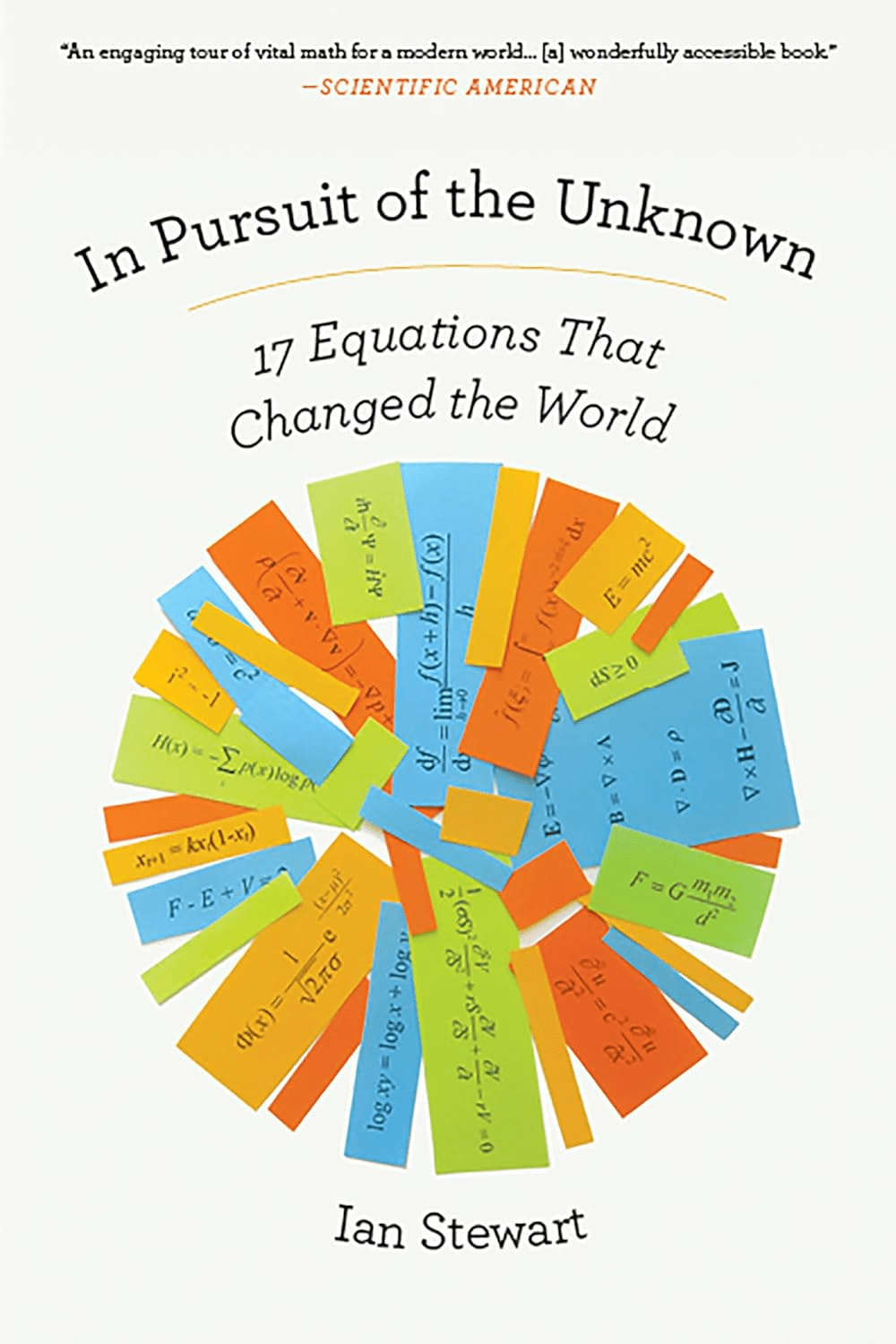
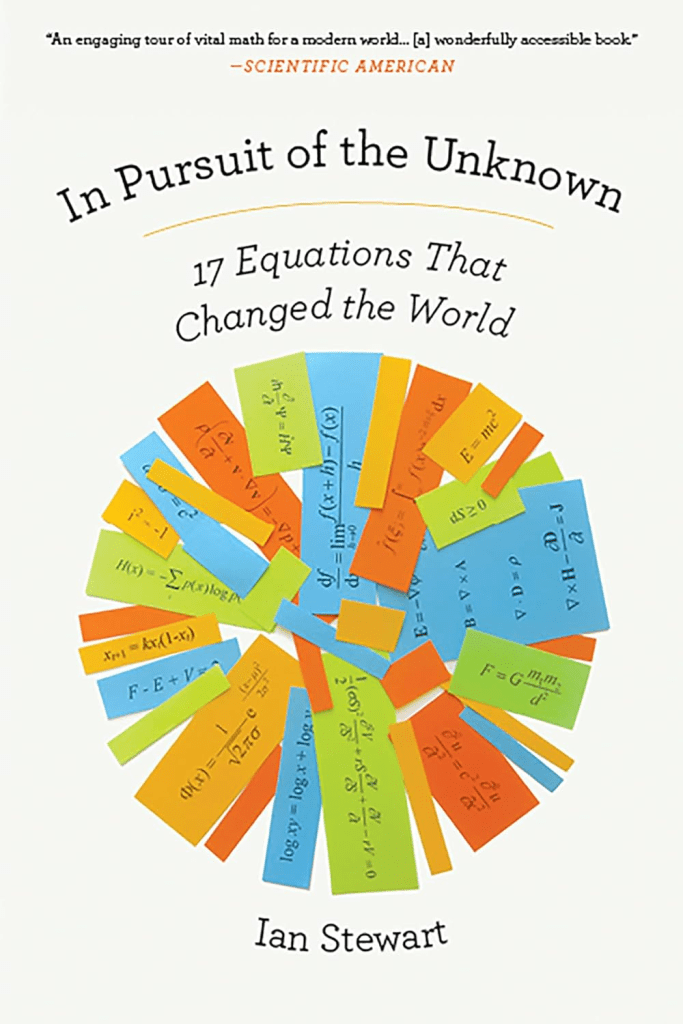
    Book Review: In Pursuit of the Unknown by Ian Stewart

    Ian Stewart. In Pursuit of the Unknown: 17 Equations that Changed the World. (New York: Basic Books, 2012). Available on Amazon.

    I stumbled across this book when a friend mentioned it to me, albeit in quite a vague manner. Once I read the subtitle, of course, I was hooked. As someone who has loved Mathematics for as long as he can remember, I could not resist the temptation to read a book about how Mathematical equations have played a key role in giving us the world we live in today.

    As the subtitle suggests, Stewart describes the meaning and influence of seventeen Mathematical equations from all sorts of domains – from geometry to physics and from signal processing to economics. Some, such as the Pythagorean Theorem and E=mc2, are what one may call ‘usual suspects’ given that they have entered common discourse even if most people have no clue about what the equations mean or of how to use them. Others are more elusive, such as the Navier-Stokes equation and the Black-Scholes equation, the knowledge of which is restricted only to a handful of people in the know. Still others, such as the second law of thermodynamics and the definitions of the derivative and the imaginary number i, might cause high school students around the world to shudder.

    Stewart does a commendable job both of describing the meaning of each equation and of outlining its uses. While some knowledge of Mathematics is definitely helpful, Stewart has not targeted the book toward those with much knowledge of Mathematics. This makes the book far more accessible that it otherwise would have been.

    Stewart also does not shy away from the downsides of using Mathematics. He shows that, when Mathematics is used as a tool within other disciplines, the ethical considerations must be dealt with within those disciplines for Mathematics itself is unconcerned about such issues. Thus the power of Mathematics is itself a major drawback for, in allowing itself to be used by other disciplines, it subjects itself to the whims of those disciplines.

    The book, as a whole, is a remarkably good read and I could not put it down once I began. For those who benefit daily from the usefulness of Mathematics and who still wonder about why it is taught in schools, I would recommend this book as an eye-opener. Of course, I would recommend this book to anyone who has an inkling of curiosity coursing through their veins!

  • Arithmetic Doodling
    Photo by Scott Webb on Pexels.com

    Some years ago, I came across a puzzle that asked if I could use exactly six ‘4’s and the four common operations (+, -, ×, and ÷) to give the result 24. Of course, the trivial solution is 4 + 4 + 4 + 4 + 4 + 4 = 24. But after a little bit of thought I came up with (4 + 4 + 4) ÷ 4 + 4 + 4 =24. Some more thought yielded (4 + 4 + 4) × (4 + 4) ÷ 4 = 24. And a little more thought yielded (4 + 4 ÷ 4 + 4 ÷ 4) × 4 = 24. And yet more thought yielded 4 × 4 + 4 + 4 + 4 – 4 = 24. And even 44 – 4 × 4 – 4 = 24.

    Of course, if we allow exponentiation and radicals, we can have even more such solutions. For example, (√4 + √4 + √4) × (4 + 4) ÷ √4 = 24 or 4 × 4 ÷ 4 × (4 + 4 ÷ √4) = 24 or (√4 + √4 + √4) × (4 + 4) ÷ 4 = 24.

    So, I wondered if I could get any whole number this way. So here goes

    • 4 – 4 + 4 – 4 + 4 – 4 = 0
    • (4 + 4 + 4) ÷ (4 + 4 + 4) = 1
    • (4 + 4 + 4 + 4) ÷ (4 + 4) = 2
    • 4 ÷ 4 + 4 ÷ 4 + 4 ÷ 4 = 3
    • (4 + 4) ÷ 4 + (4 + 4) ÷ 4 = 4
    • (4 + 4 × 4) × 4 ÷ 4 ÷ 4 = 5
    • 4 × 4 ÷ 4 + (4 + 4) ÷ 4 = 6
    • 4 + 4 – (4 + 4) ÷ (4 + 4) = 7
    • 4 + 4 + 4 – 4 + 4 – 4 = 8
    • (4 + 4 ÷ 4) × (4 + 4 ÷ 4) = 9
    • 4 + 4 + 4 ÷ 4 + 4 ÷ 4 = 10

    We can continue in this way. I encourage you to find other patterns for the above results and to proceed beyond 10.

    Photo by Katerina Holmes on Pexels.com

    However, I wondered what the largest number might be. If we are limited to the four operations then the largest number would be 444 × 444 = 197136. However, if we allow exponentiation, then the largest number is 4^(4^(4^(4^(4^4)))) = 4^(4^(4^(4^256))) = 4^(4^(4^13407807929942597099574024998205846127479365820592393377723561443721764030073546976801874298166903427690031858186486050853753882811946569946433649006084096)). That’s 155 digits in that last number and we still have 3 more exponentiation functions to deal with! In fact, the number is so large that no publicly available computation site that I know of was able to calculate this number.

    Playing with numbers in this way has absolutely no productive purpose. It is purely a recreational activity. However, it does familiarize a person with patterns that develop when we use the mathematical operations. With respect to the above 444 × 444 versus 4^(4^(4^(4^(4^4)))), we may ask, why 4^(4^(4^(4^(4^4)))) is so large, but 4 × 4 × 4 × 4 × 4 × 4 = 4096 is not as large as 444 × 444. Indeed, we can even check to determine that 444^444 = 274181867963021452236233098115415899720776205798649755793667915961236790274589588340150992768838522033181214516284285332773163064469482041901003908126050422955612888919193934414520264211619150516791746766169089527422112735455691316517219258451182646508224779320212392542987483229069236254216598092621103632551390087850968989089099464497128935323467029182130683400149701073650091196852136571107489847564227504319046561398518922741929687815408469723169188873887882230322166952158753390120554531578647460220302381245259634634469767947795755147705092032914527384068630183109187993236769944866212774292942582416757317197927837501391362584057134071021551533313131406893521078023657100146103388103428321685173807760191113376709657657395886097014206038723956927777772422903690643103118361188528532331570074306316944892941075080102793904295150057658633501250162034388403842338437258226367135375352848005596082763545270786578951069417785335762883852191304642416990955392728403464665816357313934692154694224918478621155151771588457206018359592714202916841031166217552839560214893121104836629359007910041332262083007051081312403504450964912888379989399053705177940430208243717095550877696. This is an extremely large number with 1176 digits. However, it is clearly dwarfed by 4^(4^(4^(4^(4^4)))), which the computational engine could not even dare to calculate! It could only tell me that the result would contain over 8 × 10153 digits, which it likely calculated by repeatedly resorting to logarithms. Just to put that into perspective, current estimates of the universe say that there are about 1082 atoms in the universe.

    This gives us some insight into the power of exponentiation (pun intended!). Of course, financiers have know this, when they concocted the idea of compound interest. Indeed, if we compare simple interest of 10% p.a. with compound interest of 10% p.a. compounded annually, we obtain the following for an initial investment of Rs. 1000.

    As we can see, the difference is barely noticeable in the first few years. After 5 years, the difference is about 7.3%. However, after 10 years, it is almost 30%, while after 30 years it is a whopping 336%!

    It is this aspect of the exponential functions that makes 4^(4^(4^(4^(4^4)))) so much larger than 444^444. For large enough values of the exponent, as long as the base is greater than 1, the function will simply balloon out of control. This can be seen in the graphs below, where the graph in red is y = 1.01x, the one in blue y = 1.05x, and the one in green y = 1.1x. While the y values of the green graph will always be much larger than the values of the red graph for the same value of x, the values of all three functions explode for large values of x.

    We began this journey by playing with a set of six ‘4’s and seeing how the four operations can be used to calculate various numbers. I cannot tell you how many times just doodling like this has given me mathematical insights. So let me leave you with some doodling tasks.

    • Can you do the same kind of doodling with six ‘3’s? What about six ‘7’s?
    • How about doodling with the numbers 1, 2, 3, 4, 5, and 6? What’s the largest number you can form with these six numbers?
    • Suppose you limit yourself only to subtraction and division. What’s the smallest number you can calculate using 1, 2, 3, 4, 5, and 6?

  • Cooking the Books

    Abjuring Serialization

    Last week we finished a series on complex numbers. During this series, we took two pit stops to learn about trigonometry and calculus. Quite obviously, I have not exhausted any of these three topics. However, planning these long series is exhausting! So, for a few posts, I will refrain from serialization. Instead, I will focus on some one-off posts. I will also tone down the level of the posts to make them a little more accessible since the series on complex numbers did prove to be quite heavy.

    Now, in the minds of many, mathematics is taken to be the quintessentially objective field. After all, it is governed by logic and uses rigorous methods of proof. While this is true for the most part, there are times when some arbitrariness is permitted into the ‘rules’ of mathematics because the arbitrariness serves a greater goal. I’d like to call these instances of ‘cooking the books’ and here I’d like to discuss two such instances.

    In Its Prime

    I don’t know when I was introduced to the prime numbers. However, I do remember wondering why they were given this name. I mean, ‘prime’ sounds like these numbers are somewhat better or more important than numbers that are not ‘prime’. Despite this initial distraction, I found myself fascinated with these numbers. A prime number is defined as a natural number which is divisible only by 1 and itself. Hence, 2 is a prime number. So are 3, 5, 7, and so on. However, 4, 6, 8, and 9 are not because they have additional divisors other than 1 and themselves.

    Plot of the prime number counting function (Source: ResearchGate)

    Most students learn this kind of definition early on. However, I have discovered of late an alarming trend. Many students reach high school not knowing whether 1 is a prime number or not nor any reason for their answer.

    Now, if you scour the internet, you will find many sites that explicitly state that prime numbers have to be greater than 1. A few state that a prime number has to have two distinct divisors, thereby excluding 1 from the set of primes. In other words, the consensus is that 1 is not a prime.

    But why not? What would be the disastrous consequences of allowing 1 to be a prime? One of the main theorems of arithmetic, betrayed by its name is the Fundamental Theorem of Arithmetic (FTA), which states that every natural number greater than 1 is either prime or can be expressed uniquely as the product of prime numbers, apart from the order of the primes. Note the critical word ‘uniquely’ and the phrase about the order. So, for example, 12 = 2 × 2 × 3 = 2 × 3 × 2 = 3 × 2 × 2. Note that, since multiplication is commutative, that is the order of the products does not affect the product, the three products represent the same set of two ‘2’s and one ‘3’.

    However, note that the FTA itself excludes 1 by starting with natural numbers greater than 1. What gives? Actually, this exclusion gives us a hint of why 1 is excluded from the set of primes.

    Suppose 1 is included in the set of primes. Now, 1 is the multiplicative identity element. (Math jargon alert!) What that means is that, when you multiply any number by 1, the product is the number you started with. So we have 3 × 1 = 3, 7 × 1 = 7, and so on. But what this obviously means is that 1 × 1 = 1. And here we see the beginnings of the problem.

    If 1 = 1 × 1, then 1 = 1 × 1 × 1 and 1 = 1 × 1 × 1 × 1, and so on. Indeed, one of the few things most students remember is that 1n = 1 regardless of what n is. This obviously means that no number can be uniquely expressed as the product of primes. After all, we have 12 = 2 × 2 × 3 = 1 × 2 × 2 × 3 = 1 × 1 × 2 × 2 × 3 and so on. Indeed, there would not just be no uniqueness to the product, there would actually be an infinitely many products that could be written for any given number.

    While having an infinitely many products for a given number might not seem too troubling, it’s the reverse process that raises problems. If any number can be written as the product of any number of numbers, then how do we determine the number of factors that a number has? For example, if 12 = 2 × 2 × 3, we can count and determine that there are 6 factors, inclusive of 1 and 12. However, if 12 = 1 × 2 × 2 × 3, the number of factors remains 6 but only an explicit enumeration of the factors can give us this result. What do I mean?

    Consider 12 = 2 × 2 × 3. Any factor of 12 must necessarily be the product of powers of 2 from 20 to 22 and powers of 3 from 30 to 31. For example, 1=20 × 30, 2 = 21 × 30, 3 = 20 × 31, 4 = 22 × 30, 6 = 21 × 31, and 12 = 22 × 31. Indeed, if a number N can be written as

    where

    are prime numbers and

    then any factor of N can have as its own factors

    That is, there are ak + 1 possibilities for the prime number pk.

    This is why, for 12 = 2 × 2 × 3 = 22 × 31, the number of factors is (2 + 1) × (1 + 1) = 6.

    However, if we allow 1 to be a prime number, how many factors does an arbitrary number have? We wouldn’t be able to count because one person may decide that 1 only appears as 10, while another may say it appears as 123. The first person would determine that 12 has 6 factors, which is correct, while the second would determine that it has 144 factors, which is obviously incorrect.

    Precisely because 1 it the multiplicative identity element, it cannot serve the purpose of determining factors because dividing any number of times by 1 does not change the number. Because of this, including 1 as a prime would not just be problematic, but would actually undermine many things we hope to achieve using the theorems of arithmetic. Hence, 1 is somewhat arbitrarily defined not to be a prime number.

    A Matter of Choice

    Pascal’s triangle (Source: SciencePhotoLibrary)

    The second example of ‘cooking the books’ arises in the field of combinatorics, dealing with permutations and combinations. One of the most common short forms used in this field is that of the factorial, denoted with the ‘!’ symbol. Here, n! is defined as

    That is, the factorial of n is defined as the product of all the natural numbers from 1 to n. Hence, 3! = 1 × 2 × 3 = 6, 4! = 1 × 2 × 3 × 4 = 24, 5! = 1 × 2 × 3 × 4 × 5 = 120, etc. Now, given n distinct objects, the number of ways of choosing r of them is given by nCr, which is defined as

    Hence, we can calculate as follows

    an so on. Let us make the above a little more specific, observing the, when we make a choice, the order in which we choose items is irrelevant. Hence, from the set {A, B, C, D, E}, selecting A and then B is the same as selecting B and then A. So, the 10 different selections we can make from the five distinct items A, B, C, D, and E are AB, AC, AD, AE, BC, BD, BE, CD, CE, and DE.

    In much the same way, given the seven items A, B, C, D, E, F, and G, the 4 item selections will be ABCD, ABCE, ABCF, ABCG, ABDE, ABDF, ABDG, ABEF, ABEG, ABFG, ACDE, ACDF, ACDG, ACEF, ACEG, ACFG, ADEF, ADEG, ADFG, AEFG, BCDE, BCDF, BCDG, BCEF, BCEG, BCFG, BDEF, BDEG, BDFG, BEFG, CDEF, CDEG, CDFG, CEFG, and DEFG. Hence, as calculated above, there are 35 ways of making 4 item selections from 7 distinct items.

    Now, we come to the problem. How many ways are there of selecting 5 out of 5 or 7 out of 7 items? Obviously, the answer is 1. Given the items A, B, C, D, and E, there is only 1 selection, i.e. ABCDE, that contains all 5 items. Similarly, given the items A, B, C, D, E, F, and G, there is only 1 selection, i.e. ABCDEFG, that includes all 7 items. However, what does the formula above give us? Plugging in 5 and 7 into the formula we get

    In general, we obtain nCn as

    We get the same when we want to select none of the n items because

    However, the number of ways of selecting no items out of n items is obviously 1, namely the empty set, denoting that none of the items were selected. Hence, we can conclude that

    However, the equation

    can only be true if 0! = 1. However, this does not align with the definition of the factorial. However, to ensure that nCn and nC0 are meaningful, which they are, and can be meaningfully calculated, we quite arbitrarily define 0! to be equal to 1.

    Fits and Starts

    What we have seen are two instances in which something that defies a definition is force-fit with a new definition because there are many gains to be had by doing so. Mathematics, while objective for the most part, permits some arbitrariness when the benefits outweigh the losses. Actually, we have seen this earlier in The Quantifiers Strike Back, where we saw that, in order to ensure closure of some operation, we were required to expand the number system. This is something that mathematicians have done for ages. However, every new arbitrary inclusion is often met with opposition. And rightly so. We do not want just about any arbitrary idea to be added on to our edifice of mathematical knowledge. However, through debate and discussion, often including some quite harsh ad hominem attacks, mathematicians slowly get convinced that some ideas are better than excluded. And so, in fits and starts, mathematics, like any other branch of human knowledge, advances.

  • Forms of Complex Numbers

    Photo by Tomas Anunziata on Pexels.com

    In the previous post, The Tripartite Fugue, we finally obtained the exponential form for complex numbers. As mentioned in the previous post, we will conclude our series on complex numbers today. Here I wish to explore a couple of aspects of complex numbers that become evident from the exponential form. I also wish to relate the rotational aspect of complex numbers to the idea of negation that we saw in A New Kind of Number?.

    Let us begin our final exploration by reminding ourselves of the three equivalent forms for complex numbers we have obtained. So far we have

    In the polar and exponential forms we recognize that, due to the periodicity of the trigonometric functions and fact that θ represents a rotation, there are infinitely many values of θ that, when used in the polar or exponential forms, could give us the same complex number.

    Addition of Complex Numbers

    Now, let us consider two complex numbers

    In polar form these would be

    If we attempt to add the two complex numbers we would obtain

    Special Case 1: r1 = r2 = r

    Now, there is very little we can do to simplify the above. However, if we have the case where both complex numbers have the same modulus r, we can get

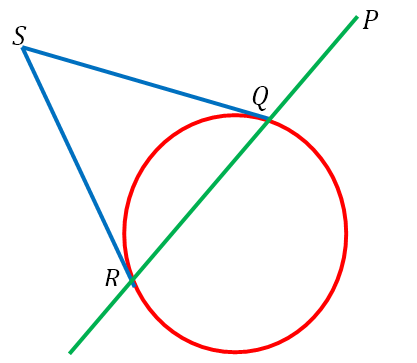
    Here, we can recognize that the term in blue is a pure rotation, which must mean that the term in term gives us the modulus of the resultant complex number. Now, if we step back and think about what this represents, we can see that the two complex numbers z1 and z2 form adjacent sides of a rhombus, one inclined at θ1 with the real axis and the other at θ2. Quite obviously, the addition of the two gives us the complex number represented by the diagonal, which must bisect the angle between the two sides, meaning that it must be inclined at an angle of (θ1 + θ2)/2 with the real axis. Further, it is easy to show that this diagonal must have a length equal to the red term, where the angle (θ1θ2)/2 is that between one side of the rhombus and the diagonal.

    Addition of complex numbers to give a rhombus (Source: Wikipedia)

    Multiplication of Complex Numbers

    Now, suppose we were attempting to multiply the original complex numbers. In exponential form they were

    In polar form they are

    Using the polar form, we can obtain

    Once again, we can see that the term in blue represents a pure rotation, meaning that the term in red must be the modulus. Hence, when we multiply two complex numbers, their moduli get multiplied while their arguments get added.

    This feature is much more easily recognized when we consider the exponential form since

    Hence, if we consider z1 to be our original complex number, then multiplying it by z2 represents a further rotation by θ2 and an enlargement by a factor of r2.

    Special Case 2: r1 = r2 = 1

    Now, if we consider the case where the modulus of both complex numbers is 1, then we have a situation of pure rotation since any power of 1 is 1. So, there is no enlargement anymore, only pure rotation. Now,

    Hence,

    As we can see, since the moduli of both complex numbers is 1, the product represents only a rotation.

    Special Case 3: r1 = r2 = 1, θ2 = π

    Suppose now that the second argument (i.e. θ2) is equal to π. Then,

    Per our understanding of rotation, this represents rotating z1 by π radians in the counterclockwise direction. However, consider

    In other words, rotating a complex number by π radians in the counterclockwise direction, which is what e represents, is the same as negating a complex number. We saw the same thing when we considered real numbers in A New Kind of Number?. That is, we said that negating a real number can be thought of as a rotation by π radians. Of course, in that post, we hadn’t yet introduced the radian measure. Hence, we had said that negation is the same as a rotation by 180°.

    We can solidify this understanding of negation by considering e using the polar form. Hence, we have

    We saw this identity in The Eye of the Beholder, one of the first posts in this blog. In a different form, namely

    this is known as Euler’s identity.

    Special Case 4: r1 = r2 = 1, θ1 = 0, θ2 = π/2

    But if a rotation by π radians is equivalent to negation, what would a rotation by half of π radians be equivalent to? Here, I am intentionally choosing z1 to be a purely real number so that we can see the effect the rotation has. Now,

    What this tells us is that the imaginary unit i represents a rotation in the counterclockwise direction by π/2 radians. We also know that i2 = -1, which would correspond to two rotations of π/2 radians in the counterclockwise direction, which is equivalent to one rotation of π radians in the counterclockwise direction as we have just seen. Moreover, i3 = –i, which would correspond to three rotations of π/2 radians in the counterclockwise direction (i3), which is equivalent to one rotations of π/2 radians in the clockwise direction (-i).

    Source: Wikimedia

    Significance of Rotation by π/2 radians

    Of course, right away we should be able to see some sort of symmetric beauty in this. Each rotation through π/2 radians in the counterclockwise direction represents moving from one term to the next in the cyclic pattern 1, i, -1, –i, 1, i, -1, –i, … It also communicates that a rotation through π/2 radians in the counterclockwise direction represents a shifting of the weights (i.e. relative magnitudes) of the real and complex parts of a complex number. What do I mean? Consider
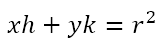
    This is equivalent to

    Now, when we multiply the two we get

    Geogebra Activity

    So we can see that, apart from any changes in ‘sign’, positive to negative or vice versa, the sine and cosine interchange positions. In other words, when we rotate by π/2 radians, the real and imaginary parts of a complex number exchange places. Much in the same way as multiplication by -1 changes the sign of a real number by negating it, rotation by π/2 radians involves moving what is real to become imaginary and what is imaginary to become real.

    A Pedagogical Note

    If you recall (and you probably don’t), in Primer to Complex Numbers, I had stated that it is unfortunate that we have used the terminology ‘complex numbers’. In A New Kind of Number? I stated that using the term ‘imaginary numbers’ is also unfortunate. This latter term is particularly unfortunate. Indeed, I have come across colleagues, that is mathematics teachers, who tell their students that the ‘imaginary numbers’ do not exist. Presumably, they mean that these numbers are like ‘imaginary friends’! However, these numbers are not figments of our imagination.

    However, consider the Schrödinger equation shown below

    It is clear that the left side of the equation has the imaginary unit i. However, this equation represents a description of the evolution of the wave function of a non-relativistic quantum-mechanical system. In other words, the equation describes a very real physical phenomenon. Could this be possible if one side of the equation represents something that does not exist? In a similar way, Fourier analysis, which is used in signal processing, depends on the use of complex numbers. Finally, the Euler-Lagrange equations, a system of second-order differential equations, are the basis of Lagrangian mechanics, a way of describing motion using energy rather than forces, which are used in Newtonian mechanics.

    I cite the above applications in physics precisely to show that complex numbers are essential to our ability to describe real world phenomena, which would be quite unthinkable if the ‘imaginary numbers’ did not exist. It is unfortunate that René Descartes’ prejudices against such numbers continues to misinform many teachers and, consequently, their students concerning these numbers.

    Hence, when I teach this topic to my students, I prefer to all these numbers ‘non-real’ numbers with the prior definition, which I would normally give them, that “a real number is a number whose square is non-negative,” thereby leaving open the possibility that there could be numbers whose squares are negative.

    Turning the Corner

    And with that we wrap up our exploration of complex numbers. We have been at it since late January with a one week break for Good Friday and a three week hiatus for my grading assignment. During this series, we took a pit stop for trigonometry and another for calculus. Today, we saw how all of this relates back to a seminal idea with which I began this blog. It has been a whirlwind for me and I am sure you feel the same. So, in the next post, we will move in a different direction. Till then, keep it complex.

  • The Tripartite Fugue

    Milestones on the Journey

    Photo by Laura Penwell on Pexels.com

    After a three week break, most of which was spent grading IB papers, I am back. We continue with our series on complex numbers. By the time we last dealt with this, in Deriving Derivatives – Part 2, we had obtained the derivatives for a few functions as follows:

    In the post that preceded it, that is Deriving Derivatives – Part 1, we also were able to obtain the following results:

    Of course, in Anticipating the Exponential Whirligig, we revisited a crucial result we had obtained during our series on e, namely that

    During the series on e, the post Infinitely Expressed introduced us to the idea of infinite series. We explored the idea of infinite series in the post Serially Expressed, during which we derived the above result for the derivative of ex. Let us now proceed with using what we know so far about infinite series to obtain similar expressions for sin x and cos x.

    Infinite Series for sin x and cos x

    Photo by Teona Swift on Pexels.com

    We begin by assuming that

    We also assume for now that this series converges. Now, we can differentiate the above equation repeatedly to obtain

    Note that, in the last two equations above, the superscripted (4) and (5), with the numerals 4 and 5 inside parentheses, indicates the 4th and 5th derivatives of the function respectively, in this case, sin x.

    Now, we can substitute x = 0 in all the equations for sinx and its derivatives to obtain the following:

    Now, we know that sin 0 = 0 and cos 0 = 1. This means that the above set of equations reduces to

    Now, we know that

    This means that the above set of equations can be written as

    We can see that the constants with even subscripts are all zero. The constants with odd subscripts are the reciprocals of the factorial of the subscript with alternating positive and negative signs. Substituting this in the infinite series expression for sin x we get

    In a similar way we can obtain

    Assembling the Fugue

    So, as of now, we have the following three infinite series

    What we can observe from the above is that the series for ex has terms with every power of x and all the coefficients are positive. The series for sin x has terms with odd powers of x and the coefficients alternate between positive and negative. Likewise, the series for cos x has terms with even powers of x and the coefficients alternate between positive and negative.

    Photo by Tayssir Kadamany on Pexels.com

    Now, recall that

    Now, in the series expression for ex let us replace x with . This will give us

    This is the exponential form of complex numbers that we have been pursuing for many weeks now. It links the exponential function to the sine and cosine functions. We can easily see that the modulus of this complex number is 1 while its argument is θ. In case you have forgotten what the modulus and argument of a complex number are, we had introduced the former in Modulating an Invariant Metric and the latter in Pole Vaunting.

    Hence, a complex number z = x + iy can be written in polar and exponential form as follows:

    where

    Here, r is the modulus of z and θ is the argument. Of course, care must be taken when determining the argument of z. When y/x is positive, it could be because both are positive, in which case the angle is in the first quadrant and atan(y/x) will give the correct value. On the other hand, both could be negative, in which case the angle is in the third quadrant, meaning that π radians or 180° need to be added to or subtracted from atan(y/x). In much the same way, when y/x is negative, it could be because x is positive and y negative, in which case the angle is in the fourth quadrant and atan(y/x) will give the correct value. However, it could be because x is negative and y positive, in which case the angle is in the second quadrant, meaning that π radians or 180° need to be added to or subtracted from atan(y/x).

    The Journey Ahead

    Now, the exponential form of complex numbers is a powerful form. However, me simply claiming this is so cannot suffice. So, in the next post, which will be the final one in this series, I will consider the exponential form in greater detail. We will also consider how it showcases the idea of rotation, linking it to the idea of negation that we first saw in A New Kind of Number.

  • It has come to that time of the year when I grade the IB papers. This requires a significant amount of my time and also focus. So I will not be posting for the next few weeks. The next post will only be on 20 June 2025. In the meantime, you can check my series on e or π. Or you could check the ongoing series on complex numbers, with its two pit stops on trigonometry and calculus. We will resume the series on complex numbers on 20 June 2025.

  • Serially Expressed

    Revisiting Convergence

    We are in the middle of the second pit stop on our journey of exploring complex numbers. We have reached a point where I can introduce us to some infinite series, as mentioned in the previous post. Of course, we have encountered infinite series when we studied e as well as when we studied π. An infinite series is simply the summation of all the terms of an infinite sequence.

    The graph of ex and the first 9 approximations from the infinite series

    In case the preceding sentence was confusing, let us recap a bit. A sequence is a succession of numbers generated according to a well defined rule. A sequence can have a finite number of terms or it could be an infinite sequence. A series is formed by adding the terms of a sequence. An infinite series can converge, diverge, or oscillate. A classic case of such a series is the geometric series. We considered the geometric series in Naturally Bounded?, the second post in the series on e. There, I only considered a single case where the common ratio r was 1/2. That series converged. In general, a geometric series will converge if the common ratio lies between -1 and +1. In all other cases, it will diverge. And if r is negative, the series will also oscillate, converging while oscillating if r is between -1 and 0 and diverging while oscillating if r is less than or equal to -1.

    Conditions for Convergence

    What this means is that, when we are faced with an infinite series, there will be conditions under which the series will converge. When these conditions are not met, the series will diverge, either oscillating or not oscillating.

    So suppose we have an infinite series

    We can define the partial sum of n +1 terms as

    Now, if

    we can say that the series converges and that it converges to the finite sum of S. In general, a necessary but not sufficient condition for a series to converge is that each term approaches zero. That is,

    However, this test is not sufficient to guarantee that the series converges. For that, we have to apply many other tests. However, this is not what I wish to focus on. For now, let us simply assume that the series we will introduce are convergent. Will will then be able to obtain some rather intriguing results.

    Infinite Series for ex

    So, suppose that

    is a convergent series. Now, from the previous post we know that the derivative of ex is ex. From the post that preceded it, we know that the derivative of xn is nxn – 1. So, if we differentiate the above equation, we will get

    We can differentiate this again to get

    We can continue in this manner ad infinitum. However, let us see what the value of all of these are when x = 0. When x = 0, ex = e0 = 1. Also, all terms with xk will become 0, leaving us with

    Rearranging each equation, we get

    Recognizing that n! = n(n – 1)(n – 2)···3·2·1, and defining 0! = 1, we can write the above as

    From this we can write the infinite series for ex as

    In the post Infinitely Expressed we looked at the speed with which a series converged. How does this series compare? The table below gives us the relevant information

    What we can see is that, as n increases, the error decreases by about one order of magnitude for each increased value of n. In the aforementioned post, we had seen that this series does not converge very quickly and we introduced other series that converge much more rapidly. However, here we are not concerned with the speed with which the series converges. Rather, the simplicity of the terms themselves provide a strange allure. From the image at the start of this post we can see how each additional term makes the resulting series more closely approximate the graph of y = ex.

    Infinite Series for sinx

    Suppose now we attempt to obtain a similar infinite series for sinx. So let us consider that

    When we repeatedly differentiate the equation we will obtain the following

    Now, if we put x = 0, we will have sinx = 0 and cosx = 1. Then we will obtain

    Rearranging these equations we get

    From this we can obtain

    Infinite Series for cosx

    In a similar way, for the cosx function, we can obtain

    Setting the Stage

    So far we have obtained infinite series expressions for ex, sinx, and cosx. This gets us to the point where we can use these series to obtain the exponential form of the complex numbers. We will deal with that in the next post. Hence, this pit stop too has come to an end. We have, quite obviously, only dealt with those concepts in calculus that directly play a role in determining the exponential form of the complex numbers. Once I have concluded with the series of posts on complex numbers, we will revisit calculus. But till then I hope that this short pit stop has been helpful in your reaching the realization that calculus is not something to fear.