• My Trigger, No Metric, Beginnings

    Brief Flashback

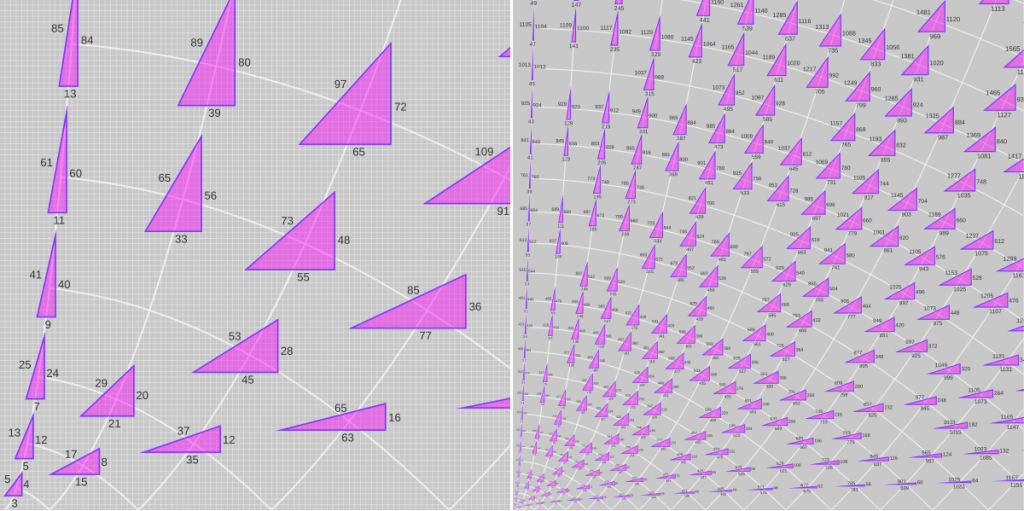
    A plot of the primitive Pythagorean triples with the odd leg on the horizontal axis and the even leg on the vertical axis. (Source: Wikipedia)

    My mathematical world was thrown wide open when, in the ninth grade, my classmates and I were introduced to the study of trigonometry. Following that, when I studied at IIT – Bombay, I wrote a research paper titled The Synthesis of Coupler Curves and designed a mobile industrial robot, both projects requiring the use of trigonometry in the extreme. Hence, this post and the next couple are ones that I have actually been looking forward to.

    Of course, this post forms a part of the ongoing series on complex numbers. However, this post forms the first in a pit stop that I had forewarned the readers about in the first post of the series. Yes, I said ‘first in a pit stop’. You see, unlike in an F-1 race, this pit stop will take some time!

    The Theorem of Pythagoras

    The journey into trigonometry begins with the ubiquitous theorem of Pythagoras or the Pythagorean theorem. This is not the place to debate where the theorem was first discovered or used or even if Pythagoras himself was an actual historical person or just a mythic figure concocted by the school that bore his name. Pythagoras’ theorem (as we call it in India) or the Pythagorean theorem (as people in North American tend to call it) states that, in a right angled triangle, the square of the length of the hypotenuse is equal to the sum of the squares of the lengths of the other two sides. Students are often instructed to memorize
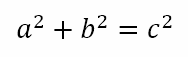
    However, without knowing what the symbols a, b, and c denote, the above equation is meaningless. In particular, without recognizing that c represents the length of the hypotenuse, the equation is not even valid! However, in my years of teaching students in high school, I have realized that many students are not even taught what the hypotenuse is!

    An Unfortunate Realization

    Most students are introduced to right angled triangles with figures like the ones below
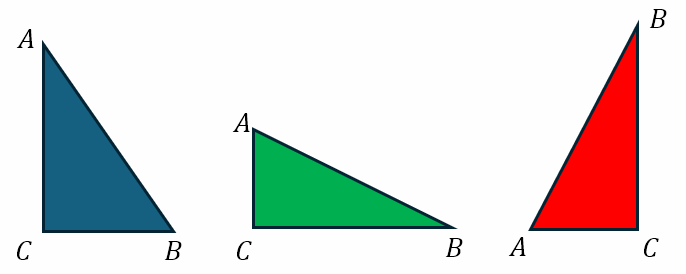
    In all three triangles, the side AB is the hypotenuse. However, the unfortunate fact is that in the above three figures AB is oblique (that is, neither vertical nor horizontal). And so many students have come to me after middle school with the understanding that the hypotenuse is the oblique side. So consider the figures below.
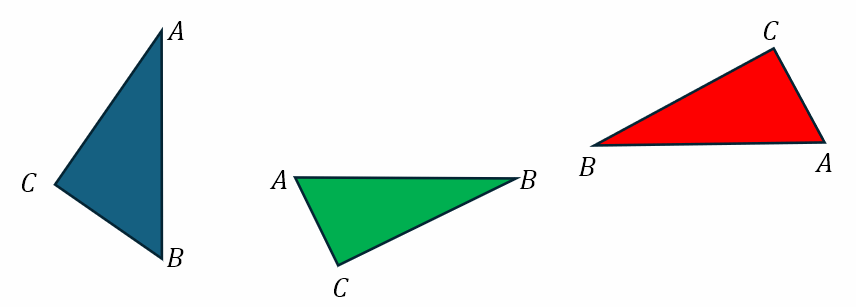
    All I have done is rotate the earlier triangles. The hypotenuse should not change. In all three cases it is still side AB. However, now AB is either horizontal or vertical. And some students have understood that the hypotenuse is oblique. Hence, they conclude that the hypotenuse is AC or BC. The hypotenuse, however, is the side opposite to the right angle. This is something that teachers in the middle school need to ensure students understand. It is not the orientation of a side that makes it the hypotenuse but its relation to the right angle.

    Pythagorean Triples

    Anyway, returning to the equation for Pythagoras’ theorem, we have

    I remember when I was introduced to this theorem back in my middle school days. My teacher introduced us to Pythagorean triples like (3, 4, 5), (5, 12, 13), etc. I remember spending a lot of time trying to find patterns to these triples. “Was there a way of finding new triples?” was the question I asked myself.

    My search for patterns revealed that

    That is, the square of the smallest number was the sum of the two larger numbers in the triple. Did this always hold true?

    I discovered that

    with (7, 24, 25) and (9, 40, 41) forming Pythagorean triples. Hence, it seemed that the pattern I had discovered did form Pythagorean triples. Could this be formalized in any way?

    Formalizing the Sequence
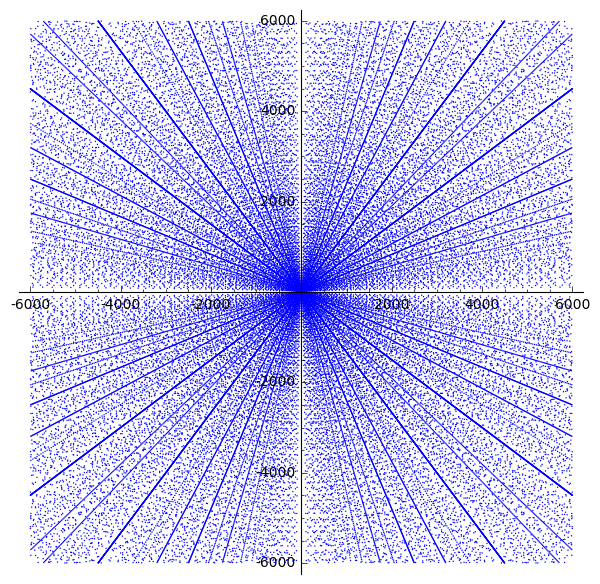
    Scatter plot of the legs (a and b) of Pythagorean triples (Source: Wikipedia)

    Later introduction to sequences and series allowed me to recognize that, in all the triples I was dealing with, the smallest number was an odd number. Moreover, the two larger numbers happened to differ by 1, the smaller being even. Knowing that 2n + 1 is always an odd number if n is a natural number, we can do the following

    So, the square of the smallest number 2n + 1 can be split into

    where the two numbers differ by 1 and the smaller is even. But do these three numbers satisfy Pythagoras’ theorem? Let’s check.

    It is clear that

    meaning that I had found a way to generate Pythagorean triples. Using this we can generate the triples (11, 60, 61), (13, 84, 85), (15, 112, 113), etc.

    Another Sequence of Triples

    However, it was clear from the triple (8, 15, 17) that I had not found a way for generating all the Pythagorean triples. Indeed, this triple does not satisfy the original premise for the triples because
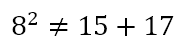
    Was there a pattern that governed these three numbers? And could that pattern be extended, as before with the first pattern, to generate a new sequence of triples? Trying different patterns, I realized that the square of 8 was equal to twice the sum of 15 and 17. That is,

    Was this something important? Using this pattern, I discovered that (12, 35, 37) was also a Pythagorean triple in which
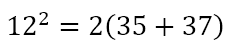
    Could this be generalized? Like before, where 2n + 1 is an odd number, 2n will be an even number, which happened to be the case with the smallest numbers in each of the new triples. Further, the two larger numbers differ by 2 and are one less and one more than the square of half the smallest number. So let’s test this. If the smallest number is 2n, then the square of half of 2n would be n2 and the two larger numbers would be n2 – 1 and n2 + 1. When we test these three numbers we get
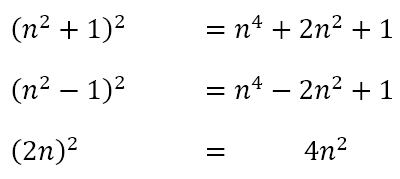
    We can see that we have found a way of generating a new sequence of Pythagorean triples. Using this method, we can generate (16, 63, 65), (20, 99, 101), etc.

    Yet Another Sequence

    However, the presence of the triple (20, 21, 29) indicates that this second sequence of triples also does not exhaust all the possible Pythagorean triples. Despite this, I tried my hand at many such patterns, just to entertain myself. The first sequence consisted of triples having the form

    The second sequence has the form

    The third sequence is formed with the triples having the form

    from which we can obtain (20, 21, 29), (28, 45, 53), and (36, 77, 85), etc.

    Next Steps in the Journey

    This was all recreational mathematics in the service of some higher understanding of how these triples, which have a geometric significance could relate to each other. There are, of course, other sequences of triples than the three we have uncovered. For example, the triples (33, 56, 65), (39, 80, 89) and (65, 72, 97) do not fit into the three sequences we have uncovered. I leave the reader to think of other possible ways of characterizing Pythagorean triples. And perhaps also think about the question, “While it is true that each sequence for generating Pythagorean triples generates infinitely many triples, is the number of such sequences also infinite? And can it be proved either way?”

    Our journey into complex numbers required a pit stop at which we will learn some trigonometry. However, the journey is way too exciting, as we have hopefully seen in this post. The simple idea of trigonometry based on the right angled triangle, presented an opportunity to look into Pythagorean triples and some patterns with which an infinite number of triples can be generated. This, of course, is not strictly the study of trigonometry, but rather just my idiosyncratic diversion within this pit stop. Most of us know that trigonometry begins with defining ratios like sine, cosine, and tangent. Such strange names, especially the first two. Ever wonder how we got them? Keep your eyes glued for the next post.
  • Modulating an Invariant Metric

    A Brief Recap

    Our journey into the wonders of complex numbers continues. In this series I hope to introduce the reader to the reality of complex numbers. In the previous post, we reached the stage where I introduced the square root of -1 as the unit of the imaginary numbers, parallel to the number 1, which is the unit of the real numbers. We looked at how addition, subtraction, and multiplication works with complex numbers. And I promised to look at division in this post.

    Division of Irrational Numbers

    Now, those who are familiar with mathematics taught till about grade 9 or 10, will know that the set of real numbers includes rational and irrational numbers. Further, a rational number cannot be irrational and vice versa. For example, numbers like

    are rational because they can be expressed as the ratio of two integers. However, numbers like

    are irrational because they cannot be expressed as the ratio of two integers. Now, when we add or subtract one rational number and one irrational number, the result will be an irrational number. Hence, numbers like

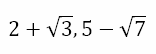
    are irrational, with one part being rational and the other part being irrational. Now, if we were asked to divide one such irrational number by another, we would proceed with the method of rationalizing the denominator. So, if we were asked to evaluate

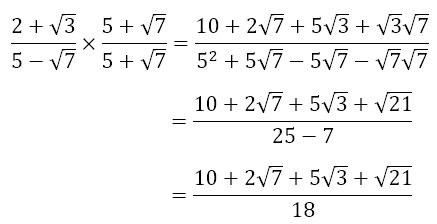
    we would begin by multiplying the numerator and the denominator as follows to get

    Note that the denominator has now become rational, which would allow us easier ways of manipulating the expression. The factor 5 + √7 is known as the irrational conjugate of the denominator 5 – √7.

    Dividing Complex Numbers

    So, the irrational conjugate, when multiplied by the irrational factor results in a rational factor. Could it be, then, that a similar ‘complex conjugate’ could transform a complex number in the denominator into a real number? Before we try it on an actual division, let us see if the product of a complex number and its complex conjugate actually gives us a real number.

    If we consider 3 + 4i, its complex conjugate (taking a hint from the irrational conjugate) would be 3 – 4i. When we multiply the two we would get

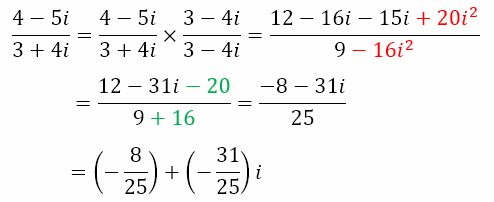
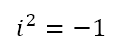
    So, our intuition that multiplying a complex number and its complex conjugate would result in a real number was right. And this is because i2 = -1. Let us use this to divide one complex number by another. Let us divide 4 – 5i by 3 + 4i.

    Note that the terms in red contain i2 and hence have a sign reversal, as indicated by the terms in green. Of course, the final result has the form a + bi, where a and b are real numbers. Hence, there is a real part, a, and an imaginary part, bi.

    A New Perspective on Multiplication and Division

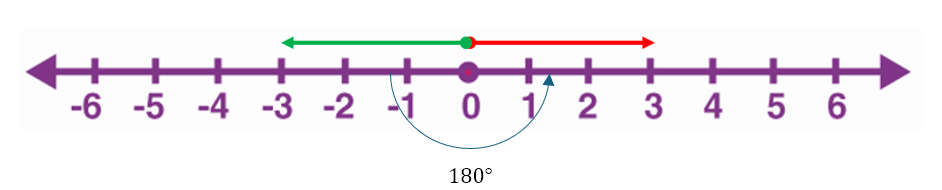
    Now, it is all well and good that we managed to divide one complex number by another. However, whatever does the division mean? We know what division with real numbers means. For example 10 ÷ 5 can be viewed as the number of times 5 can fit into 10, giving the answer 2. We can also view it as a reduction of 10 by a factor of 5, giving 2. This allows us to see division and multiplication as, in essence, the same operation. Hence, division by 5 can be considered multiplication by 1/5. So both division and multiplication can be viewed as scaling a given number. Of course, as we have seen, negation, which can be viewed as a multiplication by -1, is nothing other than an anti-clockwise rotation about zero of 180°. And since division and multiplication are inverse operations, we can consider division by -1, which also is equivalent to negation, as a clockwise rotation about zero of 180°. Of course, a 180° rotation clockwise or anti-clockwise results in the same final position. However, we will see that maintaining a difference in direction of rotation makes sense when we consider complex numbers.

    Now, while we have given some meaning, in terms of scaling and rotation, to multiplication and division of real numbers, how can this relate to complex numbers? From the previous post, we saw that we can visualize complex numbers on a plane with the horizontal axis depicting the real part of a complex number, while the vertical axis depicts its imaginary part.

    The ‘Size’ of Real Numbers

    However, viewing multiplication and division as scaling requires us to have some idea about the ‘size’ of the number. I mean it is only meaningful to say that division of 10 by 5 is a scaling of 10 by a factor of 1/5, resulting in 2, if we have some idea that the number 10 has 5 times the ‘size’ of 2.

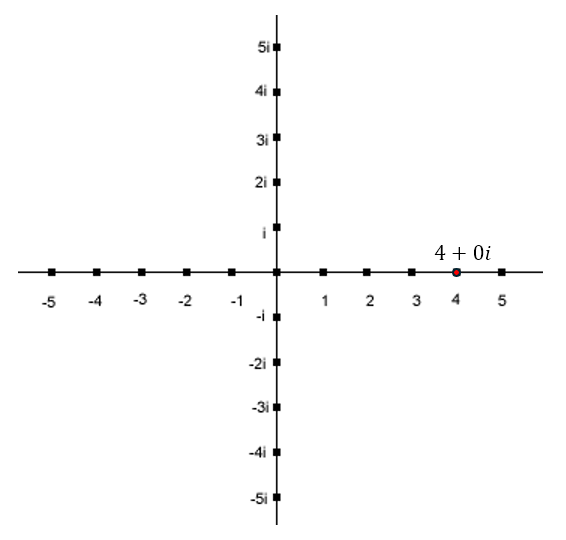
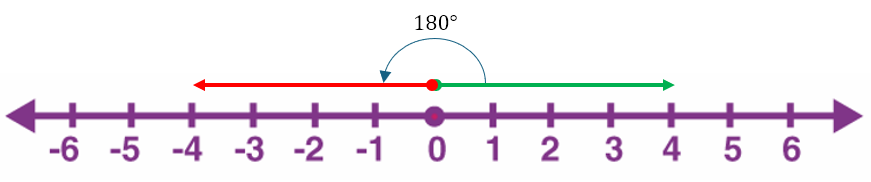
    Of course, using the number line, we understand that the ‘size’ of a real number, also known as its absolute value, is the ‘distance’ of the point representing that number from the zero on the number line. Hence, the ‘size’ of both 4 and -4, shown below, is 4 units because the points representing 4 and -4 are 4 units away from the zero.

    A Complex Cul-de-sac

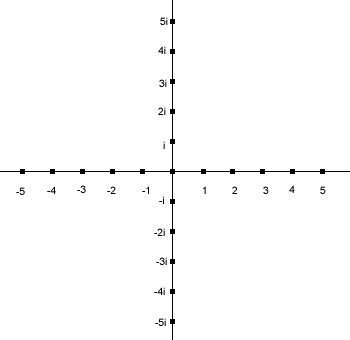
    Now we saw that we can represent complex numbers on a two dimensional plane as below

    What ‘measure’ can we use to determine the ‘size’ of these numbers? We could simply add the distances moved in the real and imaginary directions. So the ‘size’ of 3 + 2i would be 3 + 2 = 5. Similarly, the ‘size’ of -4 + 4i would be 4 + 4 = 8. However, this measure is dependent on the orientation of the axes. For example, consider the point 4, depicted below

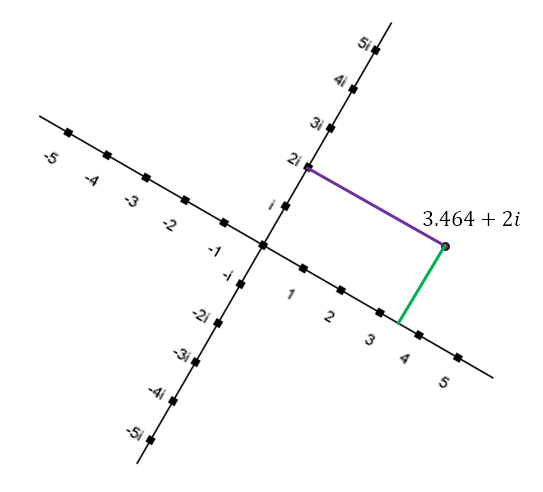
    If we now rotate the axis by 30° clockwise, we will get the following

    The distance from the imaginary axis will now be the length of the purple line, which happens to be 3.464 (rounded to 3 decimal places). The distance from the real axis will be the length of the green line, which is 0.5. Hence, as indicated, once we have rotated the axes, the new number becomes 3.464 + 2i, as indicated in the diagram. However, this means that the ‘size’ of the number is now 3.464 + 2 = 5.464. This means that a simple rotation of the axes has changed the ‘size’ of the number. We know that this is absurd. Changing the orientation of an object or our orientation with respect to an object should have no effect on the ‘size’ of the object. Hence, the measure involving simply adding the distances along the real and imaginary axes is a mathematically absurd measure.

    Vectors Again to the Rescue

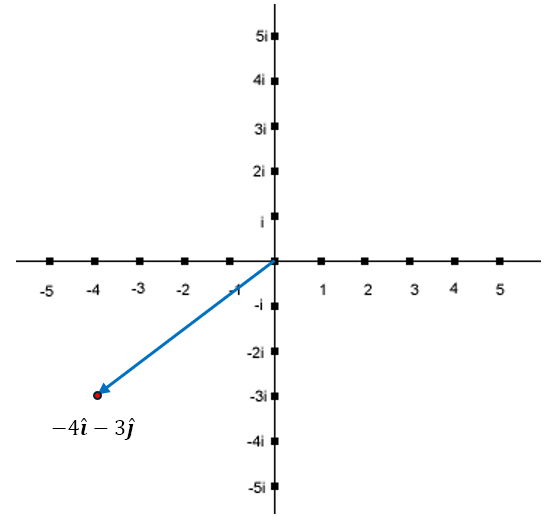
    We could take a cue from the study of vectors, remembering that it was vectors that first gave us the intuition of adding another axis to depict the imaginary numbers. Now, the ‘size’ of a vector is known as its magnitude and is calculated using Pythagoras’ theorem. So if a vector depicts a move of 4 units to the left and 3 units down, we would first depict it as below

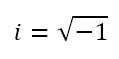
    Please do not confuse i, the imaginary unit that is equal to √-1, and î, the unit vector along the x direction. While mathematicians have felt free to adopt letters from other scripts, such as α, β, θ, etc. from the Greek script, we still predominantly use the English alphabet. And there are only 26 symbols to choose from. So some overlap is to be expected.

    Anyway, the magnitude of the above vector (i.e. -4î -3ĵ) is determined using Pythagoras’ theorem as follows

    The Modulus of a Complex Number

    We now use the same method to define the ‘size’ of a complex number, which is called its modulus. Hence, the modulus of the complex number z = a + bi is defined as

    Does this hold up for the earlier experiment with rotating the axes? Recall that the original complex number was 4 + 0i. It is trivial to see that its modulus is 4. After rotating, the number became 3.464 + 2i. We calculate its modulus below

    The final number, 3.999911999, might seem strange. However, this is the result of the rounding we had done earlier. Remember that the length of the purple line was 3.464 rounded to 3 decimal places. But how did I know if was 3.464? The measuring instruments I have at my disposal are an assortment of ruler, none of which has a least count smaller than 0.5 mm. So, if I used the rulers, I couldn’t have gotten anything better than 3.45 cm. What gives? Am I pulling the wool over your eyes? Absolutely not! You know I would not do that! So, there must be a way in which I have obtained the rounded value 3.464. Yes, indeed, there is. The actual value is 23, which the calculator gives as 3.464101615 and Wolfram Alpha gives as 3.46410161513775458705489268301174473388561050762076125611161395890386603381 to 64 decimal places. You can click on ‘More digits’ to get more digits, if that’s something you like to spend your time doing!

    Of course, if the actual length of the purple line is 23, then the complex number is 23 + 2i, which would yield

    Hence, with the exact value of the length, we get the same modulus for the complex number even after rotating the axes. Since, this is what we would expect, this definition of the modulus is what is accepted. But how did we obtain that the length was 23? In the first post of this series I had forewarned you that we would be making some pit stops along the way. Well, it’s time for one such pit stop, which I will deal with in the next post. Till then, modulate or remodulate yourself!

  • It’s Not Rocket Surgery!

    Revisiting the New Kind of Number

    We are in the middle of a series on complex numbers. I started this series with Primer to Complex Numbers, in which I shared some basic algebra tools that we would need for our exploration of complex numbers, ending in a brief discussion about the importance of the discriminant. In the second post, A New Kind of Number?, I continued with the exploration by looking at what the discriminant tells us about the kind of numbers we are considering. That discussion included the idea that negation could be considered an anti-clockwise rotation about zero of 180° rather than a reflection in zero. Quite obviously, rotation would mean ‘stepping out’ of the constraints of the number line into a new realm. What would that entail?

    Operations with the ‘Normal Numbers’

    We begin by considering this new kind of number as something that cannot be combined in normal ways with the numbers we normally encounter. For example, we know that the basic mathematical operations can be performed on all our normal numbers. So, for example, we know that 11 and 12 can be added to give 23; that 13 can be subtracted from 10 to give -3; that 3 can be multiplied by 16 to give 48; and that 50 can be divided by 6 to give a quotient of 8 and a remainder of 2.

    We do not have to restrict ourselves to integers, though. We know that the following are all valid

    We do not even have to restrict ourselves to rational numbers. In fact, the expressions

    can be evaluated to any desired degree of accuracy simply by calculating each irrational number and performing the necessary operations after that. This works even for the transcendental numbers, like e and π. For example, while it may be difficult to evaluate by hand, a computer could give us the value of the expressions below to any desired level of accuracy.

    In all the above cases, the operations, while in some cases extremely tedious, we possible to carry out. Furthermore, we had a clear idea about what these operations meant since all the numbers could be located on the number line.

    However, if we were now proposing that we escape the confines of the number line, what exactly are we attempting to do?

    Assistance from Mechanics and Vectors

    When students in school learn mechanics, either in the context of physics or mathematics, their study of motion is first confined to motion in a single dimension. A particle is considered to move along one axis, normally not even named since there is only one dimension of motion. However, since most motion in real life is three dimensional, the single dimension proves to be too unrealistic a constraint. Students are then introduced to motion in two dimensions, the most common case considered being that of a projectile, like a ball, being thrown at some angle of incline.

    Students are taught a key concept when studying motion in two dimensions – the vertical and horizontal dimensions are orthogonal to each other. The basic meaning of this is that the vertical and horizontal dimensions are at right angles to each other. However, there is a deeper insight to be gained: No horizontal motion will contribute to vertical motion and vice versa. In other words, what happens horizontally does not affect and is not affected by what happens vertically. This allows the students to study the motion in each direction separately before combining the results to describe the motion as a whole.

    This forms the basis of the study of vectors too. We conceive of mutually perpendicular axes so that we can isolate what happens along one axis from what happens along other axes. In both cases, what we are saying is that what happens in one dimension or axis is cannot be combined with what happens in another dimension or axis, but must be kept distinct.

    We express this technically by saying that vertical and horizontal motion are independent of each other. Similarly, the x and y directions are independent of each other. And this is all because the directions are at right angles to each other.

    The Imaginary Unit

    We now use this same insight to think of this new kind of number, which when squared can give a negative result. We recognize that all the numbers we normally encounter do not change when multiplied by 1. In other words

    We, therefore, consider the number 1 as the ‘unit’ of the normal numbers. Further, when faced with the square root of a negative number, we recognize that we can do something like the following.

    In other words, we recognize that any negative number can be written as the product of its absolute value and -1. Now, we proceed to define the square root of -1 as the ‘unit’ of the new kind of number. By convention, we will denote it as i. In other words,

    Linking the Normal and New Numbers

    Now, we allow ourselves to perform operations with the new numbers as usual, but ensuring that the normal numbers and the new numbers are never combined to as to lose their distinctiveness. So, for example, we can do the following.

    But what would happen if we tried to multiply these numbers? We would get the following.

    The above rearrangement is legitimate because multiplication is commutative. However, note that we have the square of i at the end. From the definition of i as the square root of -1, we should have

    However, note that -1 is a normal number. In other words, by squaring the new number, we get a normal number. But not just any normal number! Rather, we have obtained the negation of the ‘unit’ of the normal numbers. Recall that we had defined negation as  an anti-clockwise rotation about zero of 180°. This would indicate that i, the unit of the new numbers, is obtained by  an anti-clockwise rotation about zero of 90°, as a result of which squaring would involve two such rotations for a total of 180° as required by the result that

    So what we have obtained in that 1, the unit of the normal numbers, and i, the unit of the new numbers, are oriented at right angles to each other! In other words, 1 and i are independent of each other. Since the normal numbers have their own number line, we define another number line for the new numbers that is at right angles to the original number line. Also, since

    we realize that zero can be written as a normal number and as a new number. Hence, the two number lines will intersect at zero. We can depict this as below.

    Operations in the Complex Plane

    Now, I have to stop using ‘normal numbers’ and ‘new numbers’ simply because these are not the accepted conventions for referring to them. However, with respect the the above diagram, the normal numbers, known as ‘real numbers’, are represented along the horizontal or real axis, while the new numbers, known as ‘imaginary numbers’, are represented along the vertical or imaginary axis. The entire plane, consisting of the two axes, is known as the ‘complex plane’, another unfortunate term.

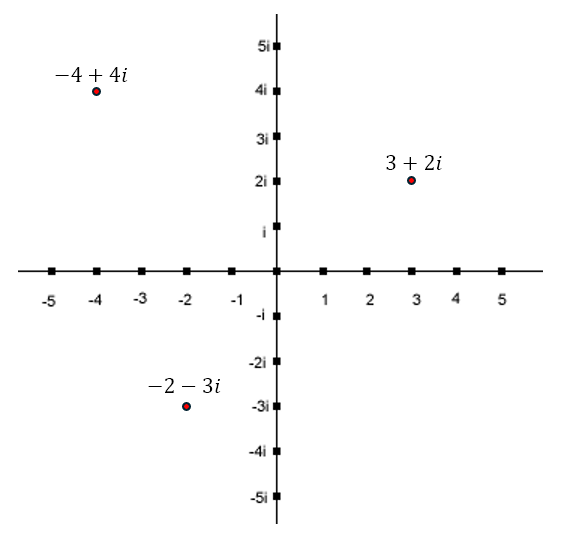
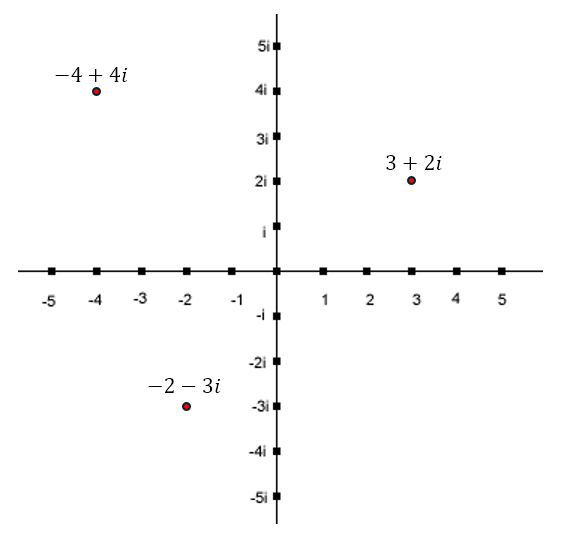
    Numbers that are a combination of real and imaginary numbers can be located on the plane as shown below

    We can describe the above numbers as follows:

    • 3+2i : Starting from the zero on both axes, move 3 units to the right and 2 units up.
    • -4+4i : Starting from the zero on both axes, move 4 units to the left and 4 units up.
    • -2-3i : Starting from the zero on both axes, move 2 units to the left and 3 units down.

    Since the real and imaginary axes are perpendicular to each other, they are independent of each other. Hence, we can add and subtract as follows

    This is because moving 3 units to the right and 2 units up followed by 2 units to the left and 3 units down, is, in effect, to move 1 unit to the right and 1 unit down. Also, moving 3 units to the right and 2 units up followed by the reverse of (i.e. negation of) two units to the left and 3 units down, is, in effect, to move 5 units to the right and 5 units up.

    When it comes to multiplication, however, we encounter a new phenomenon. It is meaningless to talk about multiplying directions. Hence, it is absurd to say that two upward directions multiply to give a leftward direction. However, when it comes to numbers, we saw that negation can be considered as  an anti-clockwise rotation about zero of 180°. Further, we saw that i can be considered an anti-clockwise rotation of 90°, allowing for the square of i to be equivalent to negation. This means that it is legitimate to multiply complex numbers and we can do this using FOIL (see Primer to Complex Numbers) as below.

    However, since the square of i is -1, we can simplify the above as

    The Fork Ahead

    So far we have seen that it is possible to conceive of imaginary numbers and real numbers as two quite different species of numbers that are independent of each other. Due to this, they can be added and subtracted in the conventional way with the only restriction being that we keep the real and imaginary parts separate. However, when we conceive of the real and imaginary numbers as independent, we face a corollary that the square of i is equivalent to negation. This gives us the justification for multiplying complex numbers using conventional algebraic rules.

    This also explains the title of this post. No, I did not make a mistake. Yes, I have combined two ideas – rocket science and brain surgery – that normally do not go together, much like the real and imaginary numbers. Not everything is smooth, as we will see. However, with the single insight that squaring the imaginary unit is equivalent to negation, we can actually make the two otherwise disparate elements work together.

    Of course, there is much more to complex numbers. We still have to give further meaning to multiplication. We also have to see how division would work, not to mention exponentiation. And that is just the start. There is so much that the imaginary numbers open up for us and I hope you are as excited as I am for the journey ahead. In the next post, we will consider how division works with complex numbers. Till then, I won’t say, “Stay real” but “Stay true.”

  • A New Kind of Number?

    The Discriminant Revisited

    Last week I began a series on complex numbers with the post Primer to Complex Numbers. At the end of that post, I considered the discriminant in the formula for solving a quadratic equation. We saw that it is easy to comprehend what a zero or positive discriminant would mean simply because the square of zero is zero itself and the square of a positive or a negative number will always give a positive result. However, what do we do with quadratic equations in which the discriminant is negative?

    Visualizing Quadratics vis à vis the Discriminant

    Here, it would help for us to visualize the functions corresponding to the quadratic equations. In other words, given the equation

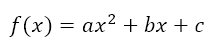
    we can consider this to be the equation f(x) = 0, where

    This is nothing less than finding the points where the graph of y = f(x) cuts the x axis. So, let us consider three different quadratic functions

    If we plot the graphs of these functions we will get

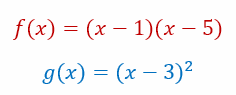
    We can factorize f(x) and g(x) giving us

    Here we can see that the factors x – 1, x – 5, and x – 2 correspond to the solutions of the corresponding equations f(x) = 0 and g(x) = 0. These also are the x-coordinates of the points where the graphs of y = f(x) and y = g(x) cut the x-axis. However, we can see that we cannot factorize h(x). Nor does the graph of y = h(x) cut the x-axis. If we calculated the discriminants of the three quadratics we would obtain

    So, when the discriminant is negative, we can see that the graph of the corresponding quadratic function does not cut the x-axis. This is precisely what we mean when we say that the quadratic equation does not have real roots or real solutions.

    However, if the quadratic equation does not have real roots, what kind of roots does it have? In other words, what kind of number can we propose which when squared gives us a negative number?

    Reimagining Negation

    Let us take step back and ask ourselves how we can visualize negating a number. What I was taught, and I think what most students today are taught, is that negating a number involves taking its reflection in the zero point. Hence, the negation of 4 is -4 and the negation of -3 is 3. We can visualize both of these as follows.

    However, we can also visualize this as an anticlockwise rotation of 180° as below.

    I will later drop the degree unit for measuring angles and replace it with the radian. I will also explain why I am considering an anti-clockwise rotation when we make this change. But for now, it should be clear that an anti-clockwise rotation about zero of 180° on the number line produces the same effect as negating a number.

    We can now consider the positive sign to represent no rotation and the negative sign to represent a rotation of 180°. Then the product of two positive numbers will involve no rotation, that is, a positive sign. Similarly, the product of a positive and a negative number will involve no rotation and a rotation of 180°, that is, a negative sign. And the product of two negative numbers will involve two rotations of 180°. This will be a rotation of 360°, which is a complete revolution, or the equivalent of no rotation, yielding, once again, a positive sign.

    So what if we considered the square root of a negative number to involve a rotation of 90°? In that case, the product of two such numbers would be two rotations of 90°, which equals an effective rotation of 180°, that is, a negative sign.

    The Next Step

    What we can see is that, if we are willing to ‘step out’ of the constraints of the number line by introducing the idea of rotations, then we can conceive of a way in which a ‘number’ which when squared gives a negative number. Of course, since we have ‘stepped out’ of the number line to understand these ‘numbers’, it is clear that these ‘numbers’ do not belong on the number line. And since the number line is intended to represent all ‘real numbers’ we are forced to conclude that these new ‘numbers’ are not ‘real numbers’. It is an unfortunate fact of mathematical history that these numbers were given the name ‘imaginary’.

    In fact, it was the philosopher and mathematician, René Descartes, who rubbished the idea that there could be numbers whose squares were negative and who then jokingly called them ‘imagined’ numbers, that is, no more than a figment of our imagination. The name stuck. However, while it is great to have some historical humor in the nomenclature, there are many mathematics teachers today who actually think these numbers are entirely made up. As we will see in future posts, this is not the case. So, in the next post, we will look at understanding some arithmetic and algebra related to these numbers. Till then, let your imagination soar!

  • Primer to Complex Numbers

    A Promise Remembered

    At the end of the previous post, I had announced that I will be starting a series on complex numbers. The name ‘complex numbers’ is unfortunate. Mathematics is already surrounded by an aura of mystery. There was no need to name something that would heighten that mystery and increase the trepidation of people – mostly teenagers – who are introduced to these numbers. In this series of posts, I wish to introduce you to the wonders and power and beauty of complex numbers. Along the way we will make some necessary pit stops that might seem irrelevant. But believe me, all of it will be beautifully relevant.

    However, what I am going to cover in this post might be too trivial for some readers. If this is you, you might be wondering why I am beginning our journey here and with such ‘simple’ ideas. Well, it’s always best to start with a firm foundation rather than presume that everyone is on the same page. Hence, bear with me.

    Our journey into the realm of complex numbers begins with a property of numbers that I highlighted two weeks back: The product of two positive or two negative numbers is always positive. “So what?” you may ask. “What’s the big deal?” you may wonder. “How is this relevant?” you may contend.

    The Quadratic Equation

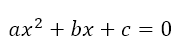
    Let us begin our journey with the simple quadratic equation

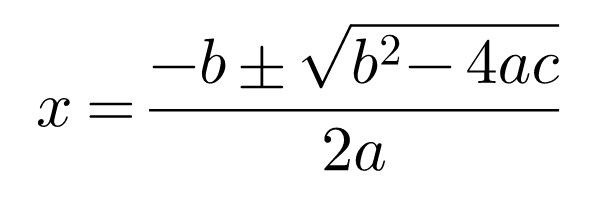
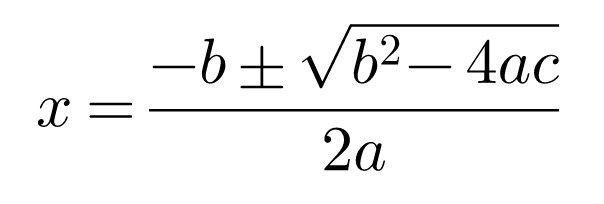
    Students in grade 9 and higher may know that this equation can be solved by using the quadratic formula shown below.

    But where does this formula come from? What kind of mathematical wizardry gives rise to it? I wish to devote much of the rest of this post simply to understanding how we get the quadratic formula. To this end, we start at a relatively innocuous result, the expansion of the product of two binomial expressions.

    Product of Binomials

    Since, I may have lost some of you, let me clarify some terms. In algebra, we encounter terms like ‘monomial’, ‘binomial’, and ‘polynomial’. These terms mean ‘one named’, ‘two named’, and ‘many named’ respectively. Expressions like a, m, and x, or even ab, ab2, and a3b5 are monomials because they have a single kind of term. Similarly, expressions like a + b, p + q, and x + y are binomials because they have two kinds of terms.

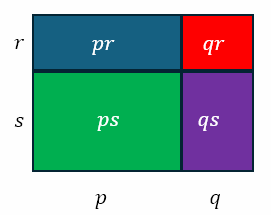
    Now we can consider the product of pq and r + s. We can visualize it as follows

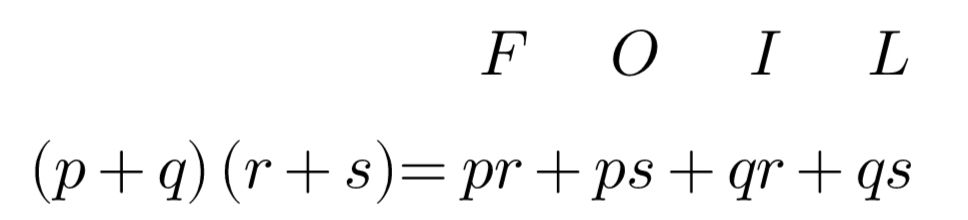
    Algebraically, we can say that each term in the first binomial needs to be multiplied by each term in the second binomial. We can do this as follows.

    In the above, F represents the product of the first term in each binomial, O the product of the outer terms, I the product of the inner terms, and L the product of the last terms. We get the convenient acronym FOIL from this. When we use FOIL to the expansion of a perfect square, we get the following.

    Perfect Square Expansion

    When we use FOIL to the expansion of a perfect square, we get the following.

    Students in grade 6 or 7 should be familiar with the above expansion. It is crucial to note that the perfect square expansion involves three terms. Hence only an expansion that includes all three terms can be considered a ‘completed square’. Unfortunately, as a high school teacher, I come across students ‘expanding’ the square as

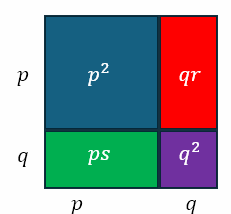
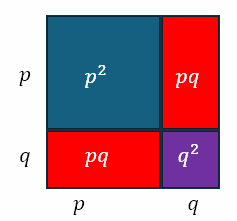
    all too often, causing considerable grief and anxiety to me. We could, of course, visualize the expansion geometrically as follows:

    The above figure shows that the expansion includes the two rectangles, each with area pq, which are excluded when a student ‘expands’ in the aforementioned way that causes me grief and anxiety.

    Deriving the Quadratic Formula

    Anyway, now we know the perfect square expansion, let us use that to solve the quadratic equation

    Let us first divide the whole equation by a and then move the constant term to the right. This will give us

    Now we consider the two terms on the left to be the first two terms of the perfect square expansion. This gives us

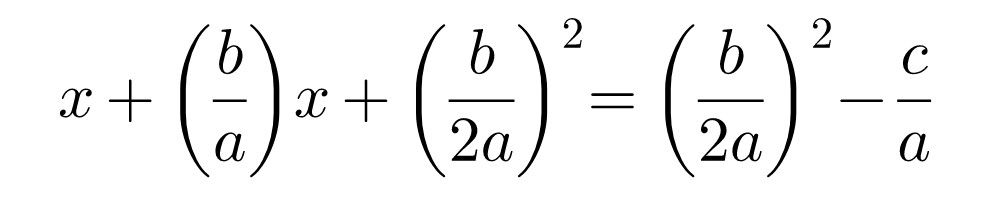
    Now, in order to complete the square on the left, we need to add the third term. We need to do this on both sides so the equation has the same solutions. This gives us

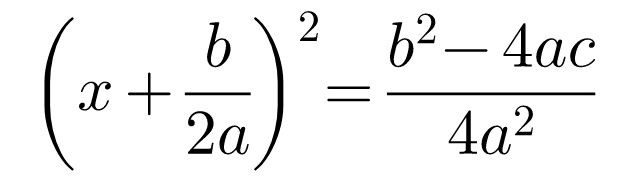
    Now, the left is a perfect square. Hence, we can write the equation as

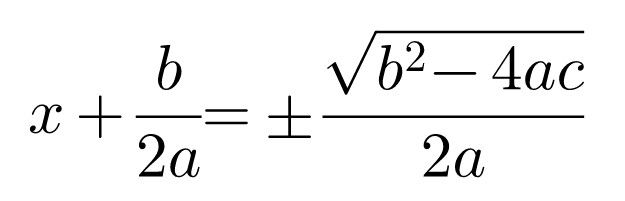
    Now, we can take the square root on both sides to get

    Now, moving the second term on the left to the right we get

    The Promise of the Discriminant

    Now, we observe that the quadratic formula just derived has a term under a square root symbol. This term is called the discriminant because it allows us to discriminate between the kind of solutions the equation will have. In particular, if Δ > 0 then we will have two distinct real solutions and if Δ = 0 then we will have one real solution. But what happens when Δ < 0? Till now we have only encountered non-zero numbers that are either positive or negative. And when we multiply two numbers with the same sign we always obtain a positive number. What sense can we make of a negative number under the radical sign? We will look at this in the next post. Stay tuned.
  • The Presenting Problem

    Recently I came across a video on YouTube that asked the question, “Which is bigger: 99! or 5099?” There are so many such questions on YouTube and I wonder why. After giving it some thought, I realize the truth in the saying, “Give a woman a fish and you feed her for a day. Show a woman to fish and you feed her for a lifetime.” Ok, fine, the original had ‘man’ instead of ‘woman’! But you get the point. When we teach people how to solve a particular problem rather than show them the principles that would enable them to solve problems in general, we are giving them a fish that will last them a day.

    So I’m going to treat problems like this under a single umbrella. You see, the question could have been, “Which is bigger: 101! or 51101?” or “Which is bigger: 199! or 100199?” and the approach would have been exactly the same. Since I’m saying this, try to determine a pattern in the numbers involved in each of the questions before you proceed.

    The Pattern

    What we should be able to see in the pairs {99! 5099}, {101! 51101}, and {199! 100199} is that the number whose factorial forms the first part of the pair shows up as the exponent in the second part of the pair. And these are odd numbers. Also, the base in the second part is half of one more than the exponent (50 = (99 + 1)/2, 51 = (101 + 1)/2, and 100 = (199 + 1)/2). So we can generalize the question to, “Which is bigger (2n-1)! or n(2n-1).

    Breakdown

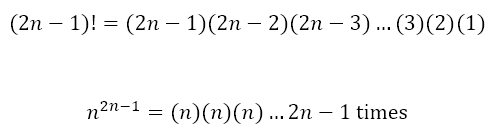
    We can recognize that (2n-1)! and n(2n-1) are each the products of 2n-1 numbers. Hence,

    Now, the middle number in each product is n. Moreover, the sum of the first and last terms in each product is 2n. And the sum of the second and second last terms is also 2n. In fact, every pair made of numbers equidistant from the ends (or the center) will add up to 2n.

    Let us consider the first pair from the ends. From (2n – 1)! we have 2n – 1 and 1 and from n2n – 1 we have n and n. Now, while the sum is the same for both pairs, the products are not the same.

    In fact

    Now, from the previous post (and elsewhere, of course!) we know that the product of two positive numbers or two negative numbers is a positive number. Hence,

    as long as n is not 1. We can expand the square to get

    Generalization

    Now, if we chose a general pair (say, the kth pair), we would have 2n – (2k – 1) and (2k – 1) from (2n – 1)! and n and n from n2n – 1. Now if we take the products we get

    Once again, let us consider the product of two numbers as below

    Expanding the square we get

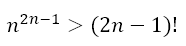
    In other words, no matter which pair we pick, the product of the pair from n2n – 1, in which all terms are n, will be greater than the product of the pair from (2n – 1)! It follows, therefore that

    Hence, we can conclude that 99! < 5099, that 101! < 51101, and that 199! < 100199.

    Stepping Back

    What we did in looking at the above was identify patterns between as many numbers involved in the question as possible. Here, specifically four things were crucial. First, both sides consisted of products of n numbers. Second, even though I did not explicitly mention it, the factorial contains all natural numbers from 1 to a particular higher number (n). However, on the other side we had n copies of the same number, the base. Third, the sum of numbers equidistant from the ends was a constant. And fourth, the base happened to be half this sum.

    Recognizing these patterns allowed us to frame the issue in terms of the product of pairs of numbers whose sum is constant. From there it was an issue of recognizing that we can use something we knew about products, namely that the product of two numbers having the same sign is always positive, to produce the inequality that would allow us to proceed to a solution.

    Now, it must be noted that not all solutions will involve identical steps. However, for most problems pattern recognition is crucial. Further, as I have shown here and here, mathematics is a coherent body of knowledge. This means that things we learn in one area can be reframed to be applicable in another area. Hence, in this post, something that a student might learn in a chapter on inequalities turns out to be applicable to algebra in general and number theory in particular.

    The willingness to ‘borrow’ knowledge from another area of mathematics to make it applicable in a new area is something that we realize is important as mathematics becomes more complex. And speaking of that which is complex, I will be starting a new series on complex numbers next week. But next week’s post will only be a beginning. Till then, try proving that, for all n > 3, nn + 1 > (n + 1)n. If you need something to point the way, the series on e might be helpful.

  • Inane Phrases

    If you read my motivations page and the previous post, you will realize that my experience of teaching grade 6 students had an immense impact on me. While the previous post focused on BEDMAS (or BODMAS or PEMDAS, etc.), in the motivations page I also reveal that the students came to me with what I said were “some inane phrases to remember while performing operations.” Unfortunately, I have found these inane phrases all to prevalent even among students in high school.

    You may be wondering what these inane phrases are. Well, for instance, you may hear a student say, “Minus and minus equals plus” or “Minus and plus equals minus.” Another student may say, “Positive and positive gives positive” or “Positive and negative gives negative.” Whatever in the world is this nonsense?

    Most of you might, however, know what they are trying to say. However, without any proper context within which the phrases are to be interpreted, I could conclude, as many students do, that – 2 – 3 = +5. After all, “minus and minus equals plus,” right? Or I could insist that – 7 + 10 = – 3 since “minus and plus equals minus.”

    Need for Precision and Clarity

    What the phrases actually intend to communicate are “the product of two positive numbers is a positive number,” “the product of two negative numbers is a negative number,” and “the product of a positive number and a negative number is a negative number.” Of course, my phrases have 10, 10, and 14 words, while the original inaccurate phrases have 5 words each. The inaccurate phrases are certainly more economical in terms of the number of words they contain and the time it takes to say them. And don’t get me wrong. I’m all for saving time and effort.

    However, I am not for saving time and effort at the cost of precision and accuracy and clarity. If the price exacted by the shorter phrases is the confusion among students about whether these are applicable only for multiplication or also for addition and subtraction, then I think the price is too high to pay.

    Basic BEDMAS

    But you may ask, “If these phrases are applicable only for multiplication, what rules do we follow when it comes to addition and subtraction?” This is a valid question because here too I have found students floundering. It’s not just that they have got the order of operations wrong, but also that they do not understand what is happening, especially when we are asked to add and subtract multiple numbers, some of which are positive and others of which are negative.

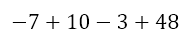
    Let us consider one problem. Suppose we are asked to evaluate

    Equipped with our understanding that the convention is to perform division and multiplication first, we obtain

    Now what do we do? We begin by performing the calculations from left to right. What we first do is orient ourselves so we imagine we are on the number line facing the right (i.e. the positive direction). Now, we locate ourselves where the first number is. So we land on the position for -7.

    Now all we have to do is move forward or backward the appropriate number of steps according to whether we encounter an addition or subtraction respectively. So, we first move forward 10 spaces, landing on +3, then back 3 spaces, landing on 0, and then forward 48 spaces, landing on +48.

    BEDMAS with the Brackets

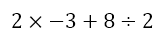
    But what if we have something more complicated, say something that involves brackets? Consider the following

    Here we have two separate parentheses to deal with. Since both are unrelated, in that there is a subtraction operator between the two, we can deal with both simultaneously. So we can first obtain

    We can now complete our dealings with the parentheses to get

    Now the –8 represents the negation of -8, which would give +8. Hence, we have

    Now, the initial multiplication involves one positive number and one negative number, meaning that the product will be negative. The division involves two positive numbers and hence will yield a positive number. So we have

    This gives the final answer as -2.

    In the above example, we had obtained –8 and I stated that this was the negation of -8. We could have also considered

    Here, instead of the negation of a negative number, we are considering the product of -1, which is inherent in the standalone negative sign, and -8, which gives us +8 since it is the product of two negative numbers.

    BEDMAS ‘Brain Teasers’

    Now, almost everyday I get some BEDMAS ‘brain teaser’ in my social media feeds. I don’t know why. Maybe my interest in mathematics related posts makes the idiotic algorithm ‘think’ that I would like such ‘brain teasers’. The reason I’m placing ‘brain teaser’ in inverted commas is because I do not think these problems qualify as brain teasers. They only check whether you know the rules of BEDMAS.

    ‘Brain Teaser’ 1

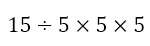
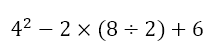
    Anyway, one such ‘brain teaser’ is

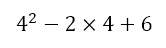
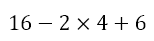
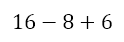
    We know we need to deal with the brackets first. To do this, we need to calculate 8 – 6 + 3, which equals 5. Hence, the problem reduces to

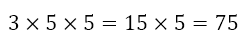
    Since we only have multiplication and division with no grouping, we can proceed from left to right. This gives us

    It is important to note that in the expression 5(8 – 6 + 3), we are not instructed to group the 5 and the value of the parentheses. Hence, the 5, which comes after the division sign, becomes the divisor, while the 5, which is the value of the parentheses, is a normal multiplicand.

    ‘Brain Teaser’ 2

    How would we calculate the value of

    Here, we observe that there is a parentheses that we need to deal with first, yielding

    Now, we have an exponent, which we need to address next, giving us

    Now we have to perform the multiplication to get

    This leaves just addition and subtraction, which we can perform from left to right to get

    which yields 14 as the final answer.

    ‘Brain Teaser’ 3

    But what if we have something like

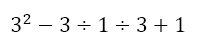
    We recognize that the first term has a nested bracket. Hence, we need to first deal with the innermost bracket. This bracket contains an exponent, which we need to perform first. The second term has an exponent, which we will perform first in that term. The third and fourth terms have division, which we will perform at this stage. This gives us

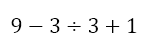
    Now, we have to perform the division in the innermost bracket of the first term. At the same time, we can evaluate the brackets of the second, third, and fourth terms. This gives

    Now we can evaluate this innermost bracket of the first term. At the same time, we can evaluate the exponent on the second term. We now have

    Evaluating the first bracket, we get

    Now evaluating the exponent gives us

    Observe that we have two division operators one after the other. When faced with this situation, we need to perform the operations one by one from left to right. So we first get

    because the first division was 3÷1, which equals 3. Now we can perform the remaining division to get

    Now we have only addition and subtraction, which we can perform from left to right to give us 9 as the final answer.

    It’s a Wrap

    What we can see is that following the BEDMAS rules carefully will yield an unambiguous answer. As mentioned in the previous post, the is nothing sacrosanct about BEDMAS. It is not inherent to any of the operations. However, this is the convention that has been adopted by mathematicians so as to remove confusion and to ensure that any particular arithmetic calculation yields one and only one answer. In these two posts I hope I have communicated the rules of BEDMAS well enough for anyone at or above grade 4 to understand. I hope the examples I have given serve as good illustrations of the process. But more than that, I hope I have communicated the fact that BEDMAS is a convention that could only have been agreed upon if there was a spirit of collaboration and camaraderie among mathematicians.

  • Order! Order!

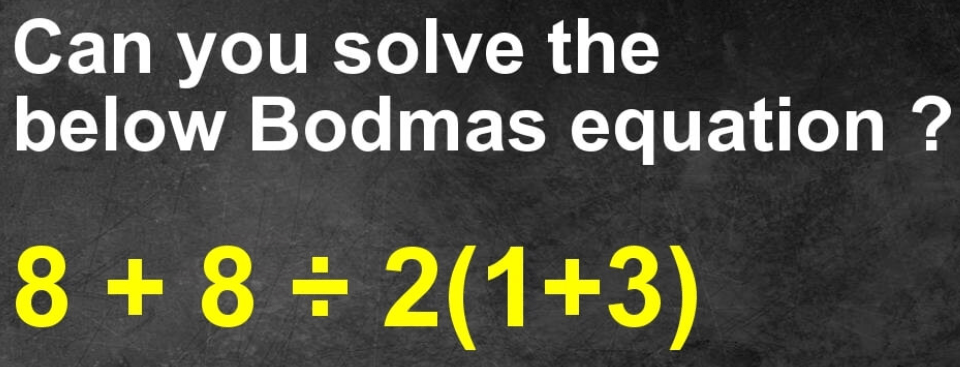
    Common BODMAS/BEDMAS ‘conundrum’ (Source: Genius Puzzles)

    As a mathematics teacher, I primarily teach students in high school, preferring, within this group, to teach grades 11 and 12. There are two reasons for this. First, mathematics taught in grades 11 and 12 is complex enough to allow for interesting nuancing of the ideas and also blending of the various areas like algebra, geometry, trigonometry, statistics and probability, and calculus. Prior to that the concepts are too superficial to allow for such unrestrained exploration. Second, I really do not know how to handle students who are younger than 14.

    Anyway, one year I was feeling somewhat adventurous and agreed to teach students in grade 6. This was the academic year 2016-2017. The kids were, as expected, difficult to handle. However, what I was surprised with was the fact that most of them were very weak with order of operations. For those of you who are confused about this terminology, perhaps BODMAS or PEMDAS or some such six letter variation might prove to be a reminder.

    In the above, ‘M’ stands for ‘multiplication’, ‘D’ for ‘division’, ‘A’ for ‘addition’, and ‘S’ for ‘subtraction’. Those are the letters that do not change, even though D and M often swap positions. We will see why shortly. However, the first two letters have some variety. The first letter varies between ‘B’ for ‘brackets’, ‘P’ for ‘parentheses’, and ‘G’ for ‘grouping’. The second letter varies between ‘O’ for ‘orders’, ‘E’ for ‘exponents’, and ‘I’ for ‘indices’. So, we can get 18 variations of these letters, all of which essentially give the same sequence for performing operations. However, whether we call it BODMAS or PEMDAS or GIDMAS, whatever does it mean? And, more importantly, why do we have such an ordering?

    Mathematics aims for consistency. In other words, if 2 people perform the same set of operations accurately, we expect them to obtain the same answer. We will see how this desire for consistency is at the root of BEDMAS. I will use BEDMAS because I think ‘O’ for ‘orders’ is weird since we never call the exponentiation operation by that name anywhere else. Also, ‘G’ for ‘grouping’ is vague and is also not common terminology. So how does BEDMAS give us the consistency we aim for?

    Testing for Consistency

    We begin with the most basic operation – addition. And we know that 2 + 3 and 3 + 2 gives us 5. We call this property the commutative property. Hence, we say that addition is commutative. This means that, given any two numbers, say a and b, a + b = b + a. When we consider subtraction, however, we get a different result because 2 – 3 is not the same as 3 – 2. In fact, the first is -1 while the second is 1. We can actually generalize this to say that ab and ba are negatives of each other. We often say that subtraction is anticommutative.

    When we move to multiplication and division, we see quite similar things. For example, we realize that multiplication is commutative because a × b = b × a. However, we say that division is noncommutative because a ÷ b and b ÷ a are not negatives of each other but reciprocals of each other.

    We have, therefore, seen how the four basic operations function. Now we have to ensure that our sequence of operations maintains this feature.

    So let us consider 2 + 5 × 3. Since we normally perform operations from left to right, let us do this here. Let us also give preference to the addition operation and perform it before multiplication. With this approach, we will first add 2 and 5 to get 7 and them multiply by 3 to get 21. However, we know that addition is commutative. Hence, if it was true that we should do the addition first, we should get the same answer if we did 5 + 2 × 3. This does prove to be the case. However, we know that multiplication is commutative. So swapping the 3 and the 7 (from 2 + 5 or 5 + 2) should give us the same answer. Now we have 3 × 2 + 5. But this gives us 6 + 5 = 11. And if we swap the 2 and 5 we have 3 × 5 + 2, which gives us 17.

    Since we are getting different answers with different approaches, let us now give precedence to multiplication over addition. Hence, if we are given 2 + 5 × 3, then we need to perform the multiplication first, to get 2 + 15, which then gives us 17. But again, we recognize that addition is commutative. So, we could write 5 + 2 × 3, which gives 11 if we perform the multiplication first.

    What we can see is that there is no sequence that is inherent to the operations themselves. After all, multiplication itself is ‘repeated addition’! So one would not expect anything inherent to the two operations than can actually make a distinction between them.

    An Alternate Convention

    But what this means is that we need to decide upon a ‘convention’ that all of us will follow, which will remove the ambiguity concerning which operations need to be done first and which ones last.

    For example, we could propose an alternate order, namely SAMD, just for the four primary operations. Then if we have to calculate 4 – 5 × 6 + 8, we would perform the subtraction first, to get -1 × 6 + 8. Then we would perform the addition, resulting in -1 × 48. Finally, we would perform the multiplication to get -48. Similarly, if we had 6 – 2 × 3 ÷ 4, we could get the following steps 4 × 3 ÷ 4 = 12 ÷ 4 = 3. As long as everyone followed the convention we would all get the same answer all the time.

    The Need for Conventions

    Conventions are crucial in any area of knowledge. For example, in the sentence, “The cat climbed the tree” it is only by convention that we accept that ‘the cat’ is the subject of the verb ‘to climb’, which ‘the tree’ is the object. There is nothing inherent to the order of the words that tell us this. That is why in many languages, the adjective comes after the noun it qualifies, while in English it comes before.

    Similarly, in chemistry we may come across the symbol Na2CO3. Only convention tell us that Na represents Sodium, C represents Carbon and O represents Oxygen. Only convention tells us that the subscripted 2 and 3 indicate the number of atoms of the element preceding it that constitutes the molecule.

    The same is true about mathematics. The symbols do not interpret themselves. We need to accept conventions that everyone agrees to follow in order to communicate mathematical knowledge reliably.

    Unfortunately, most of us mathematics teachers do not recognize the complete arbitrariness of the order of operations since we have become so used to the convention that we cannot see it as arbitrary. However, as I have attempted to show, mathematicians could have adopted another convention for the order of operations without there being any confusion. I think that, if mathematics teachers spent some time asking students to arrive at a new convention they could follow for a time, it might be a good exercise in helping students realize that there is a consensus that has been adopted, which everyone needs to follow so that we can communicate mathematical ideas reliably and without confusion.

  • Down Memory Lane

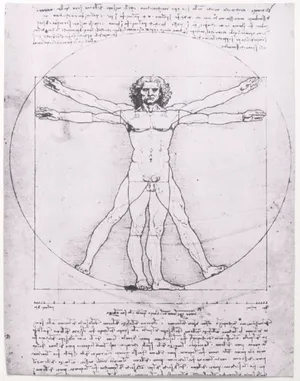
    The Vitruvian Man by Leonardo da Vinci (Source: Britannica)

    Just recently, while introducing me for a talk, someone stated that I have two loves – theology and mathematics. This is a reasonably accurate statement and I blog about these two areas regularly. I have been quite open about both of these with my students too. Hence, even though I am their mathematics teacher, they all know that I am also a pastor and that I think about theological issues. As a result many students often ask me questions related to issues outside the immediate sphere of mathematics.

    Hence, way back in 2006, shortly after the movie was released, some students asked me about my take on The Da Vinci Code. Some of them, inspired by the movie, had started reading the novel by Dan Brown and had observed some differences between the book and the movie. They wanted to know which version was correct.

    I had to disabuse – or at least attempt to disabuse – them of the notion that either the book or the movie had anything that could be considered historically reliable. Secret societies and hidden genealogies are all well and good for a novel, but they hardly hold up to rigorous scrutiny.

    In 2006 I had neither seen the movie nor read the book. My work schedule only permitted time for one ‘distraction’ and, at that time, J. K. Rowling was regaling me with the adventures at Hogwarts, both on the page and on the screen. Having had a late start with the adventures of Harry, I was attempting to catch up and finish reading till the Half Blood Prince before the Deathly Hallows was scheduled to be published the next year.

    One of my student expressed disbelief that I had not read the novel by Brown. She showed me the illustration of The Vitruvian Man in the novel and asked me how I, as a mathematics teacher, was not intrigued by the proportions of the human body that the drawing indicated. I had to tell her that, since humans come in all shapes and sizes, there is no ideal proportions for the body. After reading a bit about the Vitruvian man, I had to tell her that this was some idealized set of proportions that might have held some appeal for da Vinci, but that this does not mean it was some universal principle.

    The Golden Ratio

    She also expressed some interest in learning about the Golden Ratio, which she believed to reside in the drawing. But I had to tell her that this was impossible since da Vinci was working with ratios of whole numbers, which meant that he was not working with the Golden Ratio since the ratio is an irrational number. In this blog, I have dealt with two other irrational numbers at length – e and π. The Golden Ratio is a different sort of irrational number. Unlike e and π, which are both transcendental irrational numbers, the Golden Ratio is an algebraic irrational number.

    Of course, here we come across something very strange. There are people who claim that the Golden Ratio has some inherent aspect of beauty to it and that, therefore, many artists use it in their art. Let me be very blunt. Even if it is the case that the work of some artists might seem to indicate that there are some ratio similar to the Golden Ratio, and even if some artists today might be intentionally trying to include the Golden Ratio in their work, there is absolutely no justification, from a mathematical perspective, to think that there is any truth to such claims. In order to justify my assertion, let us consider what the Golden Ratio is.

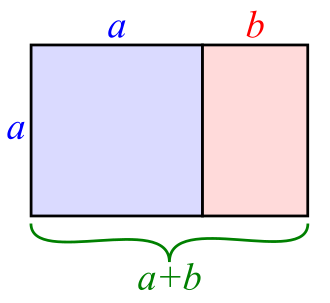
    Suppose we have a rectangle with smaller side of length a and larger side having a length a + b. Now suppose we cut off a square of side length a from the rectangle. This would leave a rectangle with sides of length a and b. This is shown in the diagrams below

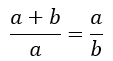
    Now if the ratio of the lengths of the sides of the original rectangle is the same as the ratio of the lengths of the sides of the smaller rectangle, then we say that the ratio of the lengths of the sides is the Golden Ratio. This gives us the equation

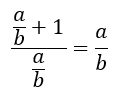
    Dividing the numerator and denominator of the left fraction by b we get

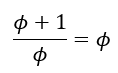
    Denoting a/b as ɸ we get

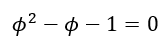
    This can be rearranged to give the quadratic equation

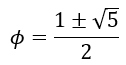
    Using the quadratic formula, we can obtain

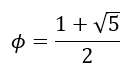
    Since ɸ is a ratio of lengths, it cannot be negative. Hence, ignoring the negative root above we get

    Using a calculator, we can obtain ɸ = 1.618033989…. The presence of the square root of 5 in the expression for ɸ indicates that it is an irrational number, as I claimed earlier.

    An Oft-Repeated Claim

    However, the irrationality of the ratio cannot be the only reason for which I reject the claims about its prevalence in art. After all, the diagonal of a unit square is 2, which is also irrational. Similarly, the ratio of the distance between parallel sides of a regular hexagon to the length of the sides is 3. While artists, in general, may not use geometric figures in their art, it would be fallacious for me to discount the presence of some ratio simply on the grounds that it is irrational.

    The claims about art do not come on their own. Rather, there is the prior claim that the Golden Ratio occurs often in nature. This is a bald-faced lie. After all, what can we observe in nature but discrete occurrences of phenomena? That is, we can count certain things. For example, it is claimed that, if we count bands of fruitlets on pineapples, we will count 5, 8, or 13 bands for small pineapples or 8, 13, and 21 bands for larger ones. So what?

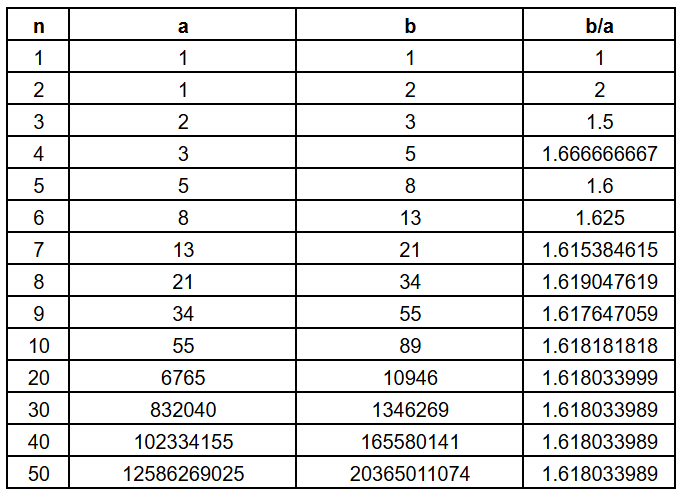
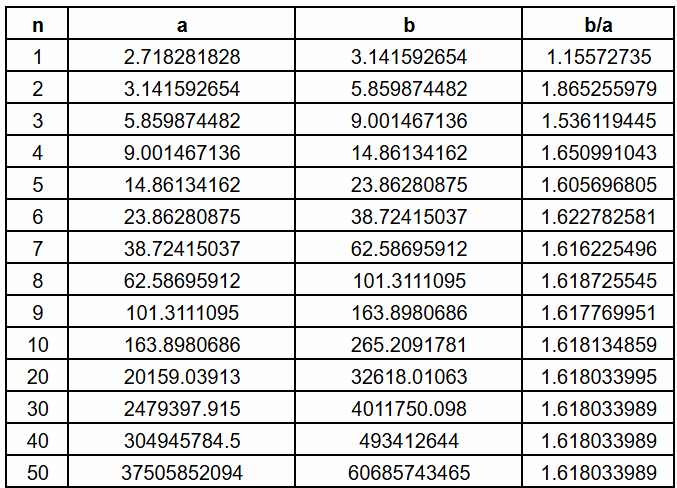
    Well, these numbers are consecutive numbers in the Fibonacci sequence. And if we take the ratio of consecutive terms in the sequence, the ratio will turn out to more closely approximate ɸ. For example, see the table below

    I have collapsed many of the rows so that the table could fit and be readable in a single screen. However, the table shows that the terms in the fourth column converge to the value of ɸ indicated earlier. It is crucial, however, to note that, while the ratio in the fourth column do converge to the value of ɸ, they will never be equal to ɸ because the ratios are rational numbers while ɸ is irrational.

    Debunking the Claim

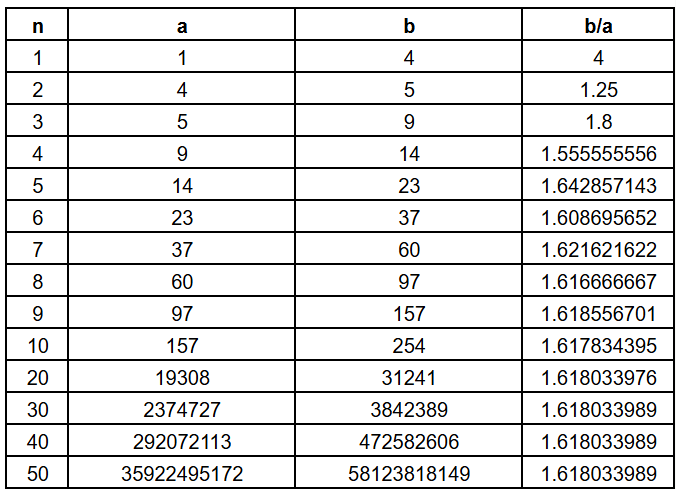
    But that’s not my beef with the earlier claims. Let us start the sequence with different numbers. Instead of the first two terms being 1 and 1, let us start with 1 and 4. Note that 4 does not appear in the original sequence. With these two as the starting point, we will get the following table

    Since the starting terms are different, all the terms in the new sequence differ from the original one. However, the ratios quickly converge to the same value!

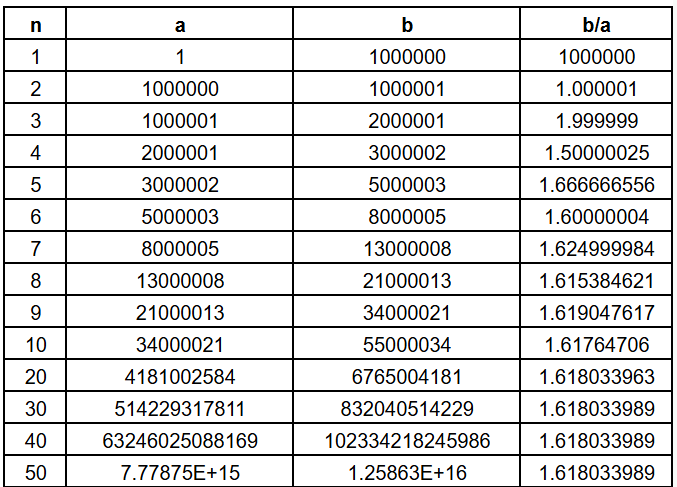
    Now let us change the second term quite drastically. Let’s make it 1,000,000! Now we get the following table

    We observe the same thing, namely that, while the individual terms are the ratios converge to the same value.

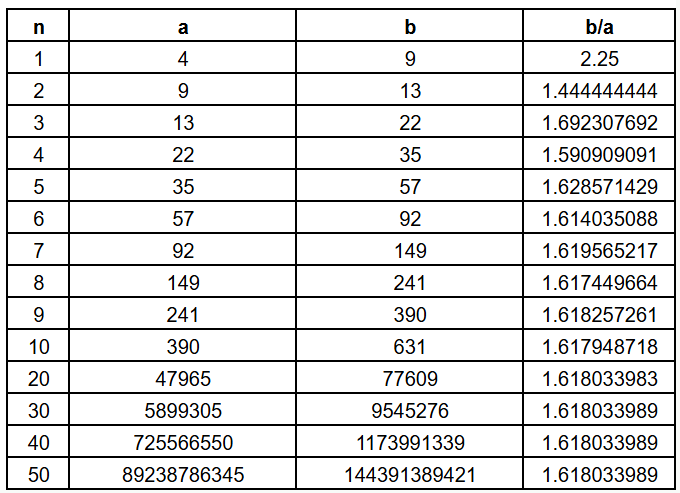
    We could take a different first term also and see what we get. Choosing a = 4 and b = 9 we get the following

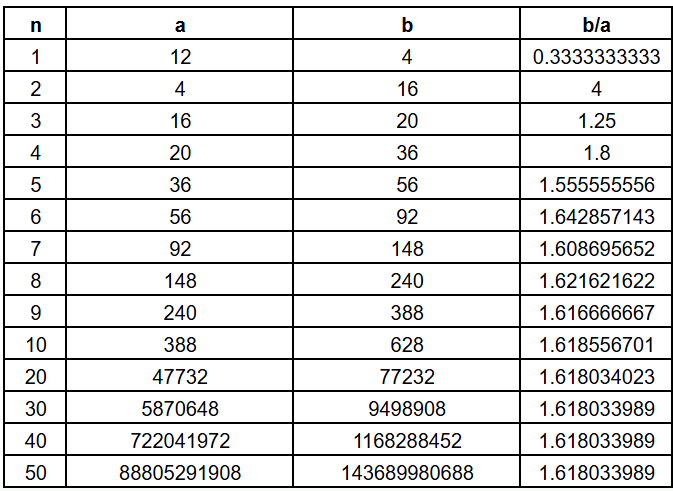
    There is no change to the ratio to which the terms of this sequence converge. Indeed, we can start with a value of a that is greater than b and get something like

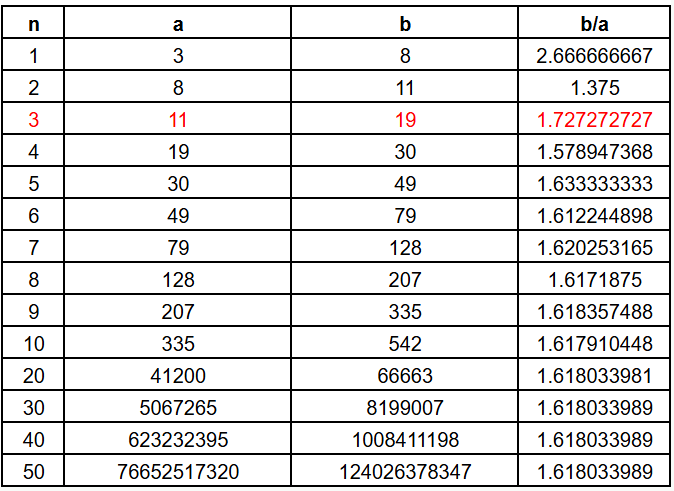
    In other words, no matter what numbers we choose to start with, the resulting ratio of consecutive terms converses to the value of ɸ. Hence, if you give me any two starting numbers, I can confidently assert that they are part of a sequence where the ratios of consecutive terms converges to ɸ. For example, if you gave me 11 and 19, I could form the sequence as below

    Here, I have shown the third row in red so you can see where in the sequence the given numbers lie. And since the sequence of ratios converges to ɸ, I can confidently state that, if we find the numbers 11 and 19 in nature, then this must be an approximation to ɸ. But the careful reader will recognize this as quite spurious reasoning. After all, every pair of starting numbers will yield a sequence of ratios that converges to ɸ. Hence, there is nothing extraordinary in finding any such pairs of numbers anywhere.

    Freedom to Explore

    Over my career as a teacher, which spans more years than I would care to admit, I have come across the claim that the Golden Ratio appears in nature many more times than I would consider acceptable. Most of these are from excited young students, who have just been introduced to the Golden Ratio or the Fibonacci sequence. However, a fair number are from teachers, some very experienced in terms of years. They point to the fruitlets of the pineapple and to the petals of various flowers to give their students examples of these presumed occurrences. However, as I have shown in this post, any starting point, as long as both numbers are positive, will result in a sequence of ratios that converges to ɸ. Here is one that starts with the transcendental number e and π.

    By pointing to numbers in nature and asking their students to draw conclusions that nature has examples of the Golden Ratio, such teachers are stunting the mathematical acumen of their students because they make the students think that something is special when in case it is nothing more than run of the mill. Instead of asking their students to wonder why every sequence of numbers defined as

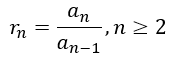
    has a corresponding sequence of ratios defined as

    that converges to ɸ, the teachers make students think that the example of the Fibonacci sequence is unique in that regard.

    Don’t get me wrong. I am not saying that the Fibonacci sequence does not represent something insightful about mathematics. What I am saying is that we should not claim any distinction for it that it actually does not have. But for this to happen the teachers should have the time to explore various ideas both individually and in groups. However, given how content heavy the high school mathematics curriculum is, teachers in the lower grades also have a lot to cover.

    As a result, most mathematics teachers are perpetually scrambling to complete the syllabus for the year, with hardly any time for the kind of exploration that would result in robust learning for the students. Because of this, most teachers are forced to use prepackaged material, such as from a textbook or online platforms. But prepackaged materials can never cater to the unique requirements of a class of students, each of whom has a uniquely expressed curiosity, unless, of course, we wish to quench that curiosity!

    If we are serious about teaching students to be adept at mathematics, we must reduce the content of our curriculums and syllabuses and focus instead on the development of a small set of skills that can be transferred not just to different areas within mathematics but also to other disciplines. And we must allow our students – and teachers – the freedom to explore the subtleties of mathematics without which their understanding of mathematics would be superficial at best.

    Note: I will be taking a break next week and will return with new posts in January 2025. Have a happy holiday season.

  • The Presenting Problem

    In this post, I wish to continue with some geometry along with some insights from sequences and series. Consider the figure below

    It is given that ∠AOB = 60°. Also, the radius of the largest circle is 1 unit. The successive smaller circles are tangential to the circles on either side. This continues indefinitely. In other words, there are infinitely many circles. We are asked to find the total area of all the infinite circles.

    If you are inclined to solve this, please pause here before proceeding.

    Introducing Infinite Geometric Series

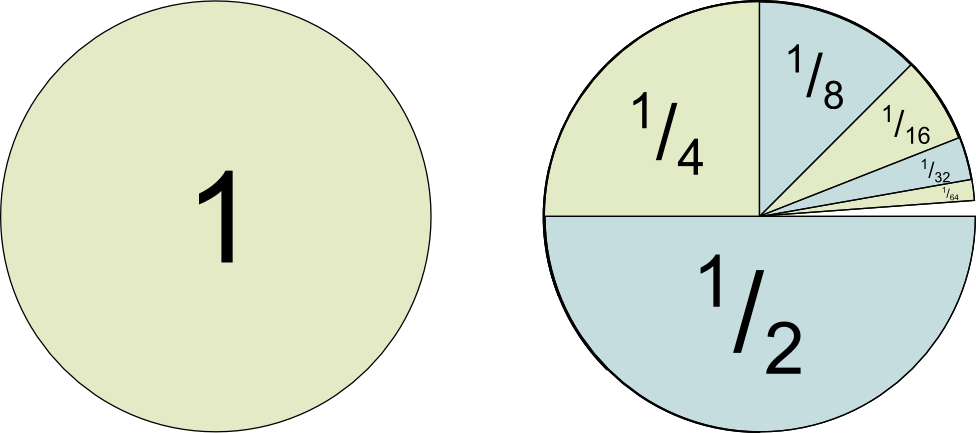
    No relevant caption to maintain some suspense! (Source: Science4All)

    Ok. I hope those who attempted the solution have obtained a satisfactory answer. Now, some of you may be wondering how the sum of the area of infinite circles could be determined. Should the finite area of infinite circles also be infinite?

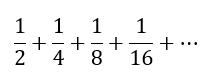
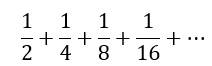
    Let us take a brief detour into the marvelous world of infinite series. Consider the series

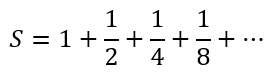
    The ellipses (i.e. ‘…’) at the end indicate that the pattern continues. We encountered an expanded version of this series in the post Naturally Bounded. There we considered the infinite series

    After some nifty algebraic manipulation we showed that S = 2. Since the sum we are considering in this post only lacks the starting 1, we can conclude that the sum of the infinite series for this post is 1.

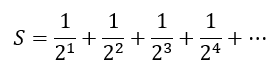
    However, let us spend some time understanding why this is the case. What in the world is the pattern in our series? We can recognize that all the values in the denominator are powers of 2. Let us designate the sum with S. Then we can write

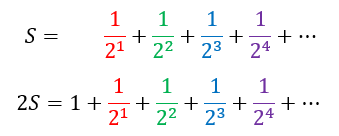
    Now let us try to see why the sum turns out to be 1. As in the earlier post, we can multiply both sides by 2 to get

    Let us make this colorful. We can write the above two equations one below the other as follows

    We can see that, if we subtract the first equation from the second, the LHS will yield Sn, while the RHS will reduce to 1 since all the terms in red, green, blue, and purple will cancel out. This gives us S = 1.

    But why does this work. We can see that, in the series we are considering, every term is obtained by multiplying the preceding term by 1/2. Such a series is known as a geometric series.

    In order to understand geometric series, let us start with a general case. Let’s say that we have a starting term, a, and that each subsequent term is obtained by multiplying by r. The multiplier, r, is called the common ratio because it is the ratio of any term to the term before it. Anyway, we can see that our geometric series up to n terms will be

    Note that the nth term is arn-1 because the first term, a, is actually ar0 and as the power of a starts from 0, the count after n terms will be n – 1. We can multiply the above equation by r and arrange a similarly color coordinated set of two equations one below the other as follows

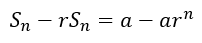
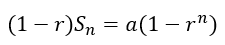
    Now, when we subtract the second equation from the first, the red, green, blue, and purple terms will vanish, leaving us with

    Both sides can be factorized to give

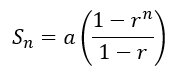
    Now, if we divide the entire equation by 1 – r we will obtain

    The first thing we can observe is the denominator 1 – r. Since the denominator cannot be zero, we can conclude that this formula will not work for r = 1. Further, we can take a look at the rn term. When the value of r is either greater than 1 or less than -1, multiplying by r results in a number that has a greater magnitude. In this case, it is obvious that we cannot find a sum of infinite terms of the series since subsequent terms have larger and larger magnitudes.

    But what happens when the value of r is between -1 and 1? In this case, multiplying by r results in a number that has a smaller magnitude. Hence, the more times we multiply by r, the closer the result gets to zero. We can see this in the original series

    We can see that each term is closer to zero than the one before it. So we can potentially consider an infinite series for these values of r and write

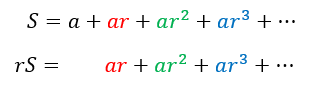
    Once again we can multiply this equation by r and stack the two equations as follows

    Now, when we subtract the second equation from the first, the red, green, and blue terms will vanish giving us

    Dividing the equation by 1 – r we get

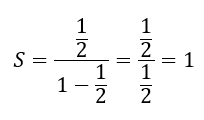
    Now, we can return to our original series. For this series, we observe that a = 1/2 and r = 1/2. Plugging these values into the above formula gives us

    Return to the Problem

    This matches with our earlier result and puts us in a position where we can actually attempt the problem with which I started the post. Let me reproduce the figure so we can recall what the problem was.

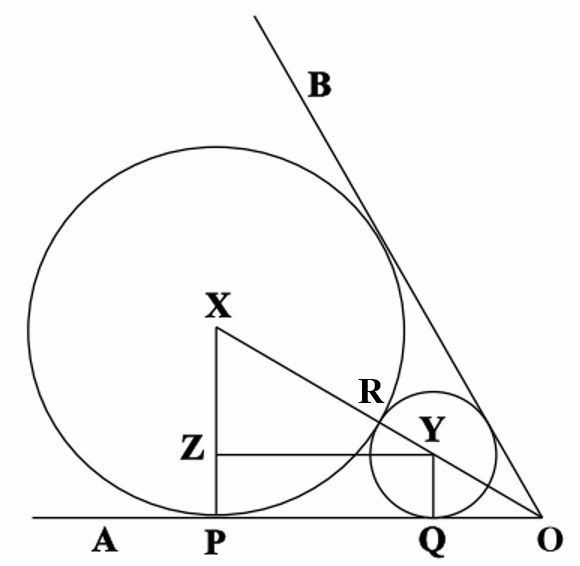
    Starting with the largest and second largest circles, we can obtain the following figure.
    Here, X and Y are the centers of the larger and smaller circles respectively. XP and YQ are perpendiculars drawn from X and Y respectively to AO. YZ is a perpendicular drawn from Y to XP. Since we were given that the largest circle has a radius of 1, this means that XP = 1. Also, R is the point of tangency of the two circles, which is also the point where the line OX intersects both circles.

    Now, we are given that ∠AOB = 60°. From symmetry, it follows that ∠AOX = 30°. Using some basic geometry, we can see that OX = 2 XP. Similarly, since the triangles OXP, PYQ, and YXZ are similar, we can obtain OY = 2YQ and XY = 2XZ.

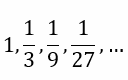
    Suppose we say that YQ = r. This gives us OY = 2r. Also, since XP = 1, we can conclude that OX = 2. But OX = OY + YR + RX. This gives us 2 = r + 2r + 1, yielding r = 1/3. However, r is the radius of the smaller circle. Since, with the use of geometry, it turns out to be a constant (i.e. 1/3), this means that the radius of each successive circle in the series will be 1/3 times the radius of the previous circle. In other words, the radii of the circles form the following sequence

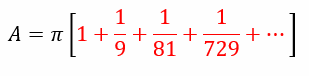
    Now, the area of a circle is πr2. This gives us the infinite series for the area is

    Taking π common we can express this as

    Here, the terms in red form an infinite geometric series with a = 1 and r = 1/9. Using the formula we earlier derived for the sum of an infinite geometric series we can obtain

    Reflection

    While solving the problem we have used both algebra and geometry. In an earlier post I have bewailed the unfortunate trend in some countries of offering distinct mathematics subjects like Algebra 1, Geometry, and Pre-Calculus. In another post I demonstrated that one’s understanding of mathematics is furthered when we consider algebra and geometry together. I have done this in this post too. Mathematics is a coherent body of knowledge. By introducing artificially defined segments of mathematics as stand-alone bodies of knowledge, we convey the idea that the whole is the sum of its parts. However, mathematics is much greater than the sum of its branches. And I will continue to harp on this till my dying breath!