
In the previous post, third in the series on triangles, we had derived some formulas. Of course, a formula is derived precisely in order that it can be used in problem solving. One of the key types of problems in the study of triangles are identities. There are identities of many kinds. And all of these depend on the relationships we uncovered in the formulas that we derived. Another contributing factor is the fact that the sum of the internal angles of a triangle is 180°. To demonstrate the wide variety of identities we can obtain, let us devote this post to playing around with the formulas.
Identity 1
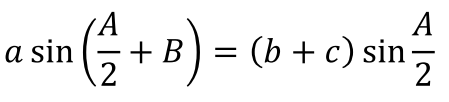
In any triangle ABC, prove that
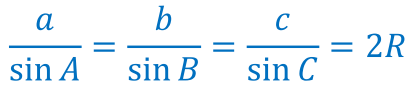
The sine rule states
We proceed as follows
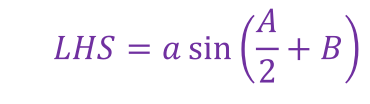
We will use the sine rule to express a in terms of sin A and also expand the sine term using compound angles. This will give us

Since we need sin (A/2) on the RHS, we will use the multiple and formula to express sin A in terms of its half-angles. This will give us

We will now take the cosine term and one of the ‘2’s inside the brackets to get

We now use the multiple angle formulas to get rid of the half angles inside the brackets. This gives us

We now distribute the terms inside the square brackets to get

We now use the compound angle formula for the first two terms inside the square brackets to get

Now, since the sum of the angles of a triangle is 180°, (A + B) and C are supplementary angles. This gives us

Now we can distribute the 2R inside the brackets to get

Finally, we can use the sine rule to express sin B and sin C in terms of b and c, giving
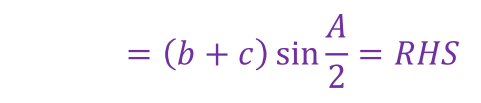
The proof of the identity depends on an understanding that terms containing lengths of sides can be changed to terms containing the sines of the corresponding angles and vice versa. Further, a knowledge of the basic multiple angle formulas and compound angle formulas was crucial. Finally, the knowledge that the sum of the angles is 180° allowed us to use some allied angle results. Let’s try another.
Identity 2
In any triangle ABC, prove that
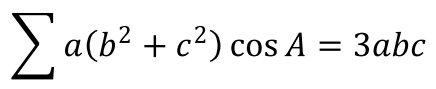
Here, the notation needs to be explained. The capital sigma (i.e. ∑) denotes a summation. We are told that we are summing terms that look like a(b2 + c2)cos A. The next term is obtained by cycling through the letters. a turns to b, b turns to c, and c turns to a. We proceed as follows.

First, for clarity, we expand the summation to give

Since the LHS has cosine terms and the RHS has only lengths of sides, it would seem that the projection formula would be helpful. We expand all the brackets and regroup the terms to get

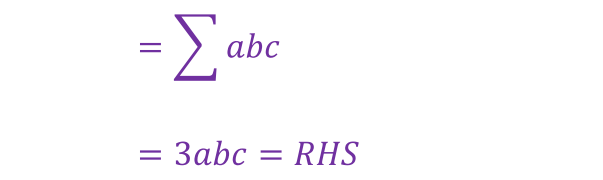
Now using the projection formula we get
Let’s try another.
Identity 3
In any triangle ABC, prove that
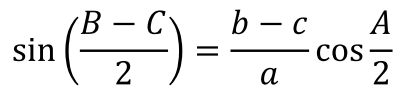
We proceed as follows.

Since the RHS has a (b – c)/a term, we will need to introduce sine terms of the angles. We multiply and divide the term above by twice the cosine of (B + C)/2. This will allow us to use a transformation formula. Hence, we get
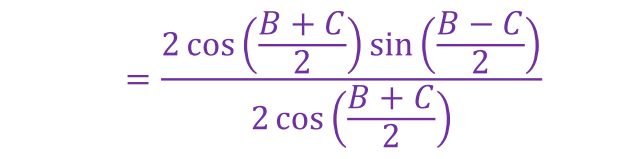
Using a transformation formula in the numerator and an allied angle formula in the denominator, based on the sum of the angles of a triangle, we get
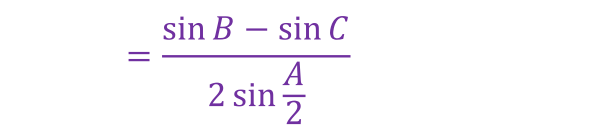
Since we need b and c on the RHS, we use the sine rule for the numerator. Since we need a cos (A/2) term on the RHS, we multiply and divide by it. This gives us
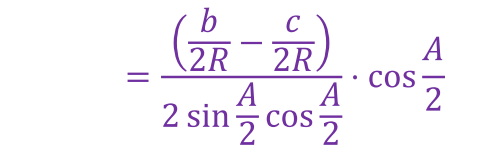
We now bring the 2R term to the denominator to get

Using the sine rule in the denominator we get

Let us consider another but this time I will only give the steps, you try to determine why I took the approach I did.
Identity 4
In any triangle ABC, prove that
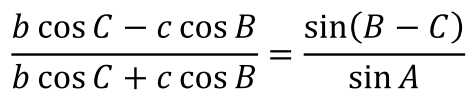
Here is the solution
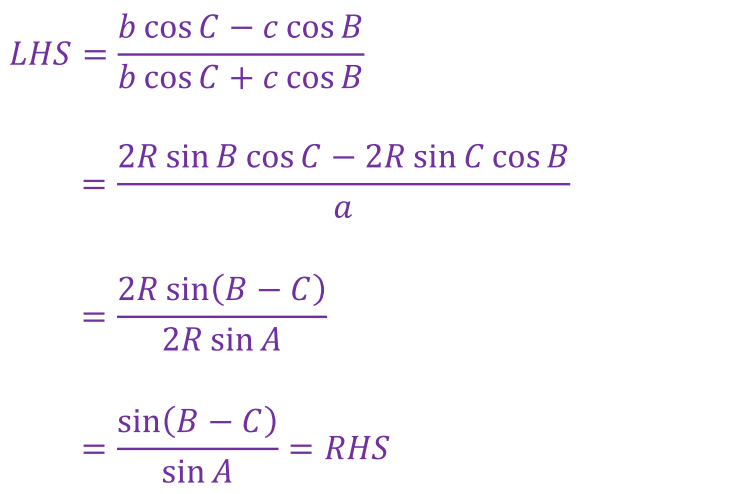
Identity 5
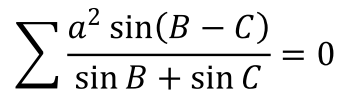
In any triangle ABC, prove that
Here is the solution
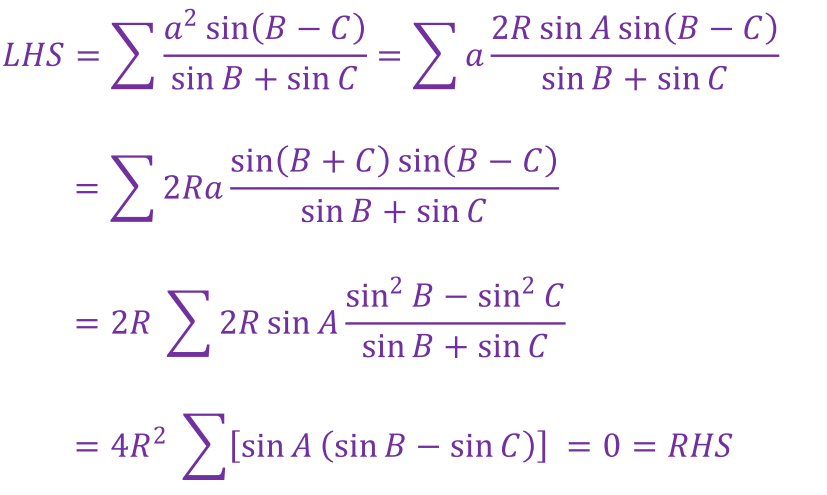
Identity 6
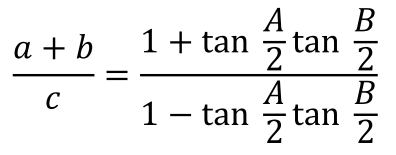
In any triangle ABC, prove that
Here is the solution
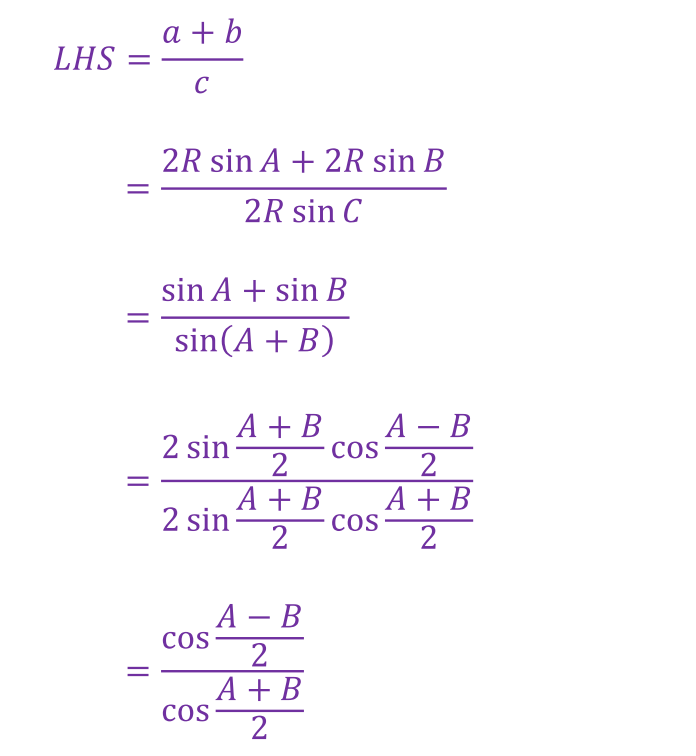
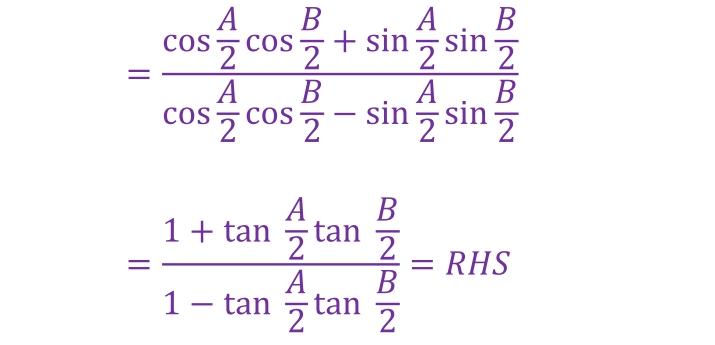
Identity 7
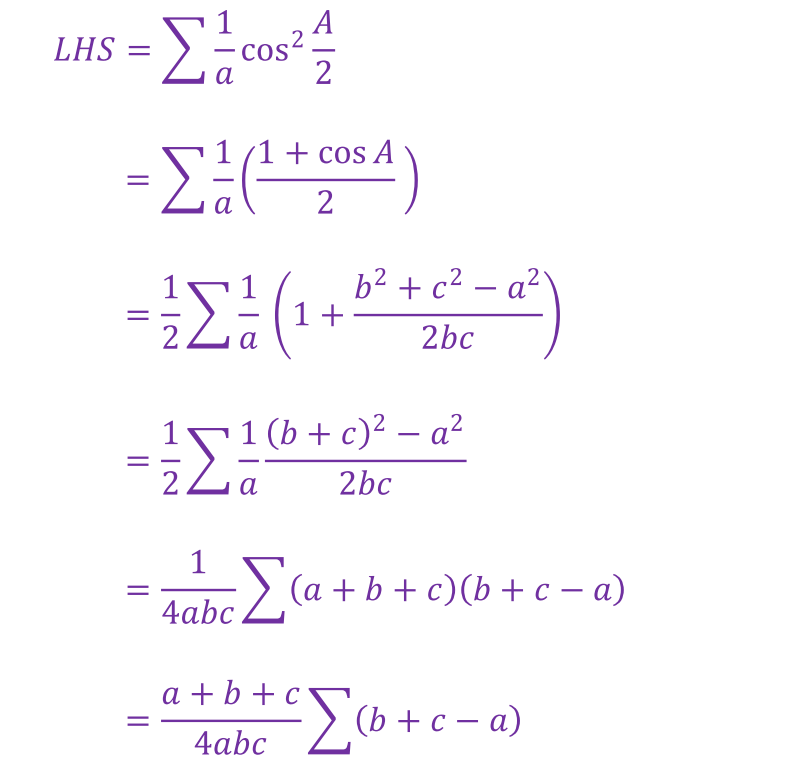
Let’s do one more. In any triangle ABC, prove that
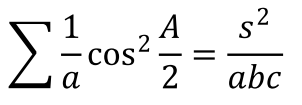
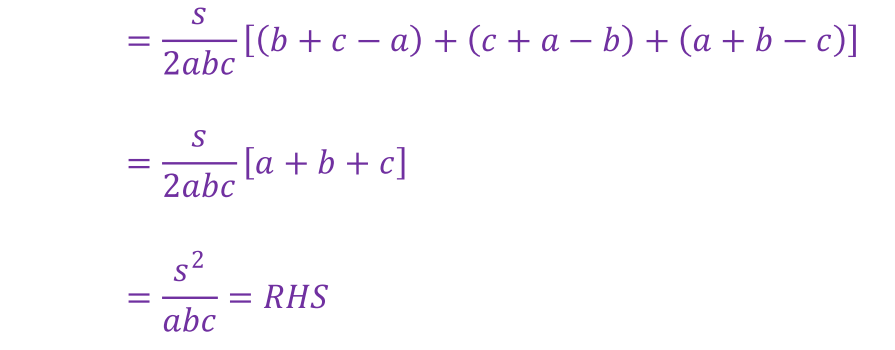
Here is the solution
Why don’t you try some yourself?
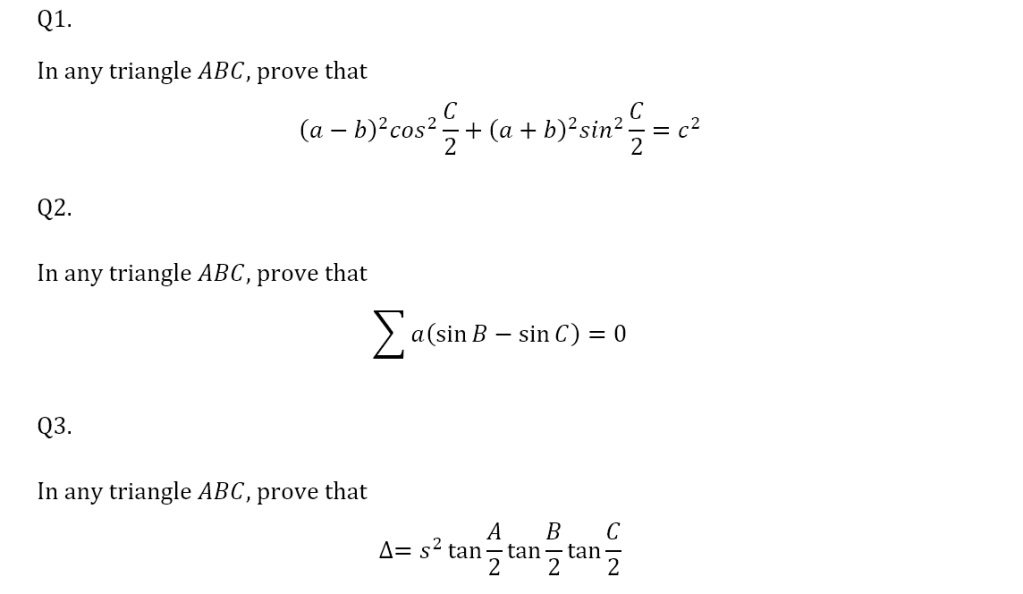
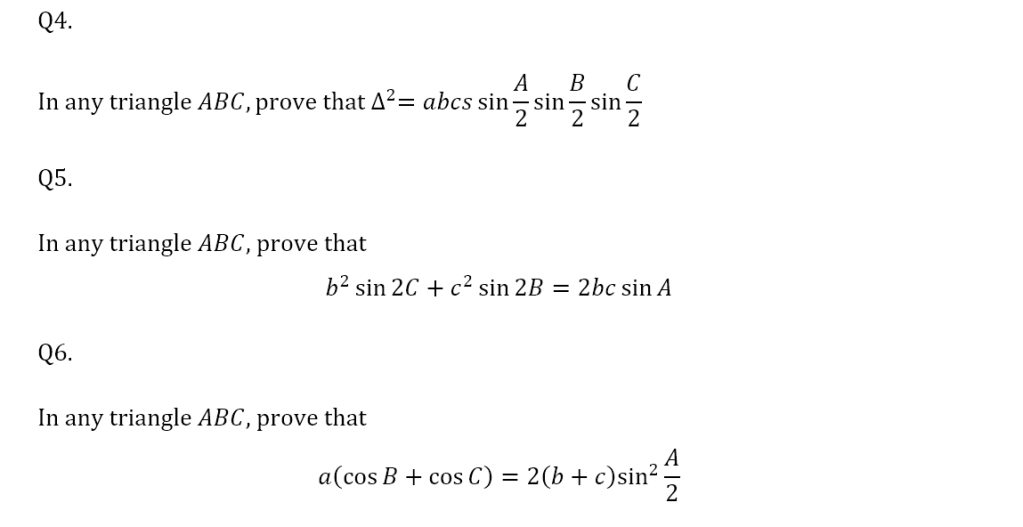
You can find the solutions here. In the next post, we will consider formulas related to the centers of a triangle.


Leave a Reply