
Today we continue our study of triangles. In the previous post, we had derived formulas for various Lengths Related to the Centers of a Triangle. The centers we considered we the circumcenter, the centroid, the incenter, and the orthocenter. All of these are studied regularly in high school. Today, we move to two different concepts that are very rarely studied in high school – the pedal triangle and the ex-central triangle.
The Pedal Triangle – Internal Angles
With reference to the figure below
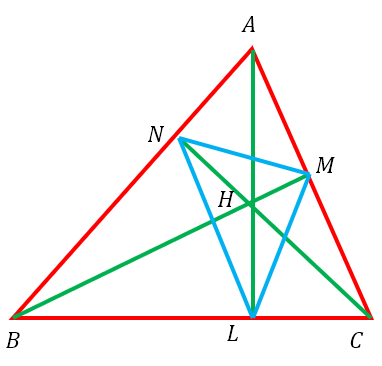
H is the orthocenter of ΔABC.
L,M,N are the feet of the perpendiculars from A,B,C respectively to the sides BC,CA,AB respectively.
ΔLMN is known as the pedal triangle of triangle ABC
From earlier ∠ABM = 90° – A
⇒ ∠NBH = 90° – A
Now consider quadrilateral HNBL
∠HNB = ∠BLH = 90°
That is a pair of opposite angles add up to 180°. Hence, HNBL is a cyclic quadrilateral.
Hence there exists a circle that passes through the four points H,N,B,L.
HN is a chord of this circle and B and L are points on the circumference of the circle.
Hence the angles subtended by chord HN at B and L are equal.
⇒ ∠NLH = ∠NBH = 90° – A
Similarly ∠MLH = 90° – A (since HLCM is also a cyclic quadrilateral)
Hence ∠NLM = ∠NLH + ∠MLH = 180° – 2A.
Similarly ∠LMN = 180° – 2B and ∠MNL = 180° – 2C.
The Pedal Triangle – Length of Sides
From earlier AM = 2R sinC cosA
From earlier ∠HNA = 90° and ∠HNM = 90° – C
Hence ∠ANM = 90°- (90° – C) = C
Similarly ∠NMA = B
Hence, in ΔANM (using the sine rule)
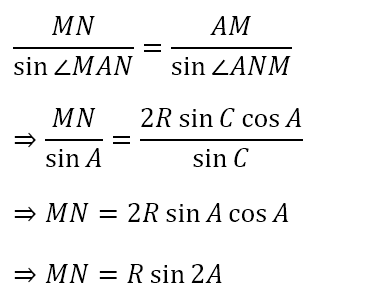
Similarly NL = R sin2B and LM = R sin2C
The Pedal Triangle – Circumradius (R‘)
In ΔLMN
MN = R sin2A
∠NLM = 180° – 2A
By the sine rule
MN = 2R‘ sin∠NLM
⇒ R sin2A = 2R‘ sin(180° – 2A)
⇒ R‘ =R/2
Hence, the circumradius of the pedal triangle is half the circumradius of the original triangle.
The Orthocenter in Relation to the Pedal Triangle
We have seen that ∠HLN = ∠HLM.
Hence HL is the angle bisector of ∠NLM.
Similarly HM and HN are the angle bisectors of ∠LMN and ∠MNL respectively.
So H is the incenter of ΔLMN.
In other words, the orthocenter of a triangle (here ΔABC) is the incenter of its pedal triangle (here ΔDEF).
The Sides of a Triangle in Relation to its Pedal Triangle
We know that HL ⊥ BC.
We also know that the angle bisectors of a pair of intersecting lines are two lines at right angles to each other.
Already we know that HL is the internal angle bisector of ∠NLM.
Hence, BC is the exterior angle bisector of ∠NLM.
Similarly, CA and AB are the exterior angle bisectors of ∠LMN and ∠MNL.
So the sides of a triangle (here ΔABC) are the exterior angle bisectors of the angles of its pedal triangle (here ΔLMN).
The Vertices of a Triangle in Relation to its Pedal Triangle
We know that LA is an interior angle bisector of ∠NLM.
Also CA and AB are exterior angle bisectors of ∠LMN and ∠MNL respectively.
Hence A is the point of concurrency of the interior angle bisector of one of the angles of ΔLMN and the exterior angle bisectors of the other two angles of ΔLMN.
In other words, A is an excenter of ΔLMN. Similarly B and C are excenters of ΔLMN.
Hence, a triangle (here ΔABC) is the excentral triangle of its pedal triangle (here ΔLMN).
Hence, the incenter of a triangle (here ΔLMN) is the orthocenter of its excentral triangle (here ΔABC).
The Excentral Triangle – Interior Angles
Below is the same diagram we have been using for the discussion of the pedal triangle. Only the labeling has changed.
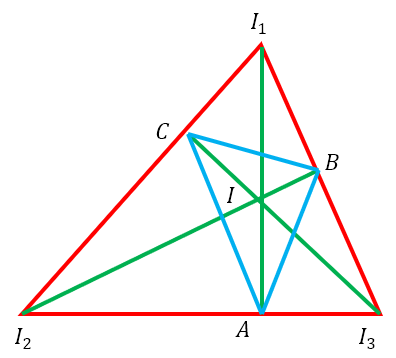
Therefore, the essential relations between the various parts have not changed.
Only now we consider ΔABC as the given triangle.
The point I is the incenter of ΔABC.
And ΔI1 I2 I3 is the excentral triangle of ΔABC.
Now we know that ∠CAB = 180° – 2∠I3 I1 I2
⇒I1 = 90° – A/2
Similarly I2 = 90° – B/2 , I3 = 90° – C/2
The Excentral Triangle – Circumradius (R*)
We know that the circumradius of the pedal triangle is half that of a given triangle.
Hence, from our realization that a given triangle is the excentral triangle of its own pedal triangle, it follows that the circumradius of the excentral triangle is twice that of a given triangle
⇒ R* = 2R
The Excentral Triangle – Length of Sides
The given triangle is ΔABC and its circumradius is R.
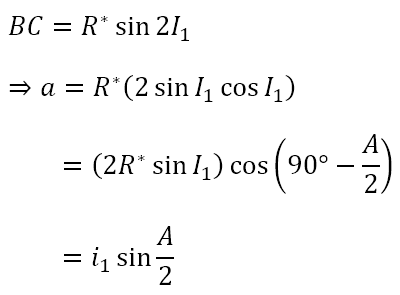
The excentral triangle is ΔI1 I2 I3 and its circumradius is R* = 2R,
From our discussion of the pedal triangle we know that
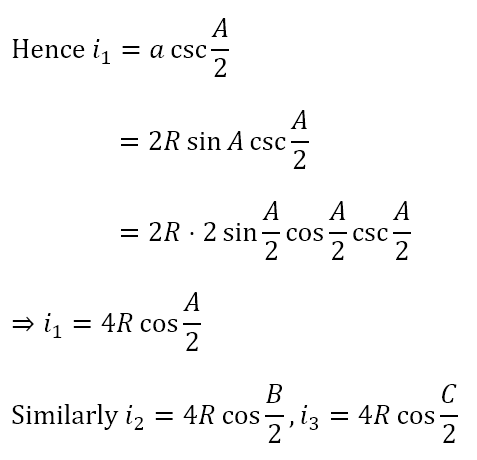
The Excentral Triangle – Distances of Excenters from Vertices
We know that I1A is an altitude of ΔI1 I2 I3.
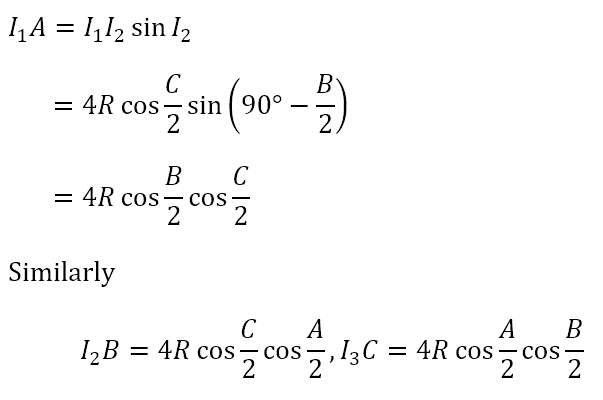
The Excentral Triangle – Distances of Excenters from Sides (Exradii)
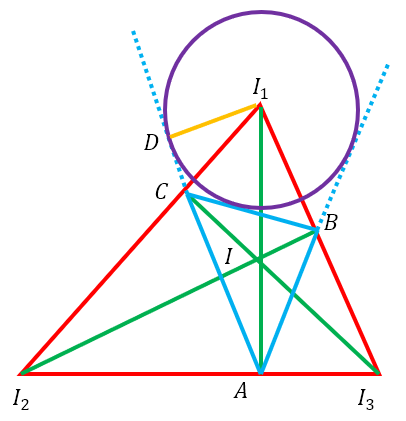
In the figure alongside the indigo colored circle is an excircle that touches BC externally and both AC and AB produced internally. S is the foot of the perpendicular from I1 to AC produced.
It is clear then that I1S = r1 the radius of the excircle opposite vertex A.
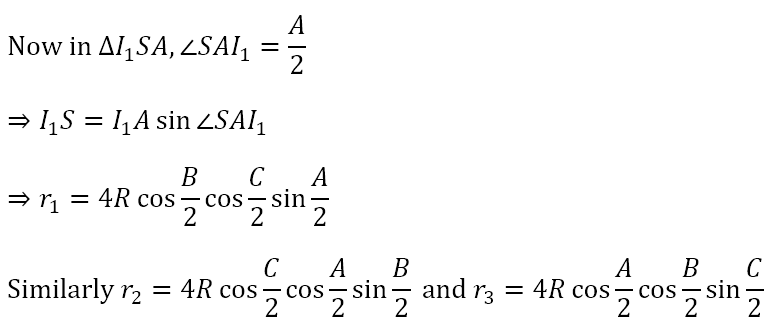
More on the Exradii
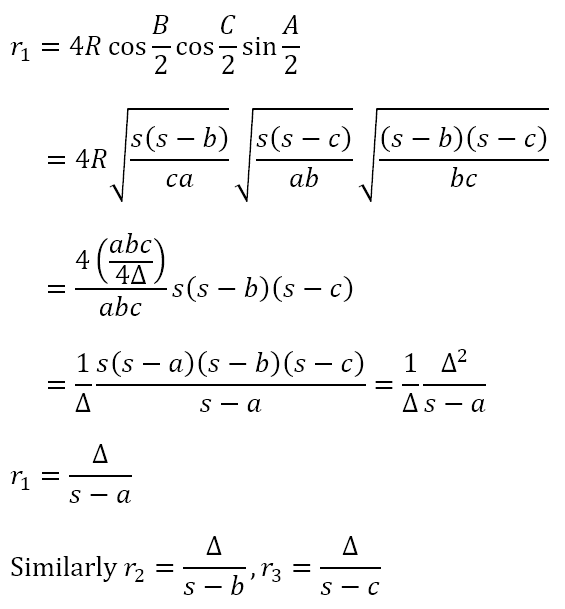
where Δ is the area of ΔABC.
We have studied the pedal and excentral triangles in depth in this post. However, our study of the triangle is not done. In the next post, we will derive some formulas for distances between the centers of a triangle and study a regular n-sided polygon.


Leave a Reply