
Parts of a Triangle
Our study of triangles leads us now to what is commonly called solution of triangles. As we know, a triangle is formed by three line segments. Hence, there are three sides and three angles. In other words, a triangle ABC has 6 parts: the 3 sides a = BC, b = CA, and c = AB; and the three angles A = ∠CAB, B = ∠ABC, and C = ∠BCA. We will start our exploration of the solution of triangles by reminding ourselves about the property of congruence of triangles.
Congruence of Triangles
When we say that two triangles are congruent, it means that it is possible to construct the triangle and that each time we do it we will get a triangle identical in every respect to the first one we constructed. Obviously since our instruments are not perfect, since our technique is not perfect, since every line we draw actually has a thickness, there will be minor differences. But these are differences that arise from our limitations rather than because the triangle itself keeps changing. Hence, two triangles are congruent if one can be perfectly placed over the other such that there is a one to one mapping of each point of the first triangle onto the corresponding point of the second triangle.
Criteria for Congruency
Students who have studied some geometry in school will know that there are four criteria by which we can prove two triangles are congruent. These are:
- SSS: Given three sides subject to the triangle inequality (the sum of the lengths of any two sides is always greater than the length of the third) we can construct a unique triangle
- SAS: Given two sides and the angle contained by them we can construct a unique triangle
- AAS: Given two angles and a side we can construct a unique triangle
- RHS: Given a right angled triangle in which the hypotenuse and another side is known we can construct a unique triangle
The Ambiguous Case
The last criterion for congruency (RHS) is a special case of the one in which we are given two sides of a triangle and the angle opposite one of them (SSA). SSA is not a criterion for congruency as we will see later. In the context of solution of triangles SSA is known as the ambiguous case.
Construction of Triangles
Recall that we linked congruence of triangles with the ability to construct the triangles to obtain identical triangles. Let us see how this would be done in each of the four cases for congruence.
Construction with Criterion SSS
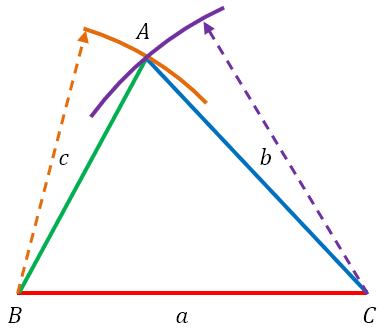
If we are given a, b, and c such that a < b + c, b < c + a, and c < a + b we can construct the triangle as follows:
- Draw BC having a length equal to a (red line).
- With B as center and radius equal to c draw an arc (orange arc).
- With C as center and radius equal to b draw an arc (purple arc) to cut the previous arc.
- The point of intersection is A.
- Join AB (green line) and AC (blue line) to complete the triangle.
The reason we insisted on the three inequalities at the start is because the lengths of the sides of every real triangle satisfies the triangle inequality. Violating it would mean we cannot form a real triangle, a condition we eliminate before we attempt construction.
Construction with Criterion SAS
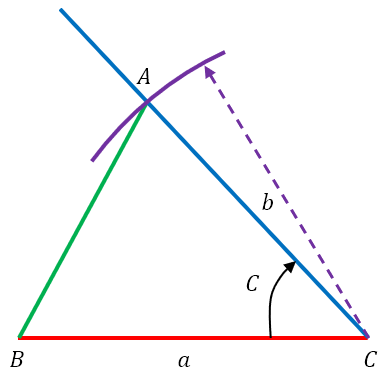
If we are given a, b and C we can construct the triangle as follows:
- Draw BC having a length equal to a (red line).
- Draw a line through C (blue line) such that it is inclined to BC at an angle equal to C. This can be done either by constructing the angle if the angle can be constructed or by measuring it.
- With C as center and radius equal to b draw an arc (purple arc) to cut the blue line at A.
- Join AB (green line) to complete the triangle.
Note that, when an angle is given, it is preferable to construct the angle rather than measure it. Of course, not all angle measures can be constructed.
Construction with Criterion AAS
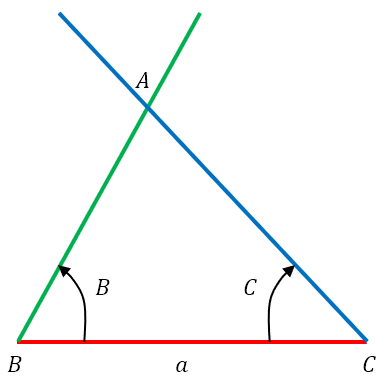
If we are given two angles and a, we first determine B and C (using the angle sum property) if either is unknown. Then we construct the triangle as follows:
- Draw BC having a length equal to a (red line).
- Draw a line through B (green line) such that it is inclined to BC and an angle equal to B. Angle construction can be done either by constructing the angle if the angle can be constructed or by measuring it.
- Draw a line through C (blue line) such that it is inclined to BC and an angle equal to C. Angle construction can be done either by constructing the angle if the angle can be constructed or by measuring it.
- The green and blue lines intersect at A completing the triangle.
Construction with Criterion RHS
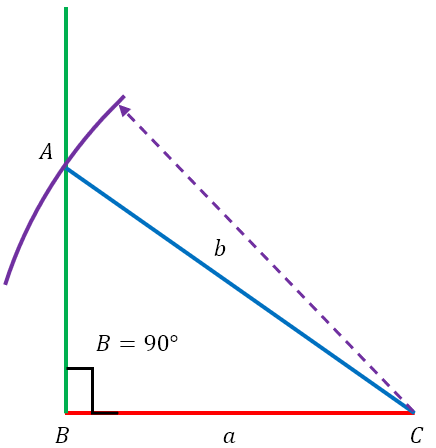
If we are given ∠B=90°,a and b we can construct the triangle as follows:
- Draw BC having a length equal to a (red line)
- Draw a line through B (green line) such that it is inclined to BC at a right angle
- With C as center and radius equal to b draw an arc (purple arc) to cut the blue line at A and complete the triangle
Solution of Triangles
Now that we have seen how construction and congruence are linked, we can proceed with the task of solution of triangles, which is the process of determining the unknown parts of a triangle given some parts of the triangle. In order to solve a triangle in an unambiguous manner we need three pieces of information that satisfy one of the congruence criteria (i.e. SSS, SAS, AAS, and RHS).
In proceeding to solve a triangle we keep in mind the following: The measures of the angles of the triangle are in the order corresponding to the lengths of the sides opposite them and vice versa.
Hence, if a < b < c then A < B < C and if A < B < C then a < b < c.
Since the sum of the internal angles of a triangle is 180°, it follows that the smallest two angles of a triangle must necessarily be acute. The largest angle of a triangle can be acute, right or obtuse.
Solution with Criterion SSS
Suppose we are given a < b < c, then A and B must be acute. We use the cosine rule to determine one of the angles. For example,
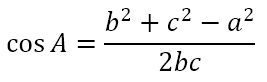
Now we use the sine rule to determine B keeping in mind that B is acute. Hence,
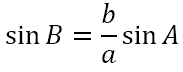
Now we calculate C since C = 180° – A – B.
Note that we can start with any angle since the cosine rule will give us a negative value if C is obtuse and zero if it is right.
Solution with Criterion SAS
Suppose we are given a < b and C. Since a is not the largest side, A must be acute.
We use the cosine rule to determine c. Hence,

Now we use the sine rule to determine A keeping in mind that it is acute. Hence,
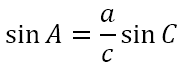
Now we calculate B since B = 180° – A – C.
Note that there is no flexibility in approach here, we must proceed as outlined above.
Solution with Criterion AAS
Suppose we are given two angles and a. We determine the third angle using the angle sum property.
Now we know A, B, and C.
Now we use the sine rule twice to determine b and c. Hence,
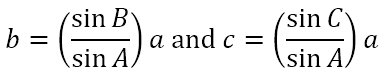
Once again the order is important, except that we could determine c before b.
Solution with Criterion RHS
Suppose we are given B = 90°, a and b. We calculate c using the Pythagorean theorem (which is simply a special case of the cosine rule!). Hence,
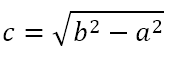
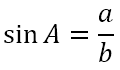
Now we use the definition of sine to determine A (this is just a special case of the sine rule!).
Now we can calculate C since C = 180° – A – B.
Note that we could determine the angles first and then the unknown side.
The Ambiguous Case
We had earlier stated that the case SSA is not a congruence criterion with only the RHS condition being a special case for congruence. We had also claimed that the SSA case is known as the ambiguous case.
We will now discuss why the general SSA case is not a congruence criterion and what the different kinds of ambiguity are.
Remember this: A criterion can be considered a congruence criterion if and only if we can show that there exists a unique triangle that satisfies the criterion.
This means that we should be able to construct one and only one triangle with the data that is given.
Setting Up the Ambiguous Case – Given Angle is Acute
Suppose we are given a , b and A < 90°. If we attempted to construct the triangle how would we proceed?
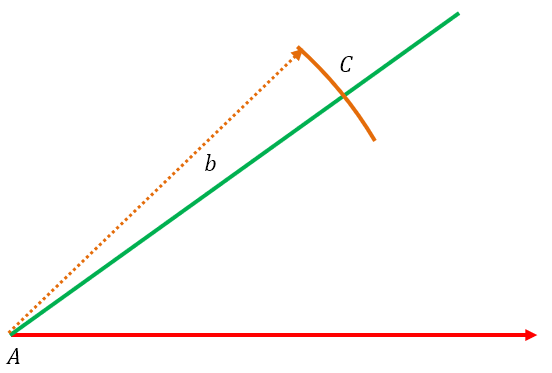
- We would have to begin with the (red) ray , the point B being unknown.
- Then we would construct a line (green) through A inclined at A with the base line.
- Then with A as center and radius of b we would draw an arc (orange) to cut the green line at the point C.
Introducing the Ambiguity
Now we would attempt to determine the point B, taking C as center and radius of a.
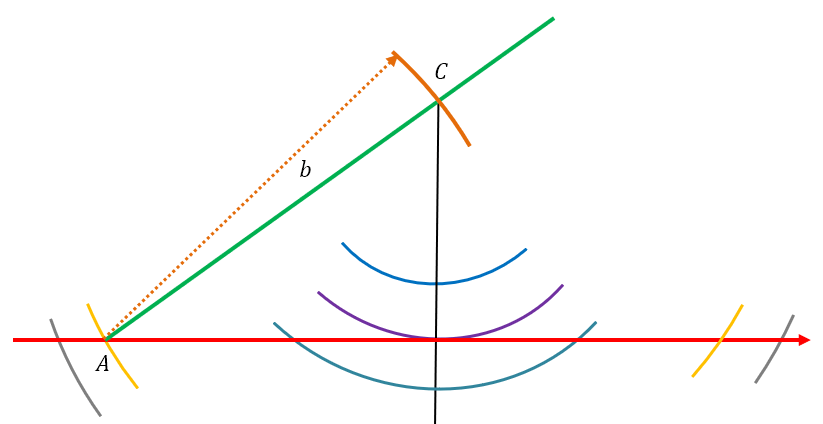
But now we face a conundrum for this arc may:
- not cut (blue arc)
- just touch (purple arc)
- cut in two points to the right of A (teal arc)
- cut at one point to the right of A and at A itself (yellow arc)
- cut at one point to the right of A and another to the left (grey arc)
Geometric Considerations
We can see that the perpendicular from C onto has a length of bsinA.
The Blue Arc
It is clear that a < bsinA and a < b.
If we apply the sine rule we get asinB = bsinA.
Hence, a < asinB ⇒ sinB > 1, which is not possible!
Hence there is no triangle formed if a < bsinA.
The Purple Arc
It is clear that a = bsinA and a < b.
If we apply the sine rule we get asinB = bsinA.
Hence, a = asinB ⇒ sinB = 1 ⇒ B = 90°.
Hence there is only one triangle formed if a = bsinA.
This is why RHS is a congruence criterion.
The Teal Arc
It is clear that a > bsinA and a < b.
If we apply the sine rule we get asinB = bsinA.
Hence, a > asinB ⇒ sinB < 1.
Since sin(180° – B) = sinB, there are two triangles formed if bsinA < a < b.
The Yellow Arc
It is clear that a > bsinA and a = b.
If we apply the sine rule we get asinB = bsinA.
Hence, a > asinB ⇒ sinB < 1.
But when the arc cuts the ray at A no triangle is formed.
Hence there is only one triangle formed if bsinA < a = b with B < 90°.
The Grey Arc
It is clear that a > bsinA and a > b.
If we apply the sine rule we get asinB = bsinA.
Hence, a > asinB ⇒ sinB < 1.
But when the arc cuts the ray to the left of A, the triangle formed has internal angle of 180° – A and is therefore not permitted.
Hence there is only one triangle formed if bsinA < a and a > b with B < 90°.
Tabulating the Results
The cells of the table below are color coded according to the arcs.
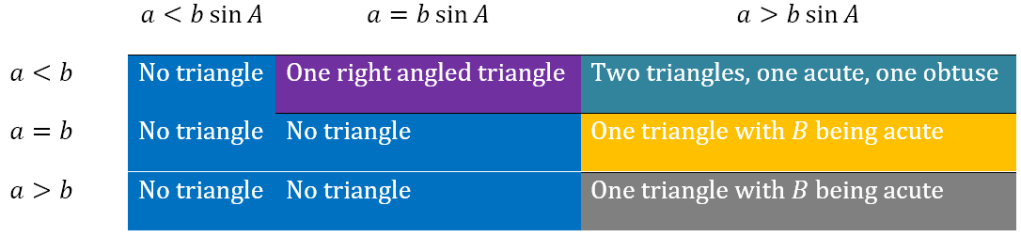
It is easy to see that if A ≥ 90° there is one and only one triangle if a > b and no triangle otherwise. This is simply a result of the sine rule (sides opposite larger angles are larger).
Algebraic Considerations
We can approach the problem using algebraic considerations as well. We have seen that the problems boils down to locating the point B, which in turn means finding the length AB, which in turn means finding the value of c. The cosine rule is

We have taken this form because with a,b,A we now have a quadratic equation in c, namely

The discriminant of this equation is

The equation will have real roots if and only if

and will have imaginary roots if and only if

Now, the roots of

will be of same sign if and only if
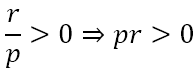
So here we have

We are dealing with the equation
For this equation,

So we have the following (color coded according to the arcs):
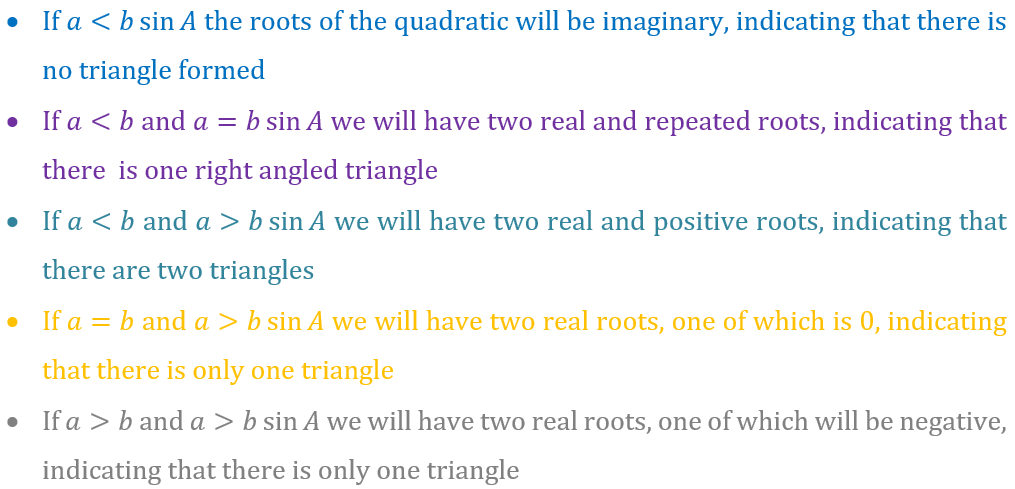
We get the same results using algebra! Mathematics is consistent. Of course, if you wish to understand the trade-offs involved in reaching the idea of consistency, you may wish to read the short series on Gödel’s incompleteness theorems.
With this we conclude the series on triangles. I will take a break for the Advent season and will resume with a fresh post on 8 January 2027.


Leave a Reply